

Motion Sickness · Travel · East Setauket, NY
Whether it is the Port Jefferson ferry across the Sound, a long drive on the LIE, a flight out of MacArthur or the back seat on a family road trip, motion sickness can ruin a trip before it starts. The good news is that the most effective tools are simple: where you sit, where you look, what you eat and how you breathe. This guide covers those first, then the P6 pressure point, wristbands and ginger, and what the research honestly says about each.
What Is the Best Natural Remedy for Motion Sickness?
Prevention works better than rescue. Sit where motion is smallest (the front seat of a car, over the wing on a plane, the middle of a boat), keep your eyes on the horizon, avoid reading or screens, get fresh air, eat a light meal and breathe slowly. Ginger and P6 acupressure on the inner wrist are low-risk add-ons that help some people; evidence for both is mixed.
If motion sickness is severe or regular, ask your pharmacist or doctor about over-the-counter or prescription options before you travel. Dizziness or nausea that happens when you are not moving is not motion sickness and should be checked by a doctor.
Why Motion Makes You Sick
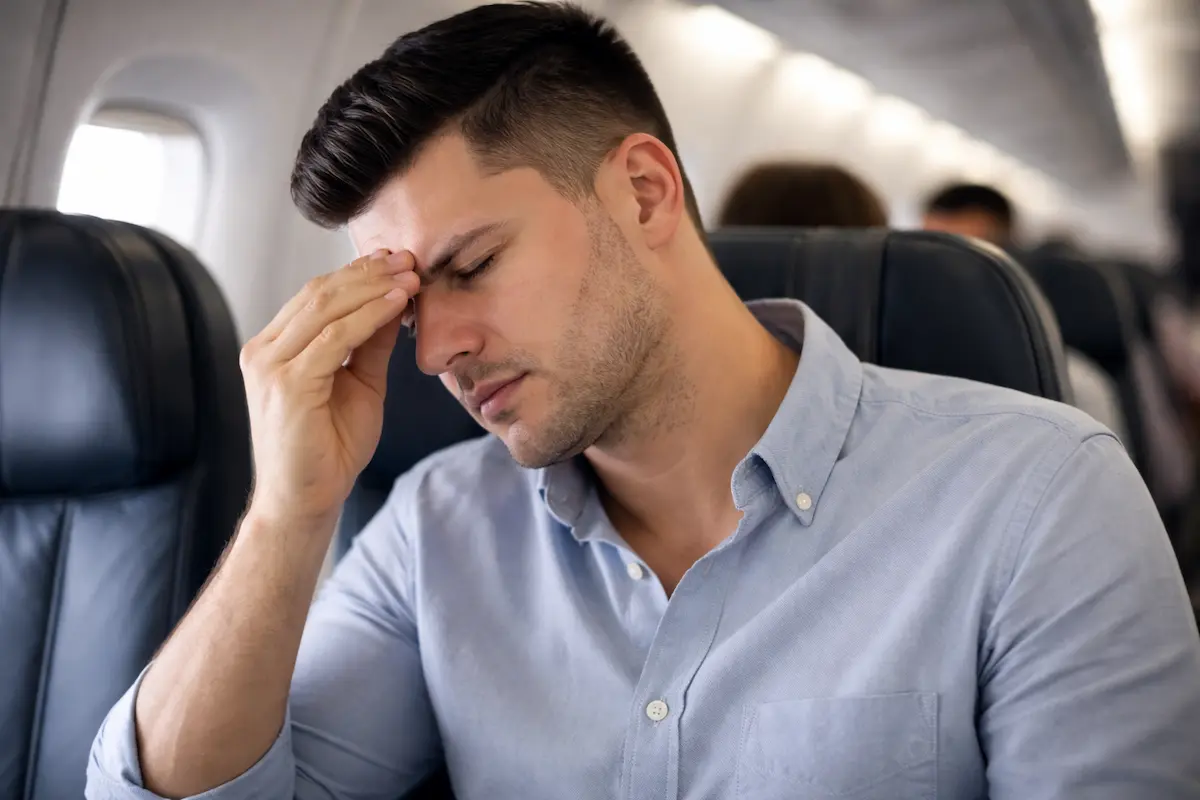
Motion sickness comes from a sensory mismatch. Your inner ear feels the car, boat or plane moving, but your eyes, fixed on a book or the seat in front of you, report that everything is still. Your brain gets conflicting signals and responds with nausea, sweating, yawning, paleness, headache and sometimes vomiting.
Anyone can get motion sickness, but according to MedlinePlus it is more common in children, pregnant people and people taking certain medicines. Many people who get migraines find they are more sensitive too. The good news is that reducing the mismatch, by letting your eyes see the motion your body feels, is the foundation of every effective strategy.
Before You Travel: Set Yourself Up
Sleep well the night before
Fatigue makes motion sickness more likely. Start the trip rested if you can.
Eat light, not empty
Have a small, plain meal one to two hours before you leave. Avoid heavy, greasy or spicy food and alcohol before and during travel.
Hydrate steadily
Sip water through the day. Pack a bottle so you can take small sips on the way.
Plan medication ahead
Most motion sickness medicines work best taken before travel. Ask your pharmacist about timing, and avoid driving if one makes you drowsy.
Pack a small kit
Water, plain crackers, ginger chews, an acupressure wristband if you use one, and a bag just in case.
Plan breaks
On long drives, stop every hour or two to get fresh air, walk and reset.
Where to Sit and Where to Look
| Travel | Best spot | Why |
|---|---|---|
| Car | The driver’s seat, or the front passenger seat | Drivers rarely get carsick because they anticipate every turn. Up front, you can see the road ahead. |
| Ferry or boat | Middle of the boat, or out on the upper deck | The center rocks least, and an open deck gives you fresh air and a view of the horizon. |
| Plane | Over the wing, window seat | The plane pitches least at the wings, and the window lets you see outside. |
| Train or bus | Forward-facing, near the front, window seat | Facing backward makes the mismatch worse. |
- Look at the horizon or a fixed point far ahead. If that is not possible, close your eyes.
- Skip reading and screens. Phones, tablets and books are the most common trigger for passengers.
- Do not watch moving things up close, such as passing cars or waves next to the boat.
- Keep your head still. Rest it against the headrest to reduce extra movement.
- Get fresh, cool air. Crack a window or aim the air vent at your face.
P6 Acupressure and Wristbands
P6, also called PC6 or Neiguan, is the pressure point most studied for nausea. It sits on the inner forearm, about three finger-widths above the wrist crease, between the two tendons.
- Find it
Three finger-widths up
Palm up, lay three fingers across your wrist with the ring finger on the crease. P6 is just past your index finger, between the two tendons.
- Press · 2 to 3 minutes
Firm, comfortable circles
Press with your thumb in small circles until you feel a dull ache, never sharp pain. Switch wrists.
- Timing
Start before you feel sick
Use P6 before you board and whenever nausea starts to build. It is easier to prevent than to reverse.
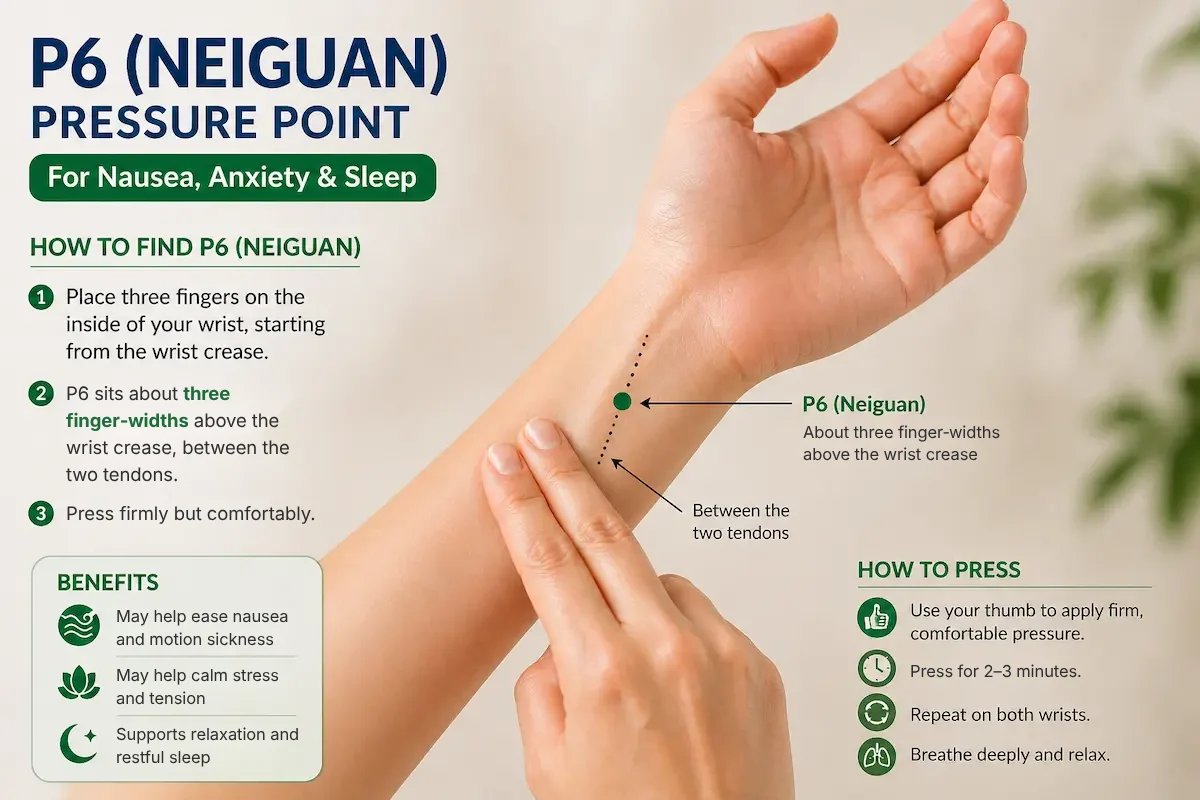
Wristbands: elastic bands with a stud over P6 are popular for travel. They are inexpensive and harmless, but as the NHS notes, they do not work for everyone. Make sure the stud sits on P6, and loosen the band if your hand tingles. For a full walkthrough of P6, see our pressure points for nausea guide.
Why we teach P6 and not a body map
You will see travel charts with LI4 in the web of the hand, ST36 below the knee, CV17 on the chest and more. Those points are used in clinic, but they are harder to locate accurately, have little motion-sickness research behind them, and LI4 is traditionally avoided in pregnancy. For self-care on the road, one well-placed point beats five guesses.
Breathing That Helps
Slow, deep belly breathing is one of the best-supported drug-free tools. In a 2015 study in Aerospace Medicine and Human Performance, people who practiced slow diaphragmatic breathing during a motion challenge had fewer motion sickness symptoms than those breathing normally. It was a small lab study, but the technique is safe and easy.

- Rest your head back and close your eyes, or fix them on the horizon.
- Breathe in through your nose for a count of four so your belly rises.
- Breathe out slowly through pursed lips for a count of six to eight.
- Keep going for five to ten minutes, pressing P6 at the same time if you like.
Ginger and Other Remedies
Ginger is the most popular natural remedy for travel nausea. A 2003 laboratory study found ginger reduced nausea and abnormal stomach rhythms in people exposed to a motion-sickness trigger, but the NCCIH describes the overall evidence for motion sickness as mixed. Ginger chews, tea or biscuits are easy to pack. Check with your doctor before using ginger supplements if you take blood thinners.
Peppermint or lemon scent feels refreshing to many travelers, though research is limited. Inhale only; never swallow essential oils.
Medication: for people with frequent or severe motion sickness, over-the-counter and prescription medicines can be very effective when taken before travel. Some cause drowsiness, so do not drive after taking them. Your pharmacist or doctor can recommend the right option and dose, especially for children, older adults or anyone pregnant.
When Nausea Breaks Through
-
Stop the trigger
Put the phone or book away. If you are driving, pull over safely. If you are a passenger, ask to stop for a few minutes.
-
Get air and look out
Open a window or step outside, and fix your eyes on the horizon or close them.
-
Breathe and press
Slow belly breaths with a long exhale while pressing P6 on one wrist, then the other.
-
Sip and nibble
Small sips of water and a plain cracker or ginger chew once the wave passes.

What the Research Says
| Approach | Evidence |
|---|---|
| Seat choice, horizon, no screens | Standard medical advice from the NHS and MedlinePlus. Directly reduces the sensory mismatch. |
| Slow diaphragmatic breathing | Small lab study showed fewer symptoms. Safe and free. |
| P6 acupressure and wristbands | Mixed for motion sickness. Stronger evidence exists for nausea after surgery (2015 Cochrane review). |
| Ginger | Some lab evidence of benefit; overall results mixed. |
| Medication | Generally effective when taken before travel; side effects such as drowsiness are common. |
When Acupuncture May Fit
For most people, the habits above are enough. If you get motion sick often, also get migraines or travel nausea is tied up with anxiety about flying or driving, acupuncture may be a supportive option alongside your doctor’s advice. At Messina Acupuncture PC in East Setauket, a first visit (about 75 minutes) covers your triggers and travel plans, treatment, and hands-on coaching so you can place P6 correctly before your next trip. Related reading: headaches and migraines and stress and anxiety.
When to See a Doctor
This may not be motion sickness
See a doctor if you feel dizzy, spinning or nauseous when you are not moving, if symptoms come with a severe or unusual headache, hearing loss, ringing in the ears, double vision, weakness, numbness or trouble speaking, or if vomiting continues long after the trip is over. Call 911 for sudden severe symptoms such as chest pain, confusion or weakness on one side of the body. Infants and young children who vomit repeatedly need medical advice sooner.
Messina Acupuncture PC is located at 100 N Country Road in East Setauket, minutes from the Port Jefferson ferry, and sees patients from Stony Brook, Port Jefferson, Port Jefferson Station, Centereach, Lake Grove, Miller Place and across Long Island’s North Shore.
Care is led by Daniel Messina, MSOM, L.Ac., a New York State Licensed Acupuncturist and NCCAOM Board-Certified Diplomate, in practice since 2016.
Frequently Asked Questions About Motion Sickness
What causes motion sickness?
It comes from a mismatch between what your inner ear feels and what your eyes see. In a moving car, your inner ear senses motion while your eyes, fixed on a phone or book, report that you are still. The conflicting signals trigger nausea.
What is the fastest way to stop motion sickness?
Stop reading or looking at screens, look at the horizon or close your eyes, get fresh air, breathe slowly with a long exhale and press the P6 point on your inner wrist. If you are driving, pull over safely first.
Where is the best seat to avoid motion sickness?
In a car, the driver’s seat or front passenger seat. On a plane, a window seat over the wing. On a boat or ferry, the middle of the vessel or out on the upper deck. On trains and buses, a forward-facing seat near the front.
Does the P6 pressure point work for motion sickness?
Results are mixed. Some people find P6 acupressure or wristbands helpful and studies are inconsistent. It is low-risk, so it is reasonable to try alongside better seating, horizon gazing and slow breathing.
Do motion sickness wristbands work?
They help some people but not everyone. They only work if the stud sits over P6, about three finger-widths above the wrist crease between the tendons. Loosen the band if your hand tingles.
Does ginger help motion sickness?
Ginger may help some people. A 2003 lab study found it reduced nausea, but overall evidence for motion sickness is mixed. Ginger chews or tea are easy to pack; ask your doctor before supplements if you take blood thinners.
Should I eat before traveling if I get motion sick?
Yes, a small, plain meal one to two hours before travel is better than an empty stomach. Avoid heavy, greasy or spicy food and alcohol before and during the trip.
Can I prevent motion sickness without medication?
Many people can, with the right seat, eyes on the horizon, no screens, fresh air, a light meal, slow breathing and P6 acupressure. If you still get sick often, ask your pharmacist or doctor about medication taken before travel.
Can acupuncture help with motion sickness?
Acupuncture may be a supportive option for people who get motion sick often, especially when migraines or travel anxiety are part of the picture. Evidence specific to motion sickness is limited, so we use it alongside proven prevention habits.
When is dizziness or nausea not motion sickness?
If you feel dizzy or nauseous when you are not moving, or symptoms come with a severe headache, hearing changes, weakness, numbness or trouble speaking, see a doctor. Call 911 for sudden severe symptoms.
Where can I learn acupressure for travel sickness near Port Jefferson?
Messina Acupuncture PC in East Setauket, minutes from the Port Jefferson ferry and Stony Brook, can check your P6 placement and talk through a plan before your next trip. Call 631-403-0504.
Get Your Pressure Point Placement Right Before You Go
If motion sickness keeps getting in the way of ferries, flights or family road trips, our East Setauket team can teach you P6 hands-on and talk through whether acupuncture may help alongside your doctor’s advice.
Sources and Further Reading
- NHS: Motion sickness
- MedlinePlus (U.S. National Library of Medicine): Motion Sickness
- Aerospace Medicine and Human Performance (2015): Diaphragmatic breathing and its effectiveness for the management of motion sickness
- American Journal of Physiology (2003): Effects of ginger on motion sickness and gastric slow-wave dysrhythmias
- Cochrane Review (2015): PC6 stimulation for postoperative nausea and vomiting
- NCCIH: Ginger