
Dry Needling & Lateral Elbow Tendinopathy
Tennis elbow can make surprisingly ordinary tasks painful: lifting a coffee mug, carrying a grocery bag, opening a jar, gripping a tool or holding a racquet. Dry needling has growing evidence for reducing pain and improving grip and function in some people with lateral elbow tendinopathy. It works best as part of a plan that also considers tendon loading, forearm strength, activity demands and the reason the elbow became irritated.
Can Dry Needling Help Tennis Elbow?
Yes, it may help. Randomized trials and systematic reviews suggest dry needling can reduce pain and improve disability and grip strength in people with tennis elbow, also called lateral elbow tendinopathy.
The strongest evidence does not show that dry needling mechanically repairs the tendon, breaks apart adhesions or permanently releases a muscle knot.
A more evidence-based approach is to use dry needling as one possible tool for symptom reduction while also rebuilding the forearm's capacity to tolerate gripping, lifting and repeated wrist loading.
What Is Tennis Elbow?
Tennis elbow is pain around the outside of the elbow, usually associated with loading the wrist-extensor and gripping system.
The clinical term lateral elbow tendinopathy is often more useful than lateral epicondylitis because long-lasting cases are not adequately explained as simple tendon inflammation.
The common extensor tendon attaches forearm muscles to the outside of the elbow. The extensor carpi radialis brevis, or ECRB, is frequently discussed in tennis-elbow research.
Repeated or excessive loading can contribute to tendon changes, pain, reduced grip tolerance and altered muscle function.
Pain on the Outside of the Elbow
Tenderness is often felt around the lateral epicondyle or slightly below it into the upper forearm.
Pain With Gripping
Carrying, squeezing, opening containers or gripping sports equipment may reproduce symptoms.
Pain With Wrist Extension
Lifting the wrist upward against resistance can provoke pain in lateral elbow tendinopathy.
Reduced Load Tolerance
The arm may feel weaker or less tolerant of repetitive work, racquet sports, lifting or prolonged gripping.
Tennis Elbow Is Not Just a Tennis Injury
You do not need to play tennis to develop lateral elbow pain.
Repeated gripping and wrist loading can occur during:
- tennis and pickleball,
- golf,
- weight training,
- construction and trade work,
- landscaping,
- painting,
- mechanical work,
- cooking,
- computer and mouse use, and
- many hobbies involving repetitive hand use.
The activity itself is not necessarily harmful. Problems often arise when demand exceeds what the tendon and forearm musculature can currently tolerate.
What Does Research Say About Dry Needling for Tennis Elbow?
The evidence is encouraging, but it is important to understand what the studies actually measured.
An updated systematic review found dry needling was associated with improvements in pain, elbow disability and grip strength.
Pain benefits were particularly evident in the first week after treatment.
A randomized trial compared dry needling plus eccentric exercise with oral or topical NSAID approaches that also included eccentric exercise.
The dry-needling group showed greater short-term improvements in pain and hand function.
A network meta-analysis of 41 randomized trials compared several percutaneous treatments.
Dry needling was among approaches showing favorable longer-term pain results, but no treatment was universally best across every time period.
Dry Needling Can Help Without Being a Standalone Cure
Current research supports dry needling as a reasonable option for selected patients with lateral elbow tendinopathy.
Improvements in pain, function or grip strength do not prove that the tendon has been structurally regenerated or permanently repaired.
Symptom improvement can create an opportunity to move, strengthen and progressively reload the arm more comfortably.
How Might Dry Needling Help?
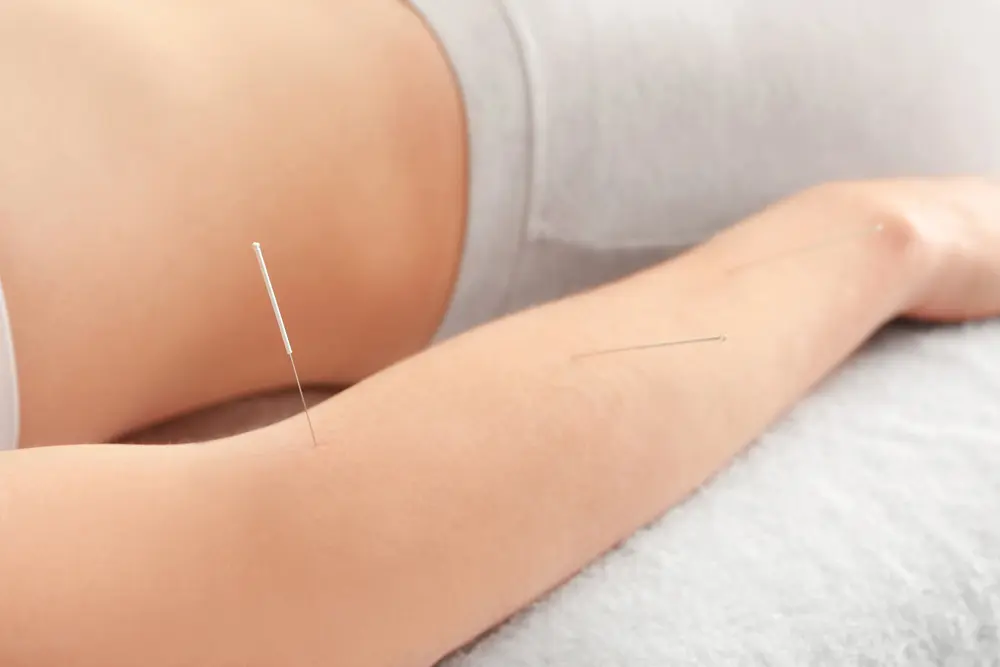
Dry needling creates mechanical and sensory stimulation in selected tissue.
Studies of lateral elbow pain use different needling protocols. Some target myofascial trigger points in the forearm musculature, while others use percutaneous tendon needling.
Those techniques should not automatically be treated as identical.
Proposed effects include changes in:
- local pain sensitivity,
- sensory processing,
- muscle tenderness,
- pain-modulating pathways, and
- tolerance of gripping and movement.
The complete mechanism is not settled.
Dry Needling Does Not Simply “Restart Healing”
A needle can interact mechanically with muscle or tendon tissue, but clinical improvement should not be explained as the needle automatically creating angiogenesis, rebuilding collagen or restarting a stalled healing process.
Those biological processes are much more complex.
A patient can experience less pain and better grip without demonstrating accelerated structural tendon repair.
What About Trigger Points in the Forearm?
Tender bands or myofascial trigger points can occur in forearm muscles involved in wrist and finger extension.
In some patients, pressing on a sensitive area may reproduce familiar elbow or forearm symptoms.
Dry needling may be considered when those myofascial findings appear relevant.
This does not mean every case of tennis elbow begins with a hidden muscle knot.
Tendon loading, muscle capacity, pain sensitivity and the person's activity demands can all be part of the presentation.
Does a Twitch Mean the Muscle Has Been Reset?
A local twitch response can occur when a needle stimulates a sensitive area within muscle.
The 2024 dry-needling meta-analysis reported better short-term pain outcomes in studies where trigger-point needling produced local twitch responses.
That finding does not mean the twitch physically resets the muscle or permanently removes the cause of tennis elbow.
A twitch is one response to needling. The clinically important question is whether pain, grip and function improve.
Does Dry Needling Improve Blood Flow?
Needling research has examined local circulation changes.
That does not mean tennis elbow is caused simply by poor blood flow, or that needling works by flooding the tendon with oxygenated blood.
A temporary circulation change also does not prove that tendon healing is accelerated.
Pain Relief and Tendon Repair Are Different Outcomes
Pain can change much faster than tendon structure.
If gripping feels easier after dry needling, that can be clinically useful.
It should not be interpreted as proof that damaged collagen has already been repaired.
Why Strengthening Still Matters
Long-term improvement usually requires more than reducing tenderness.
The forearm has to tolerate whatever tasks are important to you, whether that means:
- playing tennis,
- playing pickleball,
- lifting weights,
- using tools,
- carrying equipment,
- working at a computer, or
- performing repetitive gripping at work.
Build Capacity, Not Just Comfort
Clinical guidelines and orthopedic rehabilitation programs emphasize progressive resistance exercise for lateral elbow tendinopathy.
The goal is to improve strength, muscle endurance and tolerance to repeated loading.
Depending on the patient, rehabilitation may include wrist-extensor loading, wrist-flexor work, forearm rotation, grip training and broader upper-extremity strengthening.
Exercise selection and progression should fit the individual's symptoms and activity demands.
Does It Have to Be Eccentric Exercise?
Eccentric exercise is frequently studied and commonly used in tendon rehabilitation.
It is not the only possible strengthening strategy.
Isometric, concentric, eccentric and progressive resistance exercises may all be used depending on the patient's symptoms, strength and stage of rehabilitation.
The important principle is progressive exposure to appropriate load, rather than assuming one contraction type is universally best for every elbow.
Dry Needling Plus Exercise
This combination is particularly relevant because dry needling may reduce symptoms while exercise addresses the arm's capacity to handle load.
A 2025 randomized trial involving 111 people compared:
- dry needling plus eccentric exercise,
- oral NSAID treatment plus eccentric exercise, and
- topical NSAID treatment plus eccentric exercise.
All groups improved over the 30-day study period. The dry-needling group showed the largest improvements in pain and hand function.
That study supports dry needling as an adjunct to exercise-based care.
It does not mean a patient should stop prescribed medication in favor of dry needling. Medication decisions belong with the clinician managing that treatment.
What Happens During a Dry Needling Visit?
Review the Pain Pattern
We look at where the pain occurs, which gripping or wrist movements reproduce it, how long symptoms have been present and what work, sport or daily activities load the elbow.
Assess the Elbow and Forearm
Examination may include tenderness, resisted wrist movement, grip-related symptoms, forearm muscle sensitivity and relevant movement testing.
Decide Whether Dry Needling Fits
Dry needling may be considered when the findings suggest it could be useful for pain or myofascial involvement.
Reassess Function
Useful reassessment measures can include grip, pain during resisted wrist extension, lifting tolerance or another task that was painful before treatment.
What Does Dry Needling Feel Like?
The needle itself is very thin.
Depending on the technique, you may feel:
- a brief prick,
- pressure,
- a dull ache,
- a quick muscle twitch, or
- temporary local soreness.
Some patients experience little discomfort. Others find more targeted muscle needling more noticeable.
Tell the practitioner if something feels unusually sharp, electrical or otherwise concerning during treatment.
Is Soreness After Dry Needling Normal?
Mild temporary soreness can occur after dry needling.
Minor bruising or a small amount of bleeding can also occur.
Soreness is not evidence that the tendon is rebuilding or that the treatment worked more effectively.
If the arm feels temporarily tender, modifying a demanding workout may be more comfortable.
There is no universal rule requiring every patient to completely rest the arm for exactly 24 hours after needling.
Can You Exercise After Dry Needling for Tennis Elbow?
Often, yes, but the decision depends on the condition, treatment intensity and planned activity.
Light normal use may be comfortable for many patients.
Heavy gripping, maximal pulling or high-volume racquet play may be worth modifying if the forearm is temporarily sore.
More importantly, activity restrictions for the tendon itself still apply.
Read our detailed guide: Can You Exercise After Acupuncture or Dry Needling?
Should You Completely Rest Tennis Elbow?
Usually, the goal is not indefinite complete rest.
Repeatedly performing a clearly aggravating task at the same intensity may keep symptoms active.
On the other hand, eliminating all use of the arm does not rebuild strength or tolerance.
Many rehabilitation plans temporarily modify aggravating activity while gradually increasing appropriate loading.
Do Braces or Counterforce Straps Help?
A counterforce strap or wrist support may help some people manage symptoms during selected activities.
Bracing should generally be viewed as a symptom-management option, not a treatment that permanently repairs the tendon.
Fit, comfort and the task being performed all matter.
What About Ice or Heat?
Ice or heat may be used for comfort depending on the situation and the patient's preference.
Neither should be described as the mechanism that heals the tendon.
Cold can be useful for short-term pain management in selected situations. Heat may feel useful when the forearm feels stiff.
If another clinician has given specific injury-care instructions, continue following that guidance.
Dry Needling Compared With Other Parts of Care
| Approach | Main Role | Important Limitation |
|---|---|---|
| Dry Needling | May reduce pain and improve selected measures of function and grip strength. | Does not replace progressive loading or prove structural tendon repair. |
| Strengthening | Builds tolerance to gripping, wrist loading and repetitive activity. | Needs appropriate progression rather than simply exercising through escalating pain. |
| Activity Modification | Reduces repeated exposure to an aggravating load while capacity is rebuilt. | Complete long-term avoidance does not restore capacity. |
| Bracing | May temporarily improve comfort during selected tasks. | Does not permanently correct the tendon problem. |
| Medication | May be used for symptom management when medically appropriate. | Medication decisions should be made with the appropriate healthcare professional. |
How Quickly Can Dry Needling Help?
Some studies report short-term improvements relatively soon after treatment.
The 2024 meta-analysis found a significant pain benefit within the first week, along with improvements in disability and grip strength.
That does not guarantee an immediate response for every patient.
Some people improve quickly. Others improve gradually. Some do not respond meaningfully to dry needling.
A treatment plan should be reassessed according to measurable progress, not continued indefinitely because the elbow still feels tender.
How Many Dry Needling Sessions Are Needed?
There is no universal evidence-based session count for tennis elbow.
The appropriate plan depends on:
- how long symptoms have been present,
- severity of pain,
- grip limitations,
- work or sport demands,
- whether forearm muscle tenderness is present,
- what rehabilitation is being performed, and
- whether measurable improvement is occurring.
Routine maintenance needling is not automatically required once symptoms improve.
Long-term prevention is more logically focused on maintaining strength, capacity and appropriate management of repeated load.
Can Dry Needling Prevent Tennis Elbow From Coming Back?
Research does not establish periodic dry needling as a proven method of preventing recurrence.
Recurrence risk may be influenced by the same factors that contributed to the original problem, including:
- sudden increases in gripping volume,
- limited forearm capacity,
- repetitive occupational demands,
- sports technique or equipment changes, and
- returning to full load faster than the arm can tolerate.
Strength and load management therefore remain important even when pain improves.
When Elbow Pain May Not Be Tennis Elbow
Pain on the outside of the elbow can have other causes.
Depending on the symptoms, the differential diagnosis can include:
- radial tunnel syndrome,
- cervical nerve irritation,
- elbow joint pathology,
- traumatic injury,
- fracture,
- referred pain from the neck or shoulder, and
- other nerve or tendon disorders.
That is one reason treatment should begin with evaluation rather than assuming every lateral elbow pain is a trigger point or tendon problem.
Some Elbow Symptoms Need a Different Care Pathway
- Significant trauma, deformity or inability to use the arm normally.
- Rapid or substantial swelling.
- Progressive weakness that is not explained by pain.
- Persistent numbness or tingling into the hand or fingers.
- Elbow locking or significant loss of motion.
- Fever, increasing redness, warmth or signs of infection.
- Persistent pain that is not behaving like a typical overuse problem.
Where Dry Needling Fits at Messina Acupuncture PC
The goal is not simply to find the most painful point and needle it.
An orthopedic-focused evaluation looks at the pattern: what hurts, what reproduces it, what load the arm needs to tolerate, and whether the findings fit lateral elbow tendinopathy.
Depending on the presentation, treatment may include dry needling, acupuncture, electroacupuncture, medical massage or another care pathway.
Treatment should support the patient's functional goal, whether that is returning to tennis, pickleball, lifting, work or simply using the arm comfortably during daily life.
Messina Acupuncture PC is an orthopedic-focused acupuncture practice in East Setauket serving Stony Brook, Port Jefferson, the Three Village community and patients throughout Long Island's North Shore.
Care is led by Daniel Messina, MSOM, L.Ac., a New York State Licensed Acupuncturist and NCCAOM Board-Certified Diplomate. The practice has served the local community since 2016.
Care starts with evaluation and focuses on measurable changes in pain, movement, grip and function rather than assuming one treatment is appropriate for every elbow.
Frequently Asked Questions About Dry Needling for Tennis Elbow
Does dry needling work for tennis elbow?
Research suggests dry needling may reduce pain and improve disability and grip strength in some people with lateral elbow tendinopathy. Response varies, and dry needling is best considered within a broader rehabilitation plan.
How does dry needling help tennis elbow?
The complete mechanism is not established. Dry needling creates mechanical and sensory stimulation in selected tissue and may influence pain sensitivity, muscle tenderness and pain-modulating pathways.
Does dry needling heal the tendon?
Clinical studies show improvements in symptoms and function, but that does not prove dry needling accelerates structural tendon repair or regenerates collagen.
Does a twitch mean dry needling worked?
A local twitch response can occur during trigger-point dry needling. Some research has associated twitch responses with better short-term pain results, but a twitch does not prove the muscle has been reset or the tendon has healed.
Is dry needling better than exercise for tennis elbow?
These treatments serve different purposes and do not need to compete with one another. Dry needling may help reduce symptoms, while progressive exercise builds the forearm's capacity to tolerate load. Combining appropriate treatments may be useful for selected patients.
Should I do eccentric exercises for tennis elbow?
Eccentric exercise is commonly used and has been included in clinical research. It is not the only possible strengthening strategy. A rehabilitation plan may use isometric, concentric, eccentric and other progressive resistance exercises depending on the patient.
How many dry needling sessions are needed for tennis elbow?
There is no fixed evidence-based number that applies to everyone. Treatment frequency should depend on symptom duration, functional limitations, activity demands and whether measurable improvement is occurring.
Can I work out after dry needling for tennis elbow?
Often, yes. If the forearm is temporarily sore, heavy gripping or high-volume loading may be worth modifying. The underlying tendon condition and rehabilitation plan are more important than a universal 24-hour rule.
Is soreness normal after dry needling?
Mild temporary soreness, tenderness, bruising or a small amount of bleeding can occur. Increasing pain, significant swelling or another unusual symptom should be discussed with the practitioner.
Can dry needling prevent tennis elbow from returning?
There is not strong evidence that periodic maintenance needling prevents recurrence. Long-term management is more likely to involve maintaining forearm strength, load tolerance and appropriate management of repetitive activities.
Build Back Grip and Function, Not Just Temporary Relief
If elbow pain is interfering with tennis, pickleball, lifting, work, gripping or everyday tasks, Messina Acupuncture PC can evaluate the pattern and discuss whether dry needling, acupuncture, medical massage or another care pathway may be appropriate.
Sources and Further Reading
- 2024 Systematic Review and Meta-Analysis: Therapeutic Effects of Dry Needling on Lateral Epicondylitis
- 2025 Randomized Controlled Trial: Dry Needling Plus Eccentric Exercise for Tennis Elbow
- 2026 Network Meta-Analysis: Percutaneous Treatments for Lateral Epicondylitis
- 2024 Network Meta-Analysis: Interventions for Lateral Elbow Tendinopathy
- JOSPT Clinical Practice Guideline: Lateral Elbow Pain and Muscle Function Impairments
- American Academy of Orthopaedic Surgeons: Therapeutic Exercise Program for Epicondylitis