
Acupressure · P6 Neiguan · East Setauket, NY
If you have ever worn a motion-sickness wristband, you have met P6, or Neiguan, the most researched acupressure point for nausea. It sits on the inner forearm, takes seconds to find once you know how, and costs nothing to use. But it is also one of the most overclaimed points in popular wellness writing. This guide gives you the precise location, proper technique, an honest evidence summary, and the limits you should know.
She bought the elastic wristbands before a cruise, wore them faithfully, and still felt queasy on rough days. A friend insisted she must have had them on the wrong spot, which sent her down an internet rabbit hole of contradictory diagrams. She wants one clear, trustworthy explanation: where P6 actually is, how to press it herself, and what it can realistically do.
Here is that explanation. At Messina Acupuncture we teach P6 location hands-on because diagrams only go so far; a licensed practitioner placing your thumb on the exact spot beats any illustration. Below is the next best thing: precise instructions, technique, evidence, and cautions. For P6 in context, see our motion sickness pressure point guide and breathing guide.
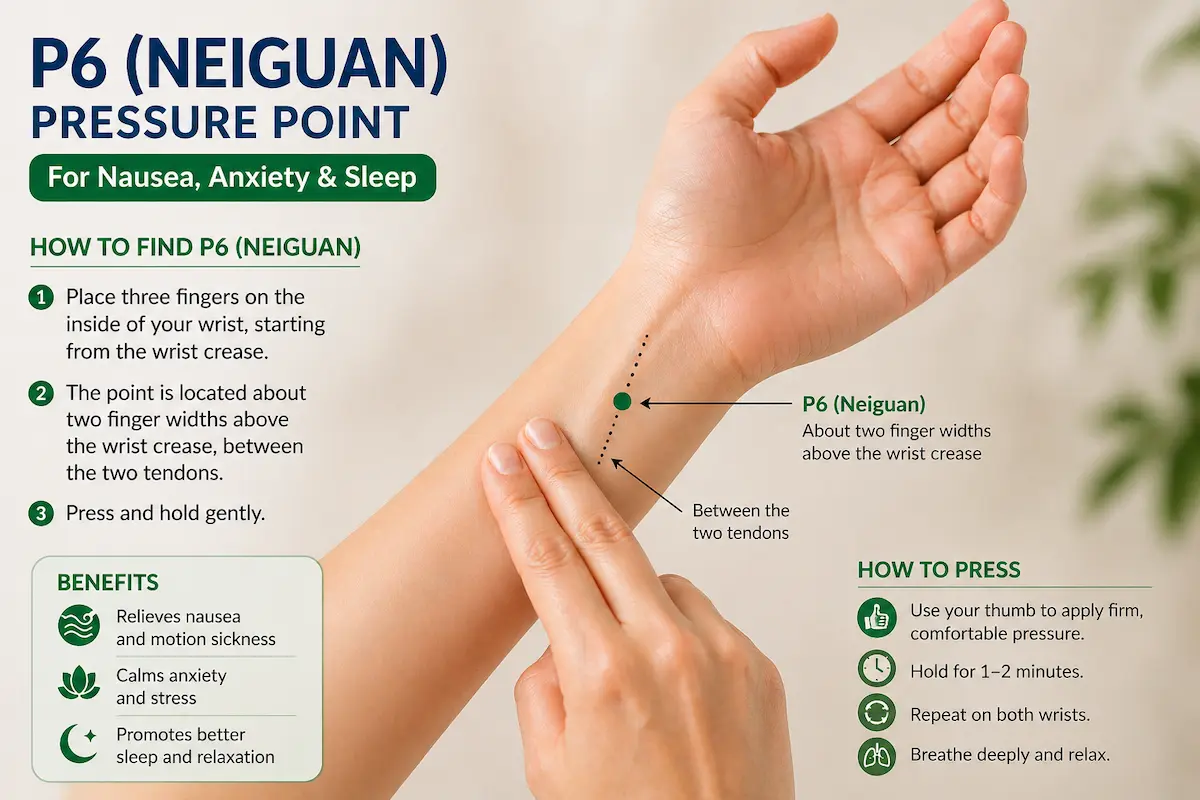
- Exact location: inner forearm, about three finger-widths below the wrist crease, between the two central tendons.
- Technique: firm thumb pressure, 30 to 60 seconds per side, combined with slow breathing. Dull ache is right; sharp pain is not.
- Best evidence: modest support for nausea, strongest for postoperative nausea and vomiting; mixed or limited for pregnancy, chemotherapy, motion sickness, anxiety, and sleep.
- Honest limits: not a cure, not instant, and not a substitute for medical care. Other claimed benefits are traditional uses with weak evidence.
- Learn it hands-on: a practitioner can confirm your placement in seconds, worth doing once.
Finding P6: Step-by-Step Location
P6, or Neiguan (“Inner Gate”), lies on the palm side of the forearm. Here is the standard method to find it. Turn one palm up and relax the hand. Place the index, middle, and ring fingers of your other hand horizontally across the wrist, starting at the wrist crease. The point sits just below the edge of your ring finger, roughly three of your own finger-widths from the crease, in the dip between the two prominent tendons running down the center of the forearm (the palmaris longus and flexor carpi radialis, though you do not need the names, just the valley between them). Press gently and you may feel a slightly tender spot; that tenderness often marks the point. Repeat the measurement on your own wrist rather than copying someone else’s placement, since proportions differ.
How to Press It: Technique and Timing
Use your thumb to press firmly into P6 for 30 to 60 seconds while breathing slowly, then switch wrists. The right sensation is a dull, achy pressure, sometimes with a mild tingling down the forearm. Sharp pain means you are pressing too hard or slightly off the point; ease up and re-check the location. You can repeat as needed, several times a day is fine. Combining pressure with slow diaphragmatic breathing (in four counts, out six) enhances the calming effect. Elastic wristbands with a pressure stud aim to do this continuously; evidence for the bands is mixed, and many people do as well or better with deliberate thumb pressure they control.
The evidence: where P6 stands in 2026
P6 is genuinely the most studied acupressure point for nausea, and the findings deserve precision. A Cochrane systematic review found that stimulating P6 may reduce postoperative nausea and vomiting compared with sham, the strongest claim in the literature. For pregnancy-related nausea, chemotherapy-induced nausea, and motion sickness, results are mixed and the evidence is limited, promising enough to try, not solid enough to promise. Claims you will see elsewhere, that P6 treats anxiety, insomnia, or palpitations, rest on traditional use and very weak evidence; we do not repeat them as facts. The fair summary: P6 is a reasonable, low-risk tool for nausea with modest evidence, best understood as one layer of care rather than a cure.
What P6 Can and Cannot Do
P6 can be a useful part of managing nausea: discreet, free, safe, and simple enough to use during a meeting, on a plane, or in a hospital waiting room. What it cannot do is guarantee relief, replace anti-nausea medication your doctor prescribed, or treat the underlying cause of persistent nausea. Think of it as a comfort measure with some science behind it, not as therapy. If nausea is frequent, severe, or unexplained, the priority is medical evaluation to find the cause, with P6 as a companion tool, not a substitute for answers.
Getting Your Placement Checked by a Professional
Reading about P6 gets you most of the way; having a licensed acupuncturist confirm your placement gets you the rest. In a single visit, a practitioner can place your thumb on the exact point, correct common errors (too close to the wrist, off to one side, pressing tendon instead of the dip between), and show you how P6 fits into a broader nausea toolkit with breathing and related points. It is a small investment for a skill you will use for years. If you are dealing with recurrent nausea, that same visit can assess whether acupuncture fits your larger pattern.
What to Expect at Messina Acupuncture
Assessment and first session (60 to 75 minutes)
We review your nausea history and place your thumb on P6 precisely, correcting placement on your own body so you leave confident, not guessing.
Follow-up sessions (30 to 45 minutes)
If acupuncture fits your pattern, we build a course of care around it and refine your at-home acupressure routine based on real-world results.
After each visit
Practice finding P6 until it is automatic. Note when it helps and when it does not; honest tracking beats wishful thinking.
Licensed instruction you can verify. Point location here follows standard acupuncture references, and clinical care is provided by a New York State licensed acupuncturist. We describe exactly where the evidence is solid and where it is thin, because a tool you understand honestly is one you will use wisely.
Acupressure is very low-risk: press firmly, not painfully, and avoid broken skin, rashes, or varicose veins. During pregnancy, P6 itself is generally considered low-risk, but check with your obstetric provider about any new self-care technique. If nausea comes with severe pain, vomiting blood, dehydration signs, or neurological symptoms, seek medical care rather than relying on acupressure.
Frequently Asked Questions
Where exactly is P6?
On the inner forearm, about three of your own finger-widths below the wrist crease, in the dip between the two central tendons. Measure on your own wrist; proportions differ between people.
How long should I press P6?
Firm thumb pressure for 30 to 60 seconds per side, repeated as needed. Combine with slow breathing for the best effect.
Does P6 work for motion sickness?
Evidence is mixed and limited for motion sickness specifically; the strongest P6 evidence is for postoperative nausea. It is reasonable to try as one layer of a broader strategy.
Can P6 help with anxiety or sleep?
These are traditional uses with very weak scientific evidence. We do not present them as established benefits. For nausea, the evidence is modest but real.
Are wristbands as good as thumb pressure?
Trials of P6 wristbands are mixed. Deliberate thumb pressure you control is at least as reasonable, costs nothing, and lets you adjust in the moment.
When should nausea be medically evaluated instead?
When it is severe, persistent beyond a day or two without clear cause, keeps you from keeping fluids down, or comes with pain, blood, fever, or neurological symptoms. Acupressure complements care; it does not replace diagnosis.
Learn P6 Hands-On, Placed Right the First Time
Stop guessing from diagrams. Visit us once and a licensed acupuncturist will place your thumb on the exact point, correct your technique, and assess whether acupuncture fits your larger pattern.
Messina Acupuncture PC
100 N Country Road, East Setauket, NY 11733
Sources and Further Reading
- Lee A, Chan SKC, Fan LTY. Stimulation of the wrist acupuncture point P6 for preventing postoperative nausea and vomiting. Cochrane Database of Systematic Reviews, 2015.
- National Center for Complementary and Integrative Health: Acupuncture effectiveness and safety.
- New York State Office of the Professions: Acupuncture consumer information.