
Nausea Relief · Breathwork · East Setauket, NY
Nausea is a nervous system event as much as a stomach event, which is why calming the nervous system can sometimes calm the stomach too. Two approaches work through that pathway: deliberate breathing techniques you can use anywhere, and acupuncture, which aims to modulate the same systems in the clinic. This guide covers both, with honest evidence notes and clear instructions.
She is a nurse who works night shifts, and the combination of flipped sleep, cafeteria food, and stress leaves her queasy at odd hours. She does not want another prescription; she wants something she can do in a break room in three minutes that might actually settle her stomach. A colleague mentioned breathing exercises and acupressure, and she is skeptical but willing to learn.
Skeptical but willing is a good starting point, because the techniques are simple and the evidence, while modest, is real. At Messina Acupuncture we teach breathwork and acupressure as first-line self-care for nausea, and offer acupuncture for people whose nausea is frequent or tied to larger patterns like migraine or anxiety. Here is the full guide, technique first, evidence second, red flags last.
- Nausea is neurological: calming the autonomic nervous system can ease nausea, which is why breathing and acupuncture target that pathway.
- Two breathing methods: diaphragmatic breathing and paced extended-exhale breathing, both simple, free, and safe.
- P6 acupressure: firm inner-forearm pressure with modest evidence, strongest for postoperative nausea.
- Acupuncture’s role: a clinical option for recurrent nausea patterns, with limited direct trial evidence for nausea itself.
- Red flags matter: severe pain, vomiting blood, dehydration, or neurological symptoms need medical care first.
Why Breathing Can Calm Nausea
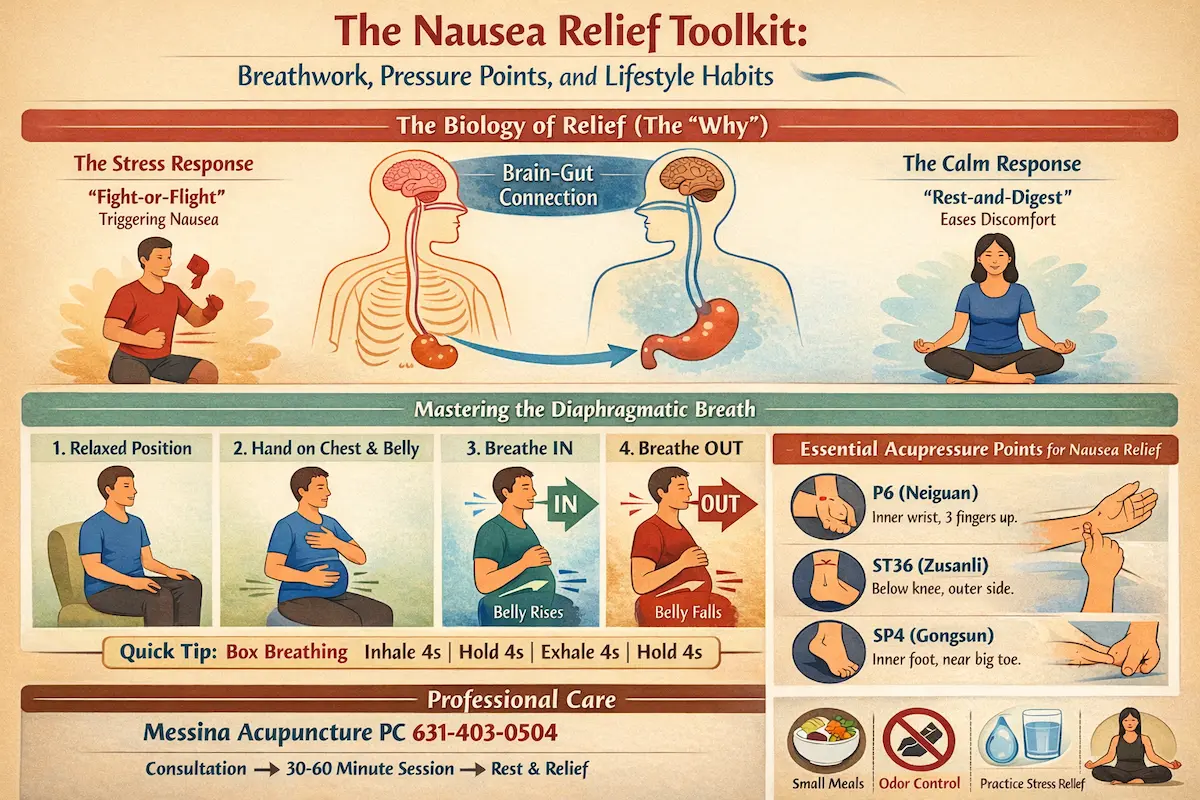
Nausea involves the autonomic nervous system, the same system that controls heart rate, sweating, and the fight-or-flight response. Slow, deliberate breathing nudges that system toward its calmer branch: heart rate steadies, muscle tension drops, and for some people, the queasy rising sensation eases. This is not positive thinking; it is physiology. Breathing techniques are also free, have no side effects, and can be used discreetly anywhere, which makes them the ideal first tool to reach for.
Technique 1: Diaphragmatic (Belly) Breathing
Sit or lie comfortably. Place one hand on your chest and one on your belly. Inhale slowly through your nose for about four counts, letting your belly rise while your chest stays relatively still. Exhale gently through your mouth for about six counts, feeling your belly fall. Continue for three to five minutes. The extended exhale is the calming part; if counting feels fussy, simply make your out-breath noticeably longer than your in-breath. Practice when you feel well so the pattern is familiar when nausea strikes.

Technique 2: Paced Breathing With Extended Exhale
This variation adds structure for moments when anxiety is amplifying nausea. Inhale through your nose for four counts, hold gently for two, then exhale through pursed lips for six to eight counts. The slight back-pressure of pursed lips slows the exhale further. Repeat for several minutes, keeping your shoulders down and your jaw unclenched. Many people find the counting itself helps by giving the mind something steady to track besides the nausea.
The evidence: small but encouraging
The most relevant trial is a 43-person simulated-motion study (Stromberg et al.) finding that diaphragmatic breathing may reduce nausea, a promising but small result we describe cautiously. For acupressure, a Cochrane review found P6 stimulation may reduce postoperative nausea and vomiting, which supports the mechanism but does not directly prove benefit for everyday nausea. Acupuncture trials measuring nausea as a primary outcome are limited; the broader NCCIH evidence summary supports acupuncture for several pain conditions with a strong safety profile in trained hands, which is relevant context but not a nausea claim. We present breathing and acupressure as sensible first-line self-care and acupuncture as a reasonable clinical option for recurrent patterns, nothing more absolute than that.
Adding P6 Acupressure to Your Breathing
Combine the two tools: while breathing slowly, press P6 firmly with your thumb. P6 sits on the inner forearm, about three finger-widths below the wrist crease, between the two central tendons. Hold 30 to 60 seconds per side. The pressure gives your nervous system a second calming input, and the dual focus, breath plus point, helps break the anxiety-nausea loop. Our detailed P6 guide covers exact location and cautions.
How Acupuncture Fits for Recurrent Nausea
When nausea is frequent, tied to migraine, anxiety, or digestive patterns, some people explore acupuncture as part of a broader plan. In the clinic, a practitioner selects points based on your overall pattern, which may include P6 and related points, and treatment aims to calm nervous system reactivity over a course of visits. We are candid that direct trial evidence for acupuncture treating nausea is limited; people consider it as one component of care, not a standalone cure. A consultation can clarify whether your pattern is a reasonable fit. Related reading: natural approaches to migraine-related nausea.
What to Expect at Messina Acupuncture
Assessment and first session (60 to 75 minutes)
We review your nausea history: triggers, frequency, related conditions, medications, and what you have tried. You will leave knowing both breathing techniques and P6 location, usable immediately.
Follow-up sessions (30 to 45 minutes)
If acupuncture fits, a course of visits targets your pattern. We track nausea frequency and severity so progress is measured, not assumed.
After each visit
Practice the techniques when well so they are automatic when needed. Note what helps; your self-care toolkit improves with use.
Licensed and evidence-honest. Care is provided by a New York State licensed acupuncturist using sterile, single-use needles. We teach self-care techniques freely because they are safe and useful, and we are explicit about where evidence is strong and where it is thin, so you can make informed decisions.
Seek prompt medical care for nausea with severe abdominal pain, vomiting blood or coffee-ground material, signs of dehydration, high fever, severe headache, chest pain, or neurological symptoms such as weakness, numbness, or vision changes. If nausea is new, persistent beyond a day or two without clear cause, or accompanied by unexplained weight loss, see your physician. Self-care techniques should never delay evaluation of a serious condition.
Frequently Asked Questions
Can breathing really help nausea?
It may help. Slow diaphragmatic breathing calms the autonomic nervous system involved in nausea, and a small study found it may reduce nausea during simulated motion. It is free, safe, and worth trying as a first step.
What is the best breathing pattern for nausea?
In through the nose for about four counts, out through the mouth for about six, with the belly rising on the inhale. Longer exhales are the calming part. Practice when well so it feels natural when nausea hits.
How does acupuncture relate to nausea relief?
Acupuncture aims to modulate nervous system activity, and P6 is a commonly used point for nausea. Direct trial evidence for acupuncture treating nausea is limited, so we present it as a reasonable option for recurrent patterns rather than a proven remedy.
Is P6 acupressure safe to try on my own?
Yes, for most people. Press firmly but not painfully, avoid broken skin, and skip it over varicose veins. During pregnancy, check with your obstetric provider about any new technique.
How long should I try self-care before seeking help?
For brief, mild nausea with a clear cause, self-care is reasonable. If nausea persists beyond a day or two without explanation, keeps you from keeping fluids down, or comes with any red-flag symptom, get medical care promptly.
Can I combine these techniques with medication?
Generally yes, but check with your physician or pharmacist, especially if you take multiple medications or are pregnant. These techniques are not a substitute for prescribed treatment.
Learn Techniques You Can Use Anywhere
Breathing and acupressure are skills, and skills are best learned hands-on. Visit us to learn them properly, and get an honest assessment of whether acupuncture fits your nausea pattern.
Messina Acupuncture PC
100 N Country Road, East Setauket, NY 11733
Sources and Further Reading
- Stromberg SE et al. Effect of diaphragmatic breathing on motion sickness. 43-participant simulated-motion study.
- Lee A, Chan SKC, Fan LTY. Stimulation of the wrist acupuncture point P6 for preventing postoperative nausea and vomiting. Cochrane Database of Systematic Reviews, 2015.
- National Center for Complementary and Integrative Health: Acupuncture effectiveness and safety.