
Motion Sickness · Acupressure · East Setauket, NY
Of all the natural remedies for motion sickness, pressure points are among the most searched and the most misunderstood. Some guides promise instant cures from a fingertip; others dismiss the whole idea. The truth sits in between: one point, P6 on the inner wrist, has modest research support for nausea, while other traditional points are best understood as traditional uses with weaker evidence. This guide shows you exactly where they are and how to use them safely.
She commutes by bus across Long Island, and the stop-and-go traffic turns her stomach most mornings. A friend swore by pressing a spot on her wrist, but when she tried it, she was not sure she had the right place, how hard to press, or whether it was doing anything at all. She wants clear instructions, not another vague internet tip.
Clear instructions are exactly what this guide offers. At Messina Acupuncture we teach patients precise point location because a centimeter off can mean missing the point entirely. Below: P6 in detail, other traditional points with honest evidence notes, and how acupressure fits with the rest of your motion-sickness toolkit. Start with our gentle natural relief guide for the seating, air, and food basics.
- P6 is the best-supported point: firm pressure on the inner forearm has modest evidence for nausea, strongest for postoperative nausea; motion-sickness evidence is thinner.
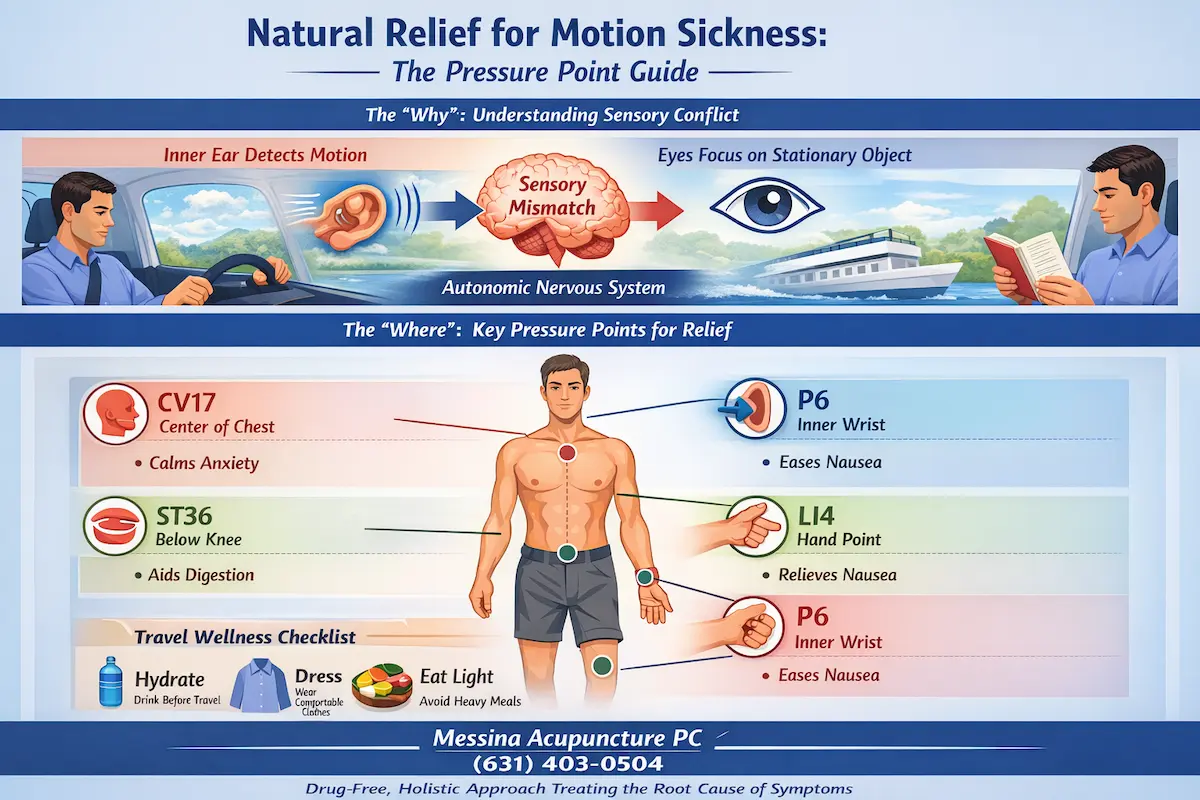
- Location matters: P6 sits about three finger-widths below the wrist crease, between the two central tendons. Precision beats pressure.
- Other points are traditional: points like ST36 or LI4 appear in traditional use for digestive upset and tension, but evidence for motion sickness is weak.
- Technique is simple: firm, steady pressure for 30 to 60 seconds per side, combined with slow breathing.
- Layer your strategies: acupressure works best alongside stable seating, horizon gazing, fresh air, and light meals, not as a solo fix.
P6 (Neiguan): Location, Technique, and What It May Do
P6, or Neiguan, is the most studied acupressure point for nausea. To find it: turn one palm up, place the index, middle, and ring fingers of your other hand across the wrist starting at the wrist crease, and note where the ring finger’s edge lands, about three finger-widths down the inner forearm. P6 lies between the two prominent central tendons at that level. Press firmly with your thumb for 30 to 60 seconds while breathing slowly, then switch wrists. You should feel a dull, achy pressure, not sharp pain. Repeat as needed during travel. Our full P6 (Neiguan) pressure point guide includes more detail and cautions.

Other Traditional Points Sometimes Used for Travel Nausea
Beyond P6, traditional practice includes several points for digestive upset and the tension that accompanies nausea. ST36 (Zusanli), below the knee on the outer shin, is traditionally used for digestive comfort and general resilience. LI4 (Hegu), in the web between thumb and index finger, is used for head tension and pain. CV12 (Zhongwan), on the midline of the upper abdomen, is traditionally associated with stomach comfort. We describe these as traditional uses: they are reasonable to try gently, but the evidence for motion sickness specifically is weak, and they should not replace the better-supported strategies. Avoid strong abdominal pressure if you are pregnant or have an abdominal condition, and skip LI4 during pregnancy unless a qualified practitioner advises otherwise.
The evidence: honest accounting
The strongest P6 evidence comes from postoperative nausea and vomiting, where a Cochrane review found wrist P6 stimulation may reduce nausea compared with sham. For motion sickness itself, trials are fewer, smaller, and mixed, so we do not present P6 as proven for travel nausea, only as reasonable and low-risk. Evidence for wristband devices that press P6 continuously is similarly mixed. For the other points discussed here, quality trials for motion sickness are essentially absent; their inclusion rests on traditional use and practitioner experience, not on clinical proof. That honesty matters: trying them is fine, but they should sit alongside proven strategies like seat choice and gaze stabilization, not replace them.
How to Combine Points With Breathing for Better Results
Acupressure pairs naturally with slow breathing. While holding P6 pressure, breathe diaphragmatically: in through the nose for about four counts, out through the mouth for about six. The combination gives your nervous system two calming inputs at once, and the breathing gives you something to focus on besides the nausea. A small simulated-motion study (Stromberg et al., 43 participants) found diaphragmatic breathing may reduce nausea, so the pairing has at least preliminary support. Practice the sequence at home before your trip so it feels automatic when you need it.
When to Consider Professional Acupuncture
If motion sickness regularly disrupts your life, professional acupuncture is an option some people explore. In the clinic, a practitioner can stimulate P6 and related points with needles, which allows more precise and sustained stimulation than fingertip pressure, and tailor point selection to your overall pattern, including related issues like anxiety or migraine. Evidence for acupuncture preventing motion sickness specifically is limited, so we discuss it candidly as an option rather than a proven fix. See our prevention strategies guide for the full travel toolkit.
What to Expect at Messina Acupuncture
Assessment and first session (60 to 75 minutes)
We review your motion-sickness history and teach you precise P6 location on your own body, so you leave with a usable skill regardless of whether you continue treatment.
Follow-up sessions (30 to 45 minutes)
If you proceed, sessions target your pattern with acupuncture, and we refine your at-home acupressure routine based on what helped during real travel.
After each visit
Practice point location until you can find P6 without thinking. Note which strategies helped on your next trip so we can adjust.
Licensed instruction, no overclaiming. Point location taught here follows standard acupuncture point references, and clinical treatment is provided by a New York State licensed acupuncturist. We will tell you plainly where the evidence is solid and where it is thin, because a technique you trust for the right reasons is one you will actually use.
Acupressure is very low-risk, but use common sense: press firmly, not painfully; avoid pressing on broken skin, rashes, or varicose veins; and skip abdominal points or LI4 during pregnancy unless a qualified practitioner advises otherwise. If nausea comes with hearing changes, fainting, severe headache, or neurological symptoms, see a physician rather than relying on pressure points.
Frequently Asked Questions
Where exactly is the P6 pressure point?
On the inner forearm, about three finger-widths below the wrist crease, between the two central tendons. Press firmly with your thumb for 30 to 60 seconds per side while breathing slowly.
How hard should I press on acupressure points?
Firm enough to feel a dull, achy sensation, not sharp pain. If it hurts sharply or leaves a mark that lasts, ease off. Steady pressure beats hard jabbing.
Do motion sickness wristbands work?
Evidence is mixed. The bands press on P6 continuously, and trials have not consistently shown benefit beyond placebo. Manual pressure you control, combined with breathing, is at least as reasonable and costs nothing.
Can I use these points during pregnancy?
P6 acupressure is generally considered low-risk, but skip LI4 and abdominal points during pregnancy unless a qualified practitioner advises otherwise. Check with your obstetric provider about any new remedy.
How quickly should acupressure work?
Some people notice easing within a few minutes; others notice little. It is not an instant cure. Give it several minutes combined with slow breathing, and layer it with seating, gaze, and air strategies.
When should I see a professional instead of self-care?
If motion sickness is frequent, severe, or worsening, or comes with hearing changes, fainting, or neurological symptoms, get evaluated. A consultation can also clarify whether acupuncture fits your pattern.
Learn Your Points From a Licensed Acupuncturist
Reading about P6 is one thing; having a licensed practitioner place your own thumb on the exact spot is another. Book a visit and leave with techniques you can use on every future trip, plus an honest assessment of whether acupuncture fits your pattern.
Messina Acupuncture PC
100 N Country Road, East Setauket, NY 11733
Sources and Further Reading
- Lee A, Chan SKC, Fan LTY. Stimulation of the wrist acupuncture point P6 for preventing postoperative nausea and vomiting. Cochrane Database of Systematic Reviews, 2015.
- Stromberg SE et al. Effect of diaphragmatic breathing on motion sickness. 43-participant simulated-motion study.
- National Center for Complementary and Integrative Health: Acupuncture effectiveness and safety.