
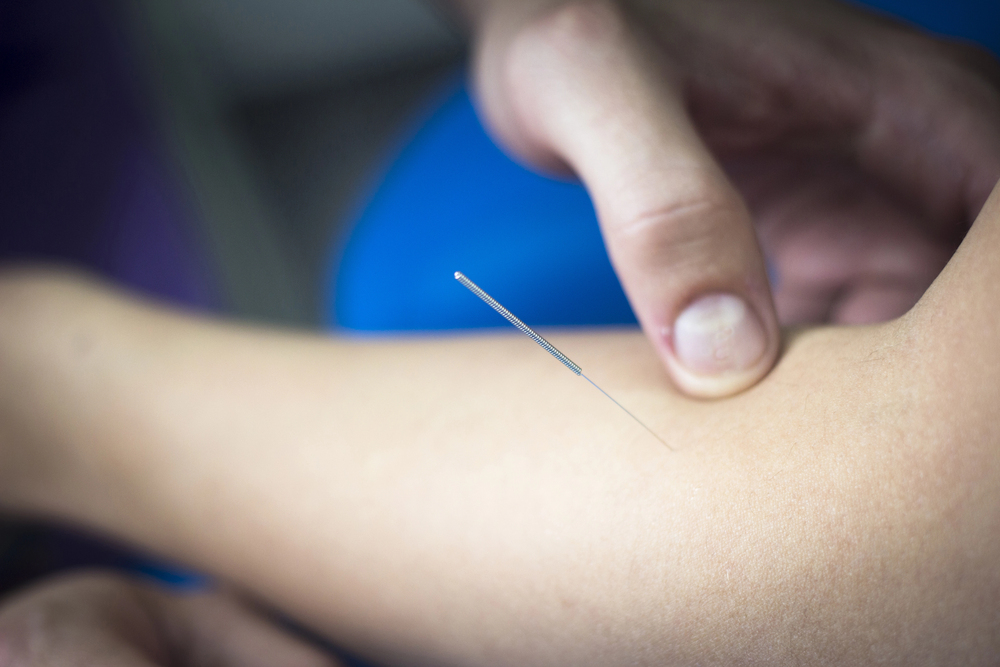
Dry Needling · Elbow Pain · East Setauket, NY
Despite the name, golfer’s elbow (medial epicondylitis) affects far more than golfers: desk workers, tradespeople, weightlifters, and anyone whose work loads the forearm flexors repetitively. Dry needling is often suggested for the stubborn inner-elbow pain it causes. Here is an honest look at what dry needling may do for this condition, where the evidence is thin, and how it fits into a sensible recovery plan.
A Long Island scenario. You notice it first carrying groceries: a dull ache on the inside of your elbow. Within weeks, gripping a coffee mug hurts, shaking hands is unpleasant, and that weekend golf game is out of the question. Rest helped a little, the brace helped a little, but the ache keeps returning. Sound familiar? Here is where dry needling fits in.
- Golfer’s elbow is an overuse injury of the wrist-flexor tendons at the inner elbow, common in many: occupations and sports, not just golf.
- Dry needling targets the associated muscle trigger points and tension: it does not directly repair tendon tissue.
- Direct evidence for dry needling in medial epicondylitis specifically is limited. Stronger evidence exists for lateral epicondylitis (tennis elbow), which may not fully transfer.
- Dry needling works best as an adjunct to load management and progressive strengthening, not as a stand-alone: fix.
- Trauma, marked swelling, fever, or progressive weakness and numbness need medical evaluation first.
What Golfer’s Elbow Actually Is
Medial epicondylitis is an overuse injury of the tendons that attach the wrist flexor and pronator muscles to the bony bump on the inside of the elbow (the medial epicondyle). Repetitive gripping, wrist flexion, and forearm rotation overload these tendons over time, producing pain at the inner elbow that worsens with gripping and wrist movement. Despite the name, most sufferers are not golfers: carpenters, plumbers, office workers, climbers, and racket-sport players all show up with it.
Typical symptoms include aching or burning on the inner elbow, pain when gripping or shaking hands, stiffness in the morning, and sometimes tingling into the forearm if the nearby ulnar nerve is irritated. Onset is usually gradual, which is why people ignore it until simple tasks become difficult.
How Dry Needling Approaches It
Dry needling for golfer’s elbow does not target the tendon attachment directly. Instead, the practitioner needles the forearm flexor muscles and their trigger points: the irritable, knotted bands of muscle that develop around an overloaded tendon. The goal is to reduce muscular hypertonicity, ease the pulling on the tendon, and calm the local pain response.
During treatment you may feel a brief cramping or twitch response as a trigger point releases. Many patients describe the sensation as a deep ache that fades quickly. Sessions are short, and the elbow area is usually needled alongside the forearm and sometimes the shoulder and neck, since gripping problems often involve the whole chain.
To be clear about what this is not: dry needling does not stitch tendon fibers back together, dissolve scar tissue on command, or “reset” nerves. It is one tool for managing the muscular component of the problem. For background on the technique itself, see our dry needling page.
What the Research Actually Shows
Here is the honest part: there are no large, high-quality meta-analyses of dry needling specifically for medial epicondylitis (golfer’s elbow). The closest strong evidence is for lateral epicondylitis (tennis elbow): a 2024 meta-analysis of 17 studies and 979 subjects (Tang et al.) found dry needling reduced pain and improved disability and grip strength compared with controls. That is encouraging but it concerns the other side of the elbow, and the transferability is uncertain.
More broadly, a 2017 meta-analysis of dry needling for musculoskeletal pain (Gattie et al.) found short-term benefits for pain and function across several conditions. Taken together, the evidence suggests dry needling is a reasonable adjunct for elbow overuse pain, but anyone promising a quick or guaranteed fix for golfer’s elbow is ahead of the data.
What a Sensible Recovery Plan Looks Like
Dry needling alone rarely resolves golfer’s elbow. The cases that improve tend to combine several elements:
- Load management: Temporarily reducing the gripping and wrist-flexion activities that overload the tendon, without immobilizing the arm completely.
- Progressive strengthening: Gradual eccentric and grip-strengthening exercises, which have the best evidence of any conservative treatment for tendinopathy.
- Dry needling or manual therapy: To address the muscular trigger points and tension around the tendon.
- Technique and ergonomics: Adjusting grip size, tool handles, workstation setup, or swing mechanics that contributed to the overload.
- Patience: Tendon problems typically improve over weeks to months, not days. Anyone promising overnight resolution is not being straight with you.
Your First Visit: What to Expect at Messina
Step 1: Elbow Assessment
We take a history of the onset, test grip and wrist strength, palpate the flexor muscles and tendon attachment, and screen for nerve involvement or other causes of elbow pain. See our services and meet our team.
Step 2: Targeted Dry Needling
If your presentation fits, we needle the involved forearm musculature and related trigger points. Most patients tolerate it well; we adjust depth and intensity to your comfort and response.
Step 3: Plan and Reassess
We discuss load management and strengthening alongside needling, then reassess grip pain and function at defined checkpoints. If you are not trending better, we change the plan or refer you for further evaluation.
Seek prompt medical evaluation for: elbow pain after a fall or direct trauma, visible deformity, marked swelling or bruising, fever with joint pain, progressive weakness or numbness in the hand, or inability to use the arm. Tell us about blood thinners, bleeding disorders, and skin infections before any needling session.
Licensed, Qualified Hands. Dry needling involves inserting needles into muscle tissue near nerves and blood vessels. In New York, it should be performed by a licensed professional with specific training in the technique. Messina Acupuncture’s practitioners are New York State licensed acupuncturists (L.Ac.) with extensive needling training, practicing under New York State Education Department oversight, using sterile single-use needles. Ask any provider about their training and licensure before booking dry needling anywhere.
Frequently Asked Questions
Does dry needling hurt for golfer’s elbow?
The forearm muscles can be tender, and you may feel a brief cramping or twitch when a trigger point releases. Most patients describe it as a deep ache that fades within seconds. Soreness for a day afterward is common and usually mild.
How is this different from tennis elbow?
Golfer’s elbow (medial epicondylitis) affects the inner elbow and the wrist-flexor tendons. Tennis elbow (lateral epicondylitis) affects the outer elbow and the wrist extensors. They are mirror-image problems with similar treatment principles but different target tissues.
How many sessions will I need?
Many patients do a trial of 4 to 6 sessions, usually weekly, alongside strengthening. Tendon problems improve over weeks to months, so we set checkpoints and adjust based on grip pain and function, not on a fixed package.
Can I keep working out or playing golf during treatment?
Usually yes, with modifications. Complete rest is rarely the answer, but the aggravating loads need to be managed while the tendon calms down. We discuss your specific activities and what to adjust at your visit.
Is dry needling the same as acupuncture?
Both use fine needles, but the frameworks differ. Dry needling targets muscular trigger points from a Western musculoskeletal model; acupuncture works within traditional Chinese medicine theory and includes a broader range of indications. Our practitioners are trained in both.
What if dry needling does not help my elbow?
Then we say so and change course. Options include physical therapy with a structured loading program, bracing, activity modification, or medical evaluation for persistent cases. A treatment that is not working should be questioned, not repeated indefinitely. Call (631) 403-0504 to discuss your situation.
Inner Elbow Pain Slowing You Down?
Book an assessment and we will determine whether your elbow pain looks like a case dry needling may help, and build a plan that includes the strengthening work that actually resolves tendon problems.
Messina Acupuncture PC
100 N Country Road, East Setauket, NY 11733
Sources and Further Reading
- Tang X, et al. Dry needling for lateral epicondylitis: systematic review and meta-analysis. Journal of Orthopaedic Surgery and Research, 2024. PubMed 38484834
- Gattie E, et al. The effectiveness of trigger point dry needling for musculoskeletal conditions. Journal of Orthopaedic and Sports Physical Therapy, 2017. PubMed 28158962