
A patient called our Setauket office last month after seeing a Groupon-style offer for “$29 acupuncture” in a city about an hour west of Long Island. She wanted to know if that was a real price, what her local follow-up sessions would cost, and whether her insurance would pick up any of it. Three reasonable questions, three different answers and exactly the conversation most people are trying to have when they type “how much does acupuncture cost?” into Google.
This is the national pricing guide. If you live on Long Island and want the local numbers of what Suffolk County clinics actually charge in 2026 head over to our Long Island-specific cost post, which covers regional ranges, insurance acceptance patterns from local panels, and what to expect at Messina specifically. Everything below is the broader U.S. picture: what a session typically costs, what affects the price, how insurance and Medicare actually work, what HSA and FSA dollars cover, and why the rock-bottom prices that look so attractive on social media often aren’t the deal they appear to be.
Key Takeaways
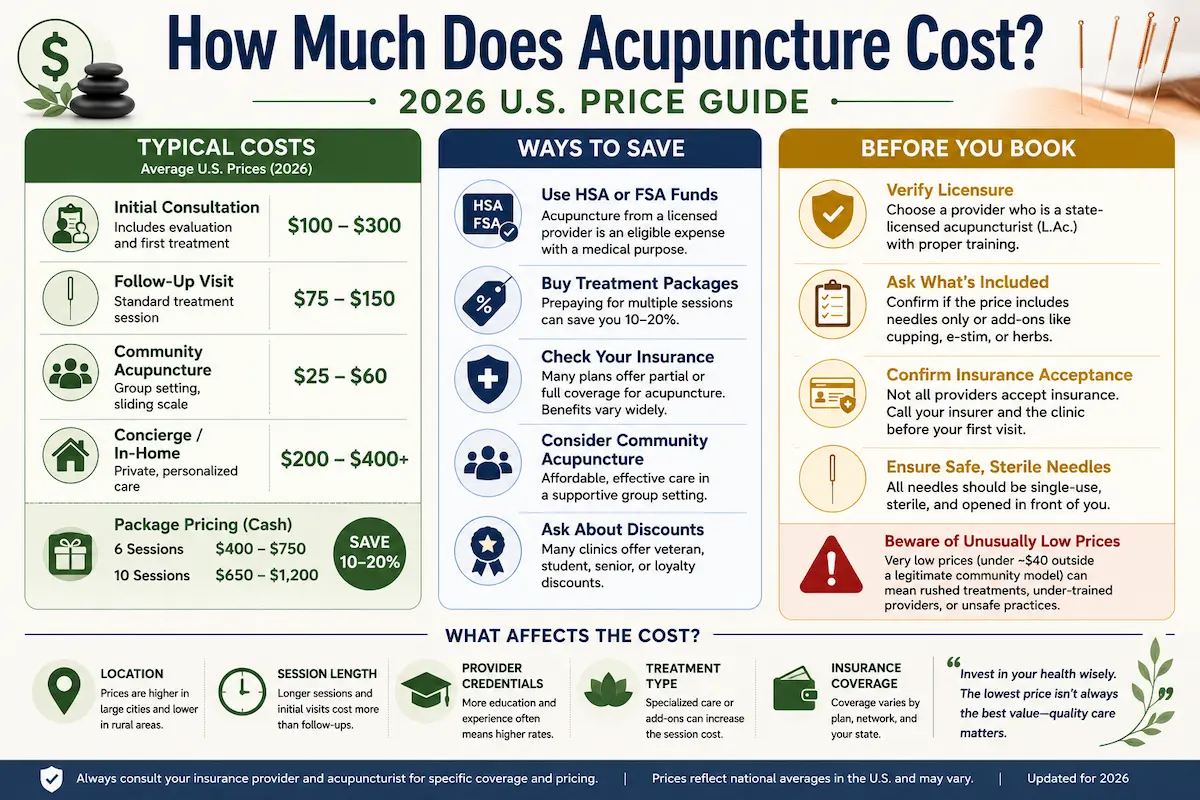
- The 2026 U.S. national average for an acupuncture follow-up session is roughly $75 to $150, with initial consults often running $100 to $300.
- Community acupuncture clinics offer sliding-scale sessions in the $25–$60 range, a legitimate model with a different setup.
- Medicare covers acupuncture only for chronic low back pain (up to 12 sessions in 90 days, max 20 in a year), and only when delivered through a Medicare-enrolled physician’s office.
- Private insurance coverage varies enormously by plan, state, and network. Always call your member services line first.
- HSA and FSA dollars can be used for acupuncture from a licensed provider when there’s a medical purpose.
- Cash-pay package pricing typically saves 10–20% per session.
- Very cheap acupuncture (under ~$40 outside a community clinic model) can correlate with under-trained providers, rushed visits, or unsafe needling technique.
What a Typical Acupuncture Session Costs in 2026
The published range across consumer pricing aggregators and clinic-side surveys looks like this:
| Visit Type | Typical U.S. Range (2026) |
| Initial consultation + first treatment | $100 – $300 |
| Standard follow-up session | $75 – $150 |
| Community acupuncture (group setting, sliding scale) | $25 – $60 |
| Concierge / in-home / boutique session | $200 – $400+ |
| Package of 6 sessions (cash) | $400 – $750 |
| Package of 10 sessions (cash) | $650 – $1,200 |
GoodRx’s consumer-facing pricing guide puts the average uninsured initial session around $112 and follow-ups around $80, with a long tail up to $300+ in major metro areas numbers consistent with what we see across the New York/Long Island corridor in 2026.
Why the range is so wide
You’ll see $50 sessions and $400 sessions advertised within the same zip code in places like New York, Los Angeles, San Francisco, Boston, and Chicago. The session length, the practitioner’s credentials, and the specific services bundled into the visit all change the price meaningfully.
What Affects the Price of a Single Session
Six factors do most of the work in setting the price.
1. Session length
A 30-minute follow-up costs less than a 75-minute initial consult and many clinics structure their schedule around 45–60-minute follow-ups. Some sports-medicine and orthopedic-focused practices (including ours) build in additional manual therapy or acupressure into the same hour, which justifies the higher end of the range.
2. Practitioner credentials
NCCAOM-certified, state-licensed acupuncturists (L.Ac.) generally charge more than physical therapists or chiropractors offering dry needling, and significantly more than a non-licensed needler. Whether that price premium is “worth it” depends on what you’re being treated for but the credential is the simplest signal you have that the person holding the needle has met formal training and continuing-education standards.
3. Services bundled in
A session that adds electroacupuncture, cupping, moxibustion, gua sha, or an herbal consult usually costs $20–$50 more per add-on than a needle-only session. Some clinics charge à la carte; others include everything in a single rate. Ask before the appointment.
4. Location
Manhattan and San Francisco rates run high. Rural and suburban rates run 30–50% lower. Long Island, Westchester, and most New York metro suburbs sit in the middle, with Messina priced consistent with the Suffolk County market (see the Long Island cost guide for specifics).
5. Specialization
Pain-management, fertility, and oncology-supportive acupuncture practices often charge more both because the training is more specialized and because the visits are longer and more complex.
6. Whether you’re paying cash or running through insurance
Some clinics post different cash rates than billed-to-insurance rates. The cash rate is sometimes lower than what insurance is billed; the patient-responsibility portion (copay or coinsurance) can still come out higher than the cash rate. We tell every patient to do the math both ways.
How Insurance Coverage Actually Works in 2026
This is the part most cost articles skim through. Real answers:
Medicare
Medicare Part B covers acupuncture only for chronic low back pain defined as low back pain lasting 12 weeks or longer, not associated with surgery or pregnancy, and with no identified systemic cause. The benefit was finalized by CMS in 2020 and remains the rule in 2026.
The official Medicare page lays out the limits: up to 12 sessions in 90 days, and if you’re showing improvement, an additional 8 sessions, for a maximum of 20 sessions per year. Important caveat for Medicare patients: the service must be delivered or directly supervised by a physician, physician assistant, nurse practitioner, or clinical nurse specialist who meets specific acupuncture training criteria. Medicare does not directly reimburse independent licensed acupuncturists. Many Medicare patients end up paying cash for acupuncture at independent clinics.
Medicare Advantage
Some Medicare Advantage plans offer broader acupuncture coverage as an “additional benefit” beyond Original Medicare. The specifics vary plan-to-plan. Call your plan’s member services line.
Private insurance
Coverage is genuinely all over the map. A few patterns hold:
- California, Washington, Oregon, Massachusetts, and a few other states have laws or strong market norms that have pushed broader acupuncture inclusion in commercial plans.
- New York plans vary by carrier; some Empire / United / Aetna / Cigna products include acupuncture, others do not. (For New York patients there’s a separate evolving conversation around the Empire Plan that we cover in our insurance-coverage post.)
- No-fault auto insurance and workers’ comp in many states (including NY) cover acupuncture when prescribed as part of a treatment plan.
- HMO vs. PPO matters: PPOs often allow out-of-network reimbursement at a reduced rate; HMOs usually don’t.
How to actually find out
Call the member services number on the back of your card and ask, in this order:
- “Is acupuncture a covered benefit on my plan?”
- “Are there visit limits per year?”
- “Do I need a referral or prior authorization?”
- “What’s my copay or coinsurance per visit?”
- “Is [your clinic name] in-network?”
Write down the rep’s name and a reference number for the call. Insurance answers don’t always survive contact with the billing department, and you want a record.
HSA and FSA: The Underused Lever
If you have a Health Savings Account (HSA) or Flexible Spending Account (FSA) through your employer, acupuncture from a licensed provider is generally an eligible expense when there’s a medical purpose. That means:
- You’re effectively paying with pre-tax dollars, which saves you 20–35% depending on your tax bracket.
- You don’t need to wait for insurance approval, you just pay and submit the receipt.
- Some FSAs and most HSAs offer a debit card you can swipe at the clinic directly.
For patients without insurance coverage for acupuncture, the HSA/FSA route is often the single biggest cost lever available and most don’t know it applies. Save the itemized receipt (CPT codes, date, provider name) for your records.
Cash Pricing, Packages, and Sliding Scales
Cash pricing
Cash-pay rates at most clinics fall within or slightly below the $75–$150 follow-up range. Some clinics offer a small “time-of-service” discount (sometimes 5–10%) if you pay at the visit rather than invoicing.
Package pricing
Buying a 6- or 10-session package usually saves 10–20% per session. Packages make sense if you’ve already had an initial visit and a treatment plan is in place. They don’t make sense as your very first commitment to a new clinic.
Community acupuncture
A legitimate alternative model where multiple patients receive needles simultaneously in a shared treatment room. Sessions usually run $25–$60 on a sliding scale. The trade-off: less privacy, generally shorter intake, fewer manual-therapy add-ons, and a different therapeutic experience. For many patients with anxiety, low-back pain, or simple stress relief, community acupuncture is excellent value. For complex orthopedic cases or patients who need a longer intake, a private-room setting is usually a better fit.
Sliding-scale and reduced-fee programs
Many independent clinics offer reduced rates for veterans, students, seniors, and patients facing financial hardship. Ask. Most clinics don’t advertise these openly but will work with patients who reach out.
Why Cheap Acupuncture Can Be a Red Flag
Here’s the uncomfortable part. The $29 Groupon offers that pop up on social media, the $40 strip-mall sessions, the heavily discounted intro promotions some of these are legitimate. Many are not. Here’s what to look for:
Verify the credential
In New York and most states, you need an L.Ac. (Licensed Acupuncturist) credential and a state license number. The credential should be visible on the website, on the wall, and printable on request. NCCAOM certification is the national standard. A “certified dry needling” weekend course is not an acupuncture credential.
Check the time
A $30 acupuncture session that includes a 5-minute intake and 10 minutes on the table is not the same product as a $120 session with a 30-minute intake and a 45-minute treatment. The needle is the same. Almost nothing else is.
Ask about needle sourcing and clean-needle technique
Licensed acupuncturists in the U.S. are required to use single-use, sterile, FDA-approved needles and follow Clean Needle Technique standards. This is non-negotiable. If a clinic can’t tell you their needle brand or their CNT protocol, walk out.
Ask about training in your specific issue
Most musculoskeletal complaints respond well to standard acupuncture. But complex cases fertility, oncology-supportive care, neurological conditions, pediatrics benefit from specialized training. A $40 generalist isn’t the same as a $200 fertility specialist for a complex case.
The NCCIH overview of acupuncture safety lays out the credentialing context: safety is excellent in trained, licensed hands and meaningfully worse in untrained hands. Price isn’t a perfect signal, but it’s not a noise signal either.
Dry Needling vs. Acupuncture Pricing
A common confusion. Dry needling is generally offered by physical therapists, chiropractors, and athletic trainers, usually as part of a broader visit, and is often billed under a PT or chiro CPT code. Acupuncture is a distinct service delivered by a licensed acupuncturist. The pricing models look different. Our dry needling cost guide covers the specifics, dry needling sessions typically run $40–$100 as an add-on to a PT visit, vs. $75–$150 for a standalone acupuncture session.
For some musculoskeletal complaints, dry needling and acupuncture overlap meaningfully. For most other indications (stress, sleep, GI, women’s health, fertility), they don’t.
When to See a Licensed Acupuncturist
Most cost questions get clearer in a 10-minute phone call with the clinic you’re considering. Ask:
- What’s the rate for the initial visit and follow-ups?
- What does each include? (Manual therapy, electroacupuncture, cupping?)
- Do you take my insurance, or only cash?
- Do you offer packages?
- Can I use HSA/FSA?
A clinic that can answer those questions cleanly is a clinic that’s used to honest pricing conversations. A clinic that hedges, deflects, or requires you to book before you can hear the rate is a yellow flag.
Frequently Asked Questions
Why is acupuncture so expensive?
Acupuncture isn’t priced like a quick clinical procedure, it’s priced like a 45–60 minute hands-on visit with a licensed practitioner. Training is significant (most NCCAOM-certified L.Ac.s have a master’s-level degree plus 1,500–4,000 supervised clinical hours), overhead is real (clean-needle supplies, individual treatment rooms, electronic records), and most clinics aren’t insurance-reimbursed at high rates. The price reflects the visit length and the credential.
Is acupuncture cheaper without insurance?
Sometimes. Many clinics offer a cash rate that’s lower than what they bill insurance. If your copay/coinsurance is high, or if you have a high deductible you haven’t met, paying cash can be cheaper net-net. Ask both prices.
Will my HSA or FSA pay for acupuncture?
Yes, in most cases, when delivered by a licensed practitioner for a medical purpose. Save the itemized receipt with CPT codes and provider name. Some HSAs prefer a Letter of Medical Necessity from your physician; most don’t require it for acupuncture.
Does Medicare cover acupuncture?
Only for chronic low back pain up to 12 sessions in 90 days, max 20 sessions in 12 months, and only when delivered by or under the supervision of a Medicare-enrolled physician, PA, NP, or clinical nurse specialist with the required acupuncture training. Independent L.Ac.s cannot directly bill Medicare. See the Medicare acupuncture page for full details.
How many sessions will I need?
For acute issues, often 4–6. For chronic pain or stress patterns, often 8–12, sometimes more. Your acupuncturist should be able to give you a realistic estimate after the initial consultation.
Is a $30 acupuncture session a good deal?
At a legitimate community acupuncture clinic with a licensed L.Ac., yes, that’s the model working as designed. At a strip-mall or social-media-ad clinic with no visible credentials, probably not. Look at the credential, the time on the table, and the needle protocol before the price.
Ready to Book at Messina Acupuncture
For Long Island patients, our Long Island cost guide has the Setauket and Suffolk County specifics. If you’re outside the area, the framework above will help you ask the right questions wherever you go.
Messina Acupuncture PC
100 N Country Road, Setauket, NY 11733
631-403-0504
Reach out at fr*******@****************re.org, or browse our acupuncture service page. We’re happy to walk through pricing, insurance, and treatment planning on a no-pressure phone call before anything is scheduled.