
Hand & Wrist Care · East Setauket, NY
Nighttime tingling, a hand that falls asleep on the keyboard, dropping things you used to grip without thinking: carpal tunnel syndrome is miserable in a quiet, persistent way. Acupuncture is sometimes suggested for it, and the research is genuinely interesting but far less conclusive than some articles claim. Here is what the studies actually found, what treatment involves, and how to know whether it is worth trying.
She is a graphic designer, and the first sign was waking at 3 a.m. shaking her right hand to wake it up. Then came the daytime tingling during long mouse sessions and the moment she nearly dropped her coffee. Her doctor confirmed carpal tunnel syndrome, suggested night splinting, and mentioned surgery as a down-the-road option. She wanted to know whether anything in between, like acupuncture, was worth trying first.
It is a reasonable question with a nuanced answer. At Messina Acupuncture, we treat wrist and hand complaints regularly, and we are careful with this one: the evidence shows possible benefit for pain, inconsistent results for function, and no basis for promising to prevent surgery. Here is the full, honest picture.
- Possible pain benefit: reviews suggest acupuncture may reduce carpal tunnel pain for some patients, as an adjunct, not a standalone solution.
- Low-certainty evidence: most reviews rate the evidence low or very low quality, with inconsistent results for symptoms, function, and nerve tests.
- Interesting mechanism research: an 80-patient brain-imaging trial found real acupuncture improved nerve-conduction and cortical measures more than sham.
- First-line care still matters: night splinting, activity modification, and ergonomics remain the foundation.
- Know the referral line: constant numbness, progressive weakness, muscle wasting at the thumb, or acute trauma need a hand specialist promptly.
What Carpal Tunnel Syndrome Is
The carpal tunnel is a narrow passage in the wrist where the median nerve and tendons pass through. When swelling or pressure builds inside that tunnel, the median nerve gets compressed, producing the classic pattern: tingling and numbness in the thumb, index, and middle fingers, nighttime waking, grip weakness, and aching that can radiate up the forearm. Diagnosis is clinical, sometimes confirmed with nerve conduction studies.
What the 2024-2025 Evidence Actually Says
This is where honesty matters most, because the source articles on this topic tend to overclaim. A 2024 overview of nine systematic reviews and meta-analyses (PMC11617874) found that eight of the nine reviews were critically low quality and one was low quality; the evidence was low or very low certainty. It found possible benefit for pain intensity but inconsistent results for symptom severity, function, and electrophysiological outcomes. A 2023 meta-analysis of randomized trials (PMC9995832) similarly found possible adjunctive benefit with low or very low certainty.
Translation: acupuncture might help carpal tunnel pain for some people, but the research is not strong enough to promise anything, and claims of “remapping the brain” or avoiding surgery outrun the data.
One Genuinely Interesting Study
A 2017 randomized trial with brain imaging (Maeda et al., Brain) studied 80 carpal tunnel patients receiving 16 sessions over 8 weeks of real versus sham electroacupuncture. Real acupuncture improved median nerve conduction latency and somatosensory cortex digit-separation measures more than sham, and early cortical change predicted longer-term symptom improvement (PubMed 28334999). It is a single well-done mechanistic study, not proof of clinical superiority, but it suggests the effects are not purely expectation.
How Acupuncture May Plausibly Help
The plausible mechanisms are modest and local: reducing pain perception, easing forearm and wrist muscle tension that contributes to symptoms, and supporting the conservative-care window while splinting and ergonomics do their work. What acupuncture does not do: shrink swollen tendons inside the tunnel, regenerate the nerve, or change the anatomy causing compression. Anyone promising those outcomes is not describing the evidence.
What Treatment Looks Like
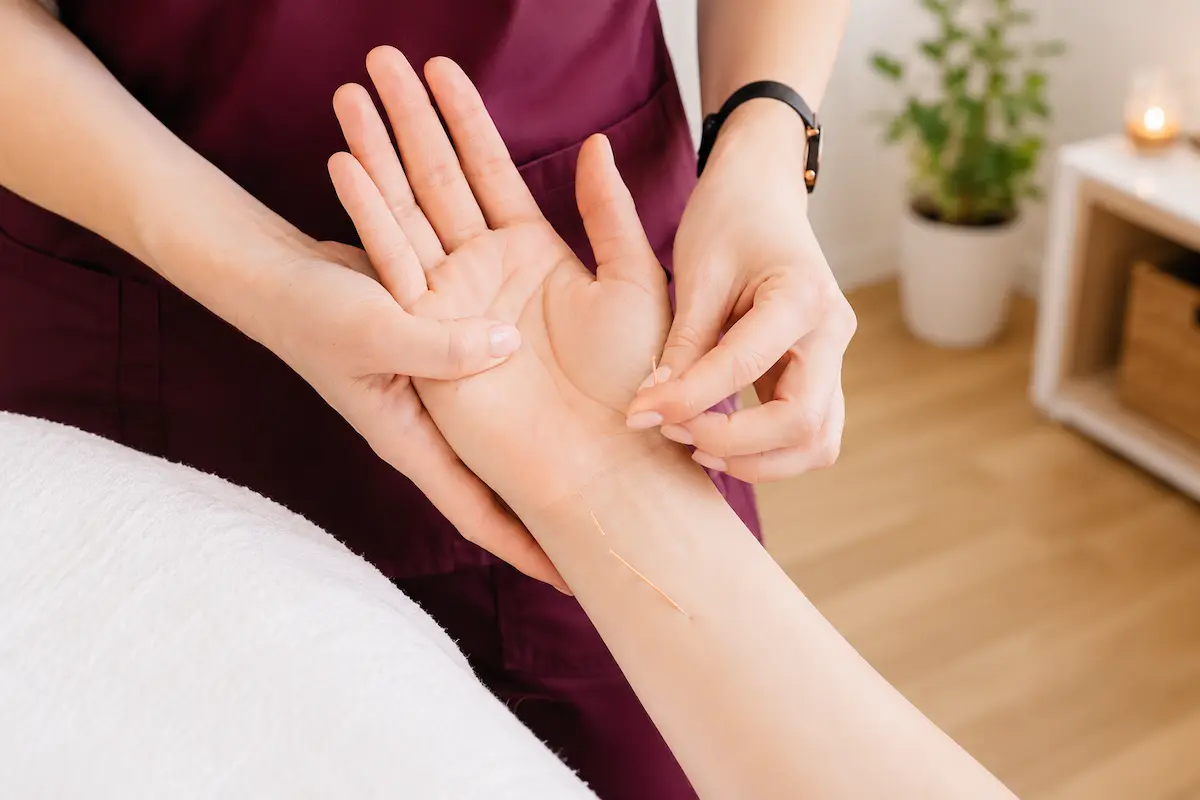
Sessions typically include points around the wrist, forearm, and sometimes the neck and shoulder, where tension contributes to symptoms, occasionally with gentle electroacupuncture. A course often runs 6 to 10 sessions over several weeks, alongside night splinting and ergonomic changes. We track the symptoms that matter to you: nighttime waking, tingling frequency, grip confidence.
Splints, Injections, Surgery: Where Acupuncture Sits
The standard ladder is conservative first: night splinting, activity modification, ergonomic setup, and sometimes corticosteroid injection for flare-ups, with surgical release for persistent, severe, or progressive cases. Acupuncture sits in the conservative layer as a possible adjunct for pain, not as a replacement for any rung of that ladder. If a hand surgeon recommends surgery for progressive weakness or muscle wasting, that advice takes precedence over any complementary therapy.
Who It May Suit, and Who Should See a Specialist First
Acupuncture may be worth trying for mild to moderate symptoms, especially nighttime tingling and aching, alongside splinting and ergonomics. See a hand specialist promptly for constant numbness that does not come and go, progressive weakness or dropping objects, visible wasting of the thumb muscles, or wrist symptoms after acute trauma. Those patterns need medical evaluation, not a trial of acupuncture.
The evidence: possible pain benefit, low certainty
A 2024 overview of nine systematic reviews and meta-analyses found eight reviews critically low quality and one low quality, with low or very low certainty evidence: possible benefit for pain intensity, inconsistent results for symptom severity, function, and nerve conduction (PMC11617874). A 2023 meta-analysis of randomized trials found possible adjunctive benefit, also low or very low certainty (PMC9995832). A well-designed 2017 mechanistic trial (n=80) found real electroacupuncture improved nerve-conduction and cortical measures more than sham (Maeda et al., Brain, 2017). Honest summary: worth trying as an adjunct for pain, not an established solution.
Assessment and screening (60 minutes)
We review your symptom pattern, prior testing, splint use, and red flags, and examine the wrist, forearm, and neck.
Conservative course (6 to 10 sessions)
Acupuncture alongside continued night splinting and ergonomic changes, tracking nighttime waking and tingling frequency.
Reassess and refer if needed
If symptoms progress or fail to improve, we refer to a hand specialist. We do not let complementary care delay needed medical treatment.
Licensed care that knows its lane. Messina Acupuncture is a licensed New York practice. For carpal tunnel, that means treating within the conservative layer, tracking meaningful symptoms, and referring to hand specialists when the pattern calls for it. We will never suggest acupuncture can replace surgery that a specialist has recommended. Verify any acupuncturist through the New York State Office of the Professions.
Seek prompt hand-specialist evaluation for constant numbness that does not fluctuate, progressive weakness or dropping objects, visible wasting of the muscles at the base of the thumb, or wrist symptoms following acute trauma. These patterns can signal advancing nerve compression where delay risks permanent loss. Acupuncture is a possible adjunct for mild to moderate symptoms, never a substitute for indicated medical or surgical care.
Frequently Asked Questions
Can acupuncture resolve carpal tunnel syndrome completely?
No. The evidence suggests possible pain reduction for some patients, with inconsistent results for function and nerve measures. It cannot change the anatomy compressing the nerve.
Can acupuncture help me avoid surgery?
There is no reliable evidence that acupuncture prevents the need for surgery. If a hand specialist recommends surgery for progressive symptoms, that recommendation takes precedence.
How many sessions are typical?
A course often runs 6 to 10 sessions over several weeks, alongside night splinting and ergonomic changes, with reassessment based on your symptoms.
Does wrist acupuncture hurt?
The wrist and forearm points use very fine needles; most people feel brief pinches. Treatment is adjusted to your comfort throughout.
Should I keep wearing my night splint during treatment?
Yes. Splinting, activity modification, and ergonomics remain the foundation; acupuncture is an adjunct to that care, not a replacement.
What results should I track?
Nighttime waking frequency, daytime tingling episodes, grip confidence, and any progression of numbness or weakness, the last of which should trigger a specialist visit.
Hand Symptoms Disrupting Your Days and Nights?
If carpal tunnel symptoms are costing you sleep and making work harder, let’s evaluate the pattern honestly. We will tell you whether acupuncture is a reasonable adjunct for your situation, and when a hand specialist is the better next step.
Messina Acupuncture PC
100 N Country Road, East Setauket, NY 11733
Sources and Further Reading
- Overview of nine systematic reviews and meta-analyses of acupuncture for carpal tunnel syndrome, 2024.
- Meta-analysis of randomized controlled trials of acupuncture for carpal tunnel syndrome, 2023.
- Maeda Y et al. Rewiring the primary somatosensory cortex in carpal tunnel syndrome with acupuncture. Brain, 2017;140(4):914-927.
- National Center for Complementary and Integrative Health: Acupuncture effectiveness and safety.