
Medical Massage · East Setauket, NY
Rounded shoulders, a forward head, and a spine that never quite feels at ease often trace back to soft tissue: tight muscles, trigger points, and restricted fascia pulling the body out of alignment. Medical massage addresses those tissues directly. Here are five ways it supports healthier posture, and what it honestly cannot do.
Working from a home office or a desk all day, many Setauket patients notice the same pattern: by late afternoon the neck aches, the shoulders have crept toward the ears, and a headache is building behind the eyes. Often the culprit is tissue, not willpower: chest muscles shortened from years at a keyboard, upper back muscles stretched and exhausted, fascia that has forgotten how to glide.
Posture is not just about remembering to sit up straight. At Messina Acupuncture, our posture-focused medical massage targets the underlying muscle tightness and soft tissue restrictions that pull the body out of alignment, so better posture becomes easier to maintain, not just easier to attempt.
- Reducing excess tension: releasing overactive muscles in the neck, chest, and hips lets the shoulders, spine, and head settle toward a more neutral position.
- Addressing imbalance: tight, shortened muscles are lengthened while their overstretched counterparts get room to re-engage with movement and exercise.
- Improving mobility: freeing restricted fascia and muscle restores range of motion in the neck, shoulders, spine, and hips, so good posture is physically possible.
- Supporting spinal mechanics: releasing the muscular forces that tug the spine away from its natural curves reduces load on joints and discs.
- Calming stress-related holding: easing the nervous system’s grip on the shoulders, jaw, and neck breaks the tension patterns that reinforce poor posture.
How Posture Problems Develop
Balanced posture stacks the head, shoulders, and hips so muscles work efficiently and joints are not forced to compensate. Daily life undermines that balance: prolonged sitting, laptop work, driving, phone use, and chronic stress tighten some muscle groups while others weaken from disuse. The familiar pattern follows: rounded shoulders, forward head, tightness between the shoulder blades.
Over time, these adaptations can contribute to chronic neck and back pain, headaches, and fatigue. Medical massage is goal-oriented bodywork designed to work directly with these tissues so posture can improve in a practical, sustainable way. It is not the same as a general relaxation massage.
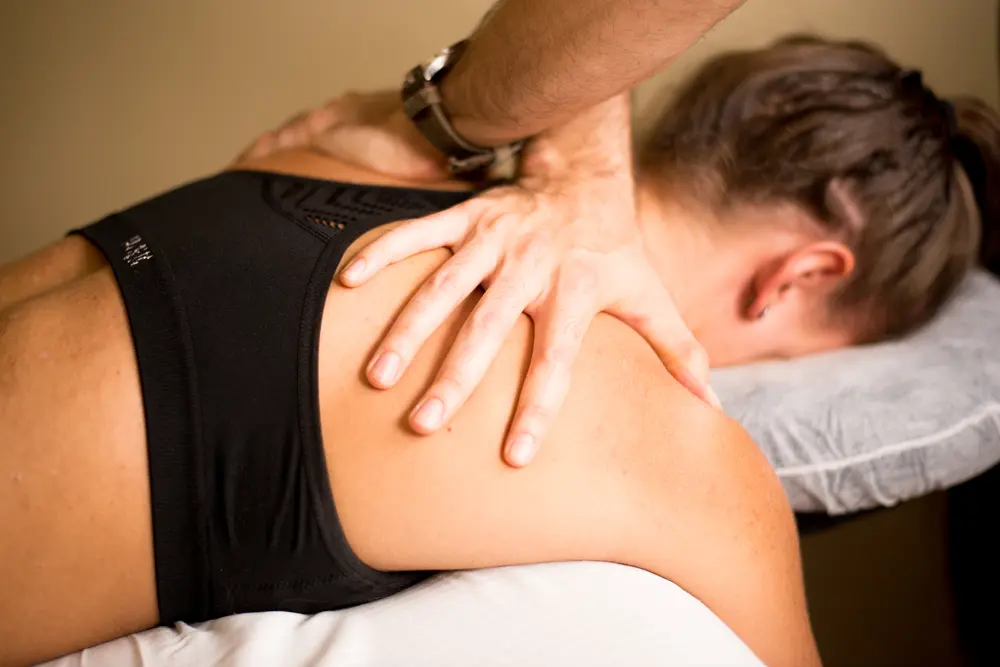
Five Ways Medical Massage Supports Better Posture
1. Reducing excess muscle tension
Long hours in one position keep certain muscles switched “on” all day: the neck, upper back, chest, and hip flexors. Medical massage identifies these overactive areas and uses specific techniques to reduce tension and trigger point activity. As tight muscles release, the shoulders, spine, and neck can settle into a more neutral position without constant conscious effort.

2. Addressing muscle imbalance
Posture reflects the balance between opposing muscle groups. Tight chest muscles pair with overstretched upper back muscles; tight hip flexors pair with underused glutes. Consistent treatment lengthens the shortened side and releases chronic tightness. To be clear, massage does not strengthen weak muscles by itself, but it creates the conditions for them to re-engage: patients often find it easier to activate their core, glutes, or upper back after restrictions are reduced, especially when paired with targeted exercise.
3. Improving flexibility and range of motion
Stiff muscles and restricted fascia limit how far joints can move. If you cannot turn your head fully, raise your arms overhead comfortably, or extend your hips without pulling, your body compensates with altered posture. Medical massage restores mobility by improving circulation, warming tissues, and addressing adhesions and knots in muscle and fascia. As the neck, shoulders, spine, and hips move more freely, maintaining better posture during work and daily life becomes realistic.

4. Supporting more comfortable spinal mechanics
The spine is supported by layers of muscle, ligament, and fascia. When those tissues are chronically tight or imbalanced, they can pull the spine away from its natural curves and increase load on certain joints and discs. Releasing restrictions around the spine encourages the vertebrae to sit in a more neutral, efficient alignment. An honest limit: massage cannot structurally “realign” the spine on its own, and it does not replace structural care when that is needed. It reduces the muscular forces working against good alignment.
5. Reducing stress-related holding
Stress and posture are closely connected. Many people unconsciously tense their shoulders, jaw, and neck under pressure, and over time that tension becomes a habitual holding pattern. Medical massage helps the nervous system shift out of a constant fight-or-flight state. As the system calms, muscle tone decreases, breathing becomes more efficient, and a balanced posture gets easier to adopt.
The evidence: supportive but still developing
Research on massage therapy supports its effects on pain, muscle tension, and stress-related measures. A widely cited review (Field et al., International Journal of Neuroscience, 2005) summarized biochemical findings including reduced cortisol and increased serotonin and dopamine following massage. Direct trials of massage specifically for postural correction are limited, so claims should stay measured: massage addresses the soft tissue factors that make good posture difficult, which is a meaningful but partial contribution. Lasting postural change also depends on movement habits, ergonomics, and strengthening, which we address in your plan.
What to Expect From a Posture-Focused Session
Assessment first
We discuss your symptoms, daily demands, and history, then assess your postural patterns. Treatment is tailored from there; no two plans look the same.
Targeted treatment
Sessions may include medical massage, acupressure, and myofascial techniques focused on the regions driving your pattern. Pressure is always adjusted to your comfort.
A practical ongoing plan
Many patients describe feeling lighter and more mobile after a session. Lasting change comes from consistent treatment plus small daily adjustments, which we will outline for you.
Licensed and coordinated care. Our practitioners are licensed in New York State, review your health history at intake to determine the safest approach, and coordinate with your physician or physical therapist when appropriate.
Contact your physician promptly for new or worsening numbness or weakness, severe or unrelenting back or neck pain, pain after trauma, unexplained weight loss, or any symptom that feels wrong to you. Massage supports soft tissue health; it should never delay evaluation of a potentially serious spinal or neurological condition.
Frequently Asked Questions
Can massage alone fix my posture?
Massage is a powerful tool for reducing tension and improving flexibility, but lasting postural change usually needs more: movement adjustments, workstation ergonomics, and strengthening for weak areas. We often combine massage with acupuncture or dry needling for a fuller plan.
How many sessions will I need?
It depends on how long the patterns have been present and your daily demands. Some patients notice improvement within a few sessions; long-standing issues often benefit from a series of visits. We will discuss a realistic plan after your assessment.
Is posture-focused massage painful?
Therapeutic work on tight areas can feel like strong pressure or mild soreness, but it should never feel intolerable. Communication matters, and pressure is always adjusted to keep you comfortable.
Can massage help if I sit at a desk all day?
Yes. Desk work is one of the most common drivers of posture-related pain. Medical massage can ease the muscular effects of prolonged sitting, making it easier to maintain better alignment during the workday, especially paired with simple ergonomic changes.
Will massage realign my spine?
No, not structurally. Massage cannot move vertebrae into place on its own. What it can do is release the tight, imbalanced soft tissues that pull the spine away from its natural curves, reducing the muscular forces behind poor posture.
Is medical massage right for everyone?
Most people can safely receive medical massage, but certain conditions call for modified techniques or input from your healthcare provider. We review your health history at intake to determine the safest approach. Call (631) 403-0504 with questions.
Tired of Fighting Your Own Posture?
If posture-related pain, stiffness, or fatigue is wearing you down, a posture-focused medical massage session may be a helpful next step. We will evaluate your patterns, discuss your daily demands, and design a plan aimed at helping you move and stand more comfortably.
Messina Acupuncture PC
100 N Country Road, East Setauket, NY 11733
Sources and Further Reading
- Field T et al. Cortisol decreases and serotonin and dopamine increase following massage therapy. International Journal of Neuroscience, 2005.
- Benefits of medical massage therapy in Setauket (Messina Acupuncture).
- National Center for Complementary and Integrative Health: Acupuncture effectiveness and safety.