
Natural Nausea Relief · East Setauket, NY
Peppermint, ginger, and lavender essential oils are popular natural options for nausea, used through inhalation or diluted skin application. They may ease queasiness for some people, but they are not instant cures and they demand respect: concentrated plant extracts can irritate skin and are not automatically safe in pregnancy or for children. Here is how to use them wisely.
The Port Jefferson to Bridgeport ferry crossing is ninety minutes, and for motion-sensitive travelers it can be a long ninety minutes. Peppermint oil kept in a bag, with a few deep breaths from the bottle when queasiness starts, is a common travel companion. But concentrated plant extracts deserve respect: using them correctly, and knowing how often they are safe to use, is worth sorting out.
Those are the right questions. At Messina Acupuncture, we sometimes pair aromatherapy with acupuncture or acupressure for nausea support. Here is an honest guide to the most useful oils, safe methods, and the precautions that matter most.
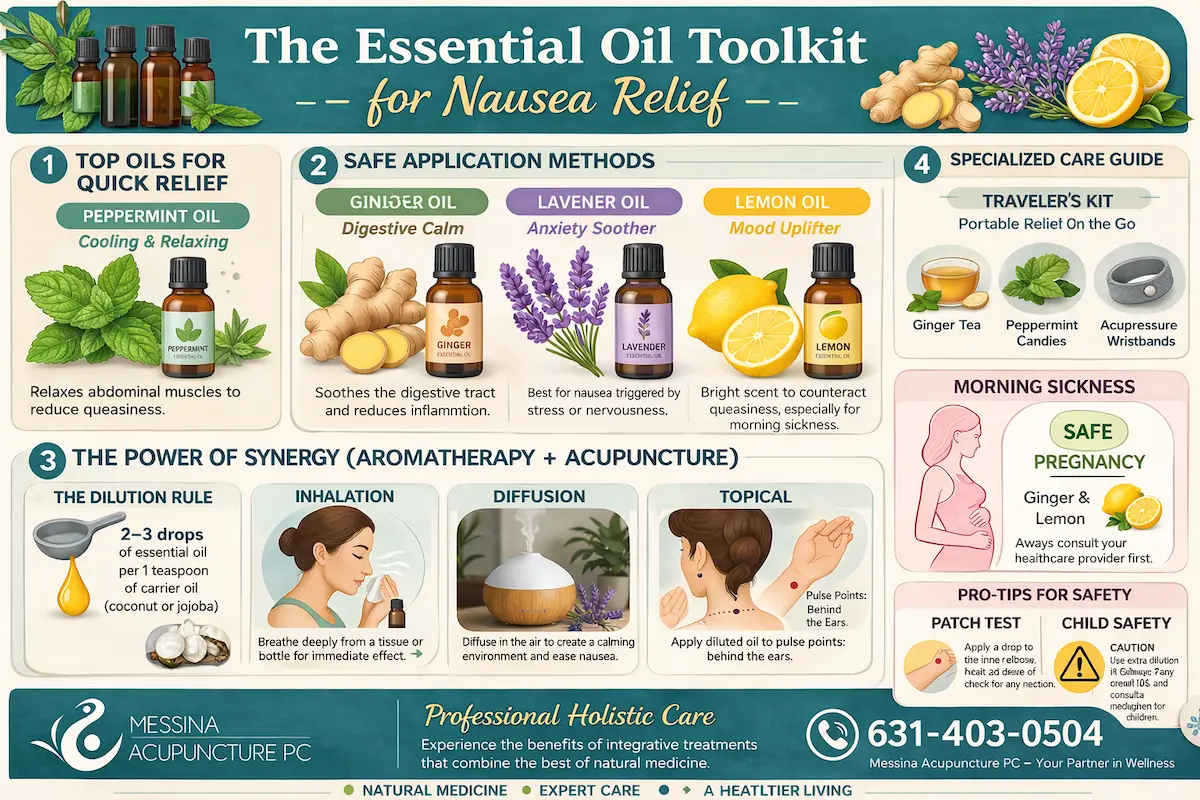
- The most useful oils: peppermint, ginger, and lavender are the best-studied and most widely used for nausea. Lemon is another common choice.
- How they are used: inhalation (from the bottle, a tissue, or a diffuser) and diluted application to the skin, such as the wrists or behind the ears.
- Safety first: always dilute in a carrier oil for skin use, patch test new oils, and keep oils away from eyes and mucous membranes.
- Do not swallow essential oils: without qualified clinical guidance. “Natural” does not mean safe to ingest.
- Special caution: pregnancy, young children, and certain medical conditions call for extra care. Check with your healthcare provider first.

Which Essential Oils May Help With Nausea?
- Peppermint: the most popular choice for queasiness, especially motion-related nausea. Its strong, cooling scent is the one most people reach for first.
- Ginger: long used in food and tea for stomach upset. Ginger as a spice has the most research behind it for nausea, including pregnancy-related nausea.
- Lavender: better known for calming, it is often chosen when nausea comes with anxiety or tension.
- Lemon: a bright, fresh scent some people find settling, particularly in stuffy environments like cars or boats.
You can use these individually or blend them. Start with one so you learn what actually helps you.
Safe Ways to Use Essential Oils for Nausea
- Direct inhalation: hold the open bottle a few inches from your nose and take several slow, deep breaths. Simple, portable, and the fastest method to try.
- Tissue or cotton ball: add one or two drops to a tissue and inhale as needed. Handy for travel.
- Diffuser: useful at home or in the office for gentle, continuous scent.
- Diluted skin application: mix a few drops into a carrier oil (such as jojoba, coconut, or sweet almond oil) and apply to the wrists, temples, or behind the ears. Never apply undiluted oils to skin.
Safety Precautions That Matter
- Always dilute for skin use. Undiluted essential oils can cause irritation, redness, or allergic reactions. A typical dilution is 1 to 2 percent (roughly 6 to 12 drops per ounce of carrier oil).
- Patch test first. Apply a small amount of the diluted oil to your inner forearm and wait 24 hours before wider use.
- Do not ingest essential oils without qualified clinical guidance. Swallowing concentrated oils can irritate the digestive tract and interact with medications.
- Pregnancy: some oils commonly used for nausea, like ginger and lavender, are widely used in pregnancy, but you should check with your healthcare provider before using any essential oil while pregnant.
- Children: use extra caution. Dilute more than you would for adults, avoid use in very young children without pediatric guidance, and keep bottles out of reach.
- Keep away from eyes and mucous membranes. If oil gets in your eyes, rinse with a carrier oil or milk, not water, and seek care if irritation persists.
How Acupuncture and Acupressure Complement Aromatherapy
Acupuncture and acupressure address nausea through a different route: stimulation of specific points rather than scent. The best-studied is PC6 (Neiguan), on the inner wrist about three finger-widths below the palm. Practitioners needle or press this point, and many people also use acupressure wristbands that maintain steady pressure there during travel.
Combining aromatherapy with PC6 stimulation is a common integrative strategy: the scent provides immediate sensory input while the point stimulation works in the background. Patients often find the combination more comforting than either approach alone, though individual responses vary.
The evidence: promising signals, limited certainty
A Cochrane review of wrist PC6 stimulation for preventing nausea and vomiting after surgery found that stimulation reduced nausea and vomiting compared with sham treatment, with minor side effects; the authors rated the overall certainty of the evidence as low (Lee et al., Cochrane Database of Systematic Reviews). For aromatherapy itself, the NCCIH notes that rigorous research is limited for most uses. For ginger specifically, a systematic review and meta-analysis (PubMed, 2014) found ginger may reduce nausea symptoms in pregnancy without increasing adverse events, though evidence quality was low. Our read: these are reasonable, low-risk options to try, not proven cures.
Tips for Travelers and Morning Sickness
- Pack a small kit: a bottle of peppermint oil, tissues, and diluted ginger oil cover most situations.
- Try a PC6 wristband for car, boat, or plane travel. They are inexpensive and drug-free.
- Eat lightly before travel and avoid strong food odors when you are already queasy.
- For morning sickness: ginger tea or capsules have more research behind them than ginger essential oil. Discuss any remedy, including oils, with your healthcare provider first.
What to Expect at Messina Acupuncture
Consultation
We discuss your nausea triggers, medical history, pregnancy status, and what you have already tried, so recommendations stay safe and appropriate.
Integrative session
Treatment may combine acupuncture or acupressure at points like PC6 with aromatherapy guidance tailored to your triggers.
Take-home plan
You leave with practical instructions: which oils to use, how to dilute and apply them, and when to check back in.
Licensed and coordinated care. Our practitioners are licensed in New York State and will coordinate with your physician when appropriate, especially for pregnancy-related nausea or nausea tied to a medical condition or medication.
Seek prompt medical care for nausea with severe abdominal pain, vomiting blood, signs of dehydration (very dark urine, dizziness, inability to keep fluids down), a stiff neck with fever, or nausea after a head injury. During pregnancy, contact your provider for severe or persistent vomiting. Essential oils and acupressure are comfort measures, not substitutes for medical evaluation.
Frequently Asked Questions
Can essential oils be used during pregnancy for nausea?
Some oils, like ginger and lavender, are commonly used for pregnancy-related nausea, but you should check with your healthcare provider before using any essential oil while pregnant to ensure safety for your situation.
How quickly do essential oils work for nausea?
When inhaled, some people notice a shift within minutes, but responses vary widely by person and method. Essential oils are a comfort measure, not an instant or guaranteed fix.
Is it safe to use essential oils on children for nausea?
Use extra caution with children. Dilute oils more than you would for adults, avoid use in very young children without pediatric guidance, and keep all bottles out of reach.
Can I swallow essential oils for faster relief?
No, not without qualified clinical guidance. Swallowing concentrated essential oils can irritate the digestive tract and interact with medications. Inhalation and diluted skin application are the safer routes.
What is the PC6 point, and does it really help?
PC6 (Neiguan) is on the inner wrist, about three finger-widths below the palm. A Cochrane review found wrist PC6 stimulation reduced postoperative nausea and vomiting compared with sham, though evidence certainty was low. Many travelers use acupressure wristbands targeting this point.
Can acupuncture be combined with essential oils?
Yes. We often pair acupuncture or acupressure with aromatherapy guidance for nausea support. The combination addresses both the physical and sensory sides of queasiness. Call (631) 403-0504 to discuss your situation.
Nausea Disrupting Your Days? Let’s Build a Plan.
If motion sickness, morning sickness, or recurring queasiness is limiting your life, we can help you build a safe, practical plan that may include acupuncture, acupressure, and aromatherapy guidance tailored to your triggers.
Messina Acupuncture PC
100 N Country Road, East Setauket, NY 11733
Sources and Further Reading
- Lee A et al. Stimulation of the wrist acupuncture point PC6 for preventing postoperative nausea and vomiting. Cochrane Database of Systematic Reviews.
- National Center for Complementary and Integrative Health: Aromatherapy.
- A systematic review and meta-analysis of the effect and safety of ginger in the treatment of pregnancy-associated nausea and vomiting. PubMed, 2014.
- Does acupressure work for nausea? The science of relief in Setauket (Messina Acupuncture).