
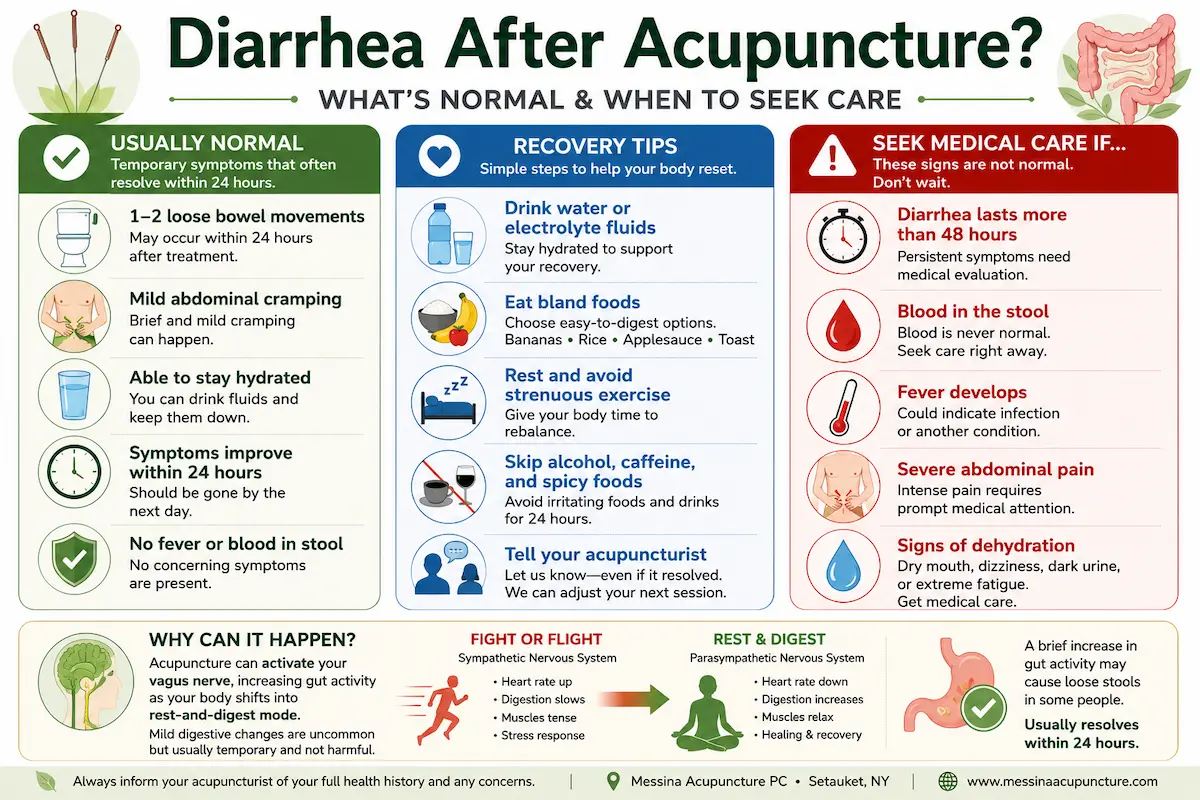
A regular patient of ours, a Stony Brook teacher in her early 40s, came in this spring for a series of sessions targeting a stubborn IT-band issue. After her third visit, she texted the front desk: “Quick weird question. I had loose stools twice last night. Is that acupuncture?” The honest answer is: it might have been, and it almost certainly wasn’t a problem. By the next morning she was back to normal. We adjusted her next session, and it didn’t happen again.
Loose stool or mild diarrhea after acupuncture is one of the less common questions we get at our Setauket office, but it shows up enough and gets searched enough across Long Island and Suffolk County that it deserves a clear, evidence-based answer. This guide walks through how often it happens, why it happens, what’s normal, and the very specific red flags that mean you should skip the wait-and-see approach and call your primary care doctor or head to urgent care.
Key Takeaways
- Mild, brief diarrhea after acupuncture is uncommon (estimated roughly 1–2% of treatments) and usually resolves within 24 hours.
- The mechanism is parasympathetic (vagal) activation of the gut, not “detox” or “toxin release.” Mayo Clinic, the Cleveland Clinic, and the NCCIH do not describe acupuncture in detox terms.
- Several commonly used points ST25, ST36, SP6, LI4, CV12 directly influence gastrointestinal motility.
- Normal: 1–2 loose stools within 24 hours, no fever, no blood, you stay hydrated.
- Red flags requiring medical evaluation: diarrhea lasting more than 48 hours, blood in stool, fever, severe abdominal pain, or signs of dehydration. Do not “wait it out” on these.
- Always tell your acupuncturist even when it resolves on its own so the dose can be adjusted next time.
How Common Is Diarrhea After Acupuncture?
In the published safety literature, diarrhea is reported but considered a minor and infrequent adverse event. A 2023 evidence mapping of 535 systematic reviews found that gastrointestinal symptoms including diarrhea, abdominal discomfort, and nausea appeared across a small percentage of acupuncture safety reports, with most resolving spontaneously and without sequelae.
In our own Setauket practice, looking back over recent years, fewer than 2 patients in 100 have ever flagged loose stool after a session. That number tracks with the broader literature: this is real, it’s known, it’s uncommon, and it’s almost always self-limiting.
Why It Happens: Vagal Stimulation, Not “Detox”
Acupuncture modulates the autonomic nervous system. When needles activate sensory fibers along certain meridians particularly along the abdomen, lower leg, and forearm the body often shifts toward parasympathetic (“rest-and-digest”) tone. The vagus nerve is the dominant parasympathetic pathway to the gut, and one of its core jobs is to increase gastrointestinal motility, secretion, and propulsion.
For most people, that vagal shift is what makes you feel calm and sleepy after a session. In a smaller subset, the gut responds more visibly: an extra bowel movement, slightly looser stool, a touch of mild cramping. A 2022 Frontiers in Neuroscience systematic review on acupuncture for diarrhea-predominant IBS lays out the mechanisms in detail: acupuncture demonstrably affects gut motility, the gut–brain axis, visceral pain processing, and even the gut microbiome. The same mechanism that helps an IBS-D patient over weeks of treatment can occasionally cause a single transient bowel change in a non-IBS patient.
Why we don’t call it “detox”
You’ll see “your body is releasing toxins” floated on wellness blogs as the cause of post-acupuncture loose stools. The major Western references NCCIH, Cleveland Clinic, Mayo Clinic don’t describe acupuncture in detox terms. The framing matters: calling a loose stool “detox” can lull a patient into ignoring symptoms that have nothing to do with their session (a stomach bug, food poisoning, a new medication, a flare of an undiagnosed GI condition). Naming the actual mechanism of vagal stimulation of gut motility keeps the bar honest about when to call for help.
For a fuller breakdown of normal post-session reactions, our companion post on 9 common post-acupuncture symptoms covers the autonomic-response umbrella that loose stool falls under.
The Points That Most Often Influence the Gut
A few specific points get used in nearly every musculoskeletal, back-pain, and stress treatment plan we run at Messina Acupuncture and several of them sit directly on the gut’s neurological doorbell.
- ST25 (Tianshu) abdominal point, two cun lateral to the navel. Classical indication for both diarrhea and constipation; widely used in modern protocols to regulate bowel function.
- ST36 (Zusanli) below the knee. One of the most-used points in all of acupuncture. Strong parasympathetic activation; well-documented effects on gastric and intestinal motility.
- SP6 (Sanyinjiao) inner ankle, three cun above the medial malleolus. Influences the spleen meridian, classically associated with digestion.
- LI4 (Hegu) between the thumb and index finger. Often added for pain; can shift autonomic tone broadly.
- CV12 (Zhongwan) midline above the navel. A direct gastric point, used when the chief complaint involves the digestive system.
If your treatment included any combination of these especially CV12 + ST25 + ST36 a transient gut response is more biologically expected than surprising. We mention this not to alarm you, but so you can have a useful conversation with your acupuncturist about what was needled and why.
Normal vs. Not Normal: A Clear Framework
Here’s the framework we use with patients at our Setauket office.
Normal (no medical care needed)
- 1 or 2 loose bowel movements within 24 hours of a session
- Mild, brief abdominal cramping that resolves
- Symptoms fully gone within 24 hours
- You can keep fluids down
- No fever, no blood, no severe pain
Tell your acupuncturist but no emergency
- A pattern of loose stool after each of two or three consecutive sessions
- Mild but lingering cramping for a full day
- New onset of bloating that wasn’t there before
This category isn’t an emergency, but it’s information we use to adjust the plan: fewer abdominal points, lower needle retention time, no electroacupuncture on gut-influencing points.
Red flags call your PCP or go to urgent care / ER
- Diarrhea lasting more than 48 hours. Do not assume this is from acupuncture.
- Blood in stool bright red, dark, or tarry/black. Any blood warrants evaluation.
- Fever, especially over 100.4°F.
- Severe abdominal pain, especially localized.
- Signs of dehydration: dry mouth, dark urine, dizziness on standing, racing heart, decreased urination, mental fogginess.
- Symptoms in someone immunocompromised, pregnant, elderly, or with a chronic GI condition lower threshold to call.
These can be signs of unrelated illness viral or bacterial gastroenteritis, foodborne illness, C. difficile (especially after recent antibiotics), inflammatory bowel disease, or other GI emergencies that have nothing to do with your acupuncture session. Acupuncture’s safety record is excellent, but no clinician (acupuncturist or otherwise) wants you to wave off blood in your stool or persistent fever as “just detox.” Call your primary care doctor or go to urgent care.
How to Recover at Home
If you’re in the normal category one or two loose stools, no red flags, supportive care is straightforward.
Hydrate steadily
Small sips of water, an oral rehydration solution, broth, or coconut water throughout the day. Avoid sugary sports drinks if you can. They sometimes make diarrhea worse.
Eat gently
The classic BRAT framework (bananas, rice, applesauce, toast) is fine for a day. Add lean proteins (eggs, plain chicken) as you feel better. Our post on what to eat after acupuncture covers the broader principle: warming, simple, easy-to-digest foods support a nervous system that’s still resetting.
Skip alcohol, caffeine, and very spicy food for 24 hours
All three irritate the gut. Save your morning coffee for tomorrow. (More on this in our alcohol-and-acupuncture post.)
Rest
You don’t need a bedrest, but the gym session, the long run, or the 12-hour shift can wait until tomorrow.
Use over-the-counter relief carefully
For mild, non-bloody, non-feverish diarrhea, OTC products like loperamide (Imodium) are generally considered safe per their label, but they are not appropriate when there’s fever or blood in stool. When in doubt, call your PCP.
When to Tell Your Acupuncturist
Always even when it resolved on its own. We chart every patient reaction, and when we know loose stool followed a session, the next plan changes:
- We avoid or reduce CV12 and ST25 needling
- We may swap from electroacupuncture to manual stimulation on ST36
- We move treatment to a less point-dense protocol initially
- We confirm your hydration and meal timing on the day of treatment
This isn’t about whether acupuncture is “right” for you, it almost always is. It’s about how to deliver an effective dose without overshooting your autonomic response. Patients who tell us about a reaction get better sessions afterward. Patients who quietly stop coming because they assume something was wrong end up missing out.
When to See a Licensed Acupuncturist
If you’ve had unexpected GI symptoms after acupuncture at another clinic and aren’t sure whether to continue, a consultation with a board-certified, NCCAOM-credentialed L.Ac. is worth your time. Dose calibration, how many needles, which points, how long retention, whether to add electroacupuncture is the part of acupuncture that most distinguishes practitioners. Our safety guide for Setauket patients covers the broader safety framework and credentialing standards to look for in any provider.
If you live along the North Shore and want a second opinion before continuing care elsewhere or before starting we offer free phone consults. Some patients aren’t great candidates for acupuncture for medical reasons, and we’d rather tell you that on the phone than have you push through symptoms.
Frequently Asked Questions
Is diarrhea after acupuncture normal?
Mild, brief diarrhea, one or two loose stools within 24 hours, no fever, no blood, no dehydration is uncommon but recognized in the literature and almost always self-limiting. The mechanism is parasympathetic activation of the gut, not “detox.” If symptoms last more than 48 hours or include red-flag features, see a doctor don’t assume it’s from the acupuncture.
How long does diarrhea after acupuncture usually last?
Most cases resolve within 24 hours. If you’re still having loose stools after 48 hours, the most likely explanation is no longer your acupuncture session; it’s a separate cause (viral, bacterial, dietary, medication-related, or an underlying GI condition). Call your primary care doctor.
Is loose stool a sign that acupuncture is “working” or “detoxing”?
Most evidence-based references don’t describe acupuncture in detox terms. What’s actually happening is a shift in vagal tone that briefly speeds gut motility. It’s not a sign that the treatment was more effective and it’s not a sign that something is wrong. It’s a sign your nervous system responded strongly, and we should adjust the dose next time.
Should I cancel my next acupuncture session if I had diarrhea after the last one?
No but tell your acupuncturist. We’ll modify the treatment: fewer abdominal points, lower stimulation, manual instead of electroacupuncture, and a check-in on your hydration and meal timing. Most patients who report this once never have it happen again on a modified plan.
Could the diarrhea be from something other than acupuncture?
Very possibly. Stomach bugs, foodborne illness, a new medication, antibiotics from the past several weeks (C. diff risk), and underlying GI conditions all present this way. If symptoms are worsening, prolonged, severe, or come with fever or blood, treat it as a non-acupuncture issue and see your PCP or urgent care.
Are there people who shouldn’t get acupuncture because of GI issues?
Most people with stable GI conditions including IBS, IBD in remission, and prior gut surgeries can safely receive acupuncture from a credentialed practitioner. We adjust the protocol. People in active flares of IBD, with active C. diff, with severe dehydration, or recovering from acute GI illness should wait and consult their PCP and acupuncturist before resuming.
Ready to Book at Messina Acupuncture
If you’ve had an unexpected post-session reaction at another clinic, or if you’re new to acupuncture and want to ask questions before stepping onto the table, we’re easy to reach.
Messina Acupuncture PC
100 N Country Road, Setauket, NY 11733
631-403-0504
Email us at fr*******@****************re.org, or start with our acupuncture service page. We serve patients from Setauket, Stony Brook, Port Jefferson, and across Suffolk County. A short phone call is often enough to walk through your history, your last experience, and what a calibrated next session would look like.