
Cupping Therapy · Pain Relief · East Setauket, NY
You have seen the circles: Olympic swimmers walking onto the pool deck with perfect purple rings down their backs. Cupping therapy has moved from ancient practice to a regular offering in modern clinics, and patients in Setauket ask about it constantly. This guide covers what cupping actually does, what the marks mean, what recent research says, who should avoid it, and what a session looks like in our office.
The question we hear weekly. A patient points at a photo of an athlete’s back and asks two things: “Does that hurt?” and “Would it help my back?” The answers: usually it does not hurt, and for some kinds of musculoskeletal pain it may help. The details matter, so here they are.
- Cupping uses suction (negative pressure) to lift skin and fascia, the opposite of massage’s downward: compression.
- Reviews suggest possible short-term pain relief for some musculoskeletal conditions, but evidence quality is: low to moderate.
- The circular marks are a local capillary response to suction, not traumatic bruises. They typically fade in 3 to 10 days.
- Cupping is not for everyone: blood thinners, bleeding disorders, skin infections, pregnancy, and recent surgery require screening.
- It works best as an adjunct to acupuncture, manual therapy, and movement, not as a stand-alone treatment.
What Cupping Actually Does
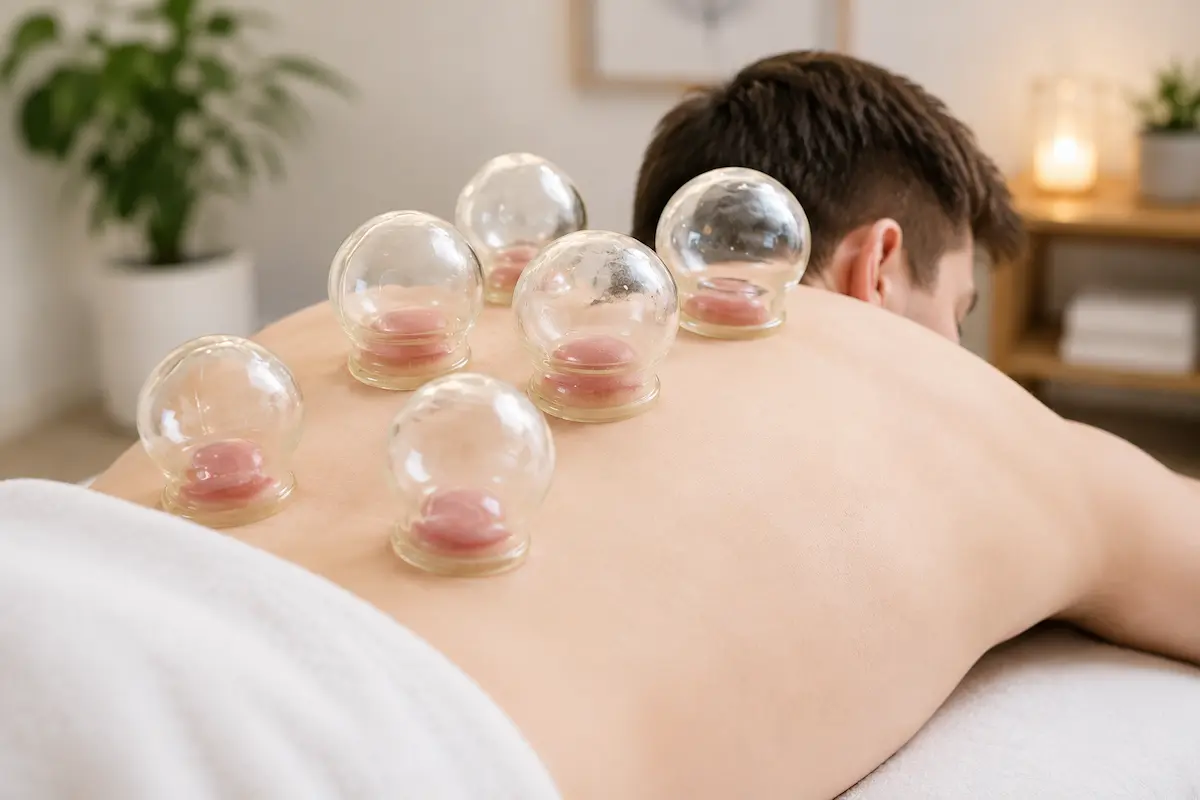
A cup, glass, plastic, or silicone, is placed on the skin and a vacuum is created, either by a hand pump or by briefly heating the air inside. The suction lifts the skin, superficial fascia, and underlying tissue into the cup. Where massage compresses tissue downward, cupping decompresses it upward.
Researchers describe the effects in terms of increased local blood flow and mechanical effects on the tissue layers where skin, fascia, and muscle meet. In traditional Chinese medicine terms, cupping is described as moving Qi and blood and resolving stagnation. We present both descriptions and distinguish the traditional framework from the modern one.
The Main Types of Cupping
Dry (stationary) cupping. The most common type in U.S. clinics. Cups are placed and left in position for 5 to 15 minutes using pump-created suction. This is what most of our Setauket patients receive, typically for the upper back, lower back, shoulders, and hips.
Fire cupping. A flame briefly heats the air inside a glass cup; the cooling air creates the vacuum. The flame never touches the skin. It tends to create deeper suction and is sometimes used for stubborn, chronic tension patterns.
Silicone (sliding) cupping. A silicone cup is squeezed by hand to create suction, then glided across oiled skin. Because the cup keeps moving, it leaves little to no marking and feels similar to deep-tissue massage. Often the best starting point for nervous first-timers.
Wet cupping. The skin is lightly scratched before cup application, drawing a small amount of blood. It is less common in U.S. clinics and more tightly regulated because of the bloodletting component. We do not perform wet cupping at Messina Acupuncture; we mention it because patients ask.
What the Marks Mean (and Do Not Mean)
The most persistent misunderstanding about cupping is that the circles are bruises. A bruise comes from blunt force damaging vessels. Cupping marks come from negative pressure drawing blood into the superficial capillary bed, which traditional theory calls “sha.” They are a local tissue response to suction, not an injury.
- Color: Darker marks generally reflect more underlying tissue congestion in that area. Color matters less than the internet suggests.
- Duration: Marks typically fade in 3 to 10 days and do not require treatment.
- Pain: The marks are usually not tender to the touch, and they do not get more painful as they fade.
- Over time: With repeated sessions in the same area, marks often become lighter as the tissue calms down.
The “detox” framing you see online is not supported by evidence. The marks reflect a local circulatory response, not the release of toxins. Planning a wedding or a beach day on the Long Island Sound? Schedule cupping at least 10 days out, not because it is dangerous, but because the marks are visible.
What the Research Actually Shows
A 2020 systematic review of dry cupping for musculoskeletal pain (Moura et al., 21 randomized trials, 1,049 participants) found cupping reduced pain for chronic neck pain and non-specific low back pain compared with no treatment or active controls, but rated the evidence as low to moderate quality. A 2022 review of cupping in musculoskeletal rehabilitation (Bridgett et al.) similarly concluded the evidence level was low to moderate, with generally positive but uncertain findings.
The consistent picture: cupping shows a plausible signal for short-term musculoskeletal pain relief with a generally favorable safety profile, but the evidence is not strong enough to call the benefits “proven.” Heterogeneity between studies and the difficulty of blinding cupping in trials limit how confident anyone should be. We offer cupping as a reasonable adjunct, primarily alongside acupuncture and manual therapy, and we track whether it is actually helping you.
Who Should Avoid Cupping or Be Screened First
Cupping is generally safe in trained hands, but we screen for the following at intake:
- Therapeutic anticoagulants (warfarin, apixaban, rivaroxaban) or bleeding disorders
- Active skin infection, eczema or psoriasis flares, sunburn, or open wounds in the treatment area
- Pregnancy: cupping over the lower back and abdomen is avoided
- Severe varicose veins in the treatment area
- Recent surgery (within about 4 to 6 weeks) in the treatment area
- Severe anemia or platelet disorders
- Implanted devices such as pacemakers, if cups would be placed nearby
Disclose your full medication list at intake, including over-the-counter products that affect bleeding, such as daily aspirin or high-dose fish oil.
What a Session Looks Like at Messina
We usually integrate cupping into a comprehensive appointment alongside acupuncture, though stand-alone sessions are available. The flow: intake and skin inspection with contraindication screening, positioning (usually face-down for the back, side-lying for hips, seated for neck and shoulders), cup application starting with lower suction and increasing only as tolerated, 5 to 15 minutes of dwell time for stationary cups (or continuous movement for sliding cupping), then removal and aftercare guidance.
Afterward, we suggest drinking water, avoiding extreme temperature exposure (hot tubs, saunas, direct cold wind) for 24 hours, and skipping intense workouts for the rest of the day. Light walking is fine. For a comparison with our other main modality, see cupping vs. acupuncture: what is the difference.
Your First Visit: What to Expect at Messina
Step 1: Screening and Assessment
We review your history, medications, and the problem area, inspect the skin, and confirm cupping is appropriate for you. If it is not, we say so and suggest alternatives. See our services and meet our team.
Step 2: Treatment
Cups are applied starting with gentle suction. Most patients describe a strong pulling or stretching sensation for the first minute, then it settles. We check in and adjust throughout.
Step 3: Aftercare and Reassess
We explain what to expect from the marks, what to avoid for 24 hours, and when to return. At follow-up we assess whether the problem is actually improving before continuing.
Cupping treats muscular tension, not undiagnosed disease. See your physician first for: fever with pain, unexplained weight loss, numbness, weakness, or bowel/bladder changes with back pain, chest symptoms, or pain after significant trauma. If you have not had persistent musculoskeletal pain evaluated, that workup should come before or alongside cupping.
Licensed, Regulated Care in New York. Look for a New York-licensed acupuncturist (L.Ac.) who performs cupping within their scope of practice and screens for contraindications at intake. Messina Acupuncture’s practitioners are New York State licensed acupuncturists practicing under New York State Education Department oversight, using appropriate cup hygiene protocols. Ask any provider about their screening process and how they clean or dispose of cups between patients.
Frequently Asked Questions
Does cupping hurt?
Most patients describe a strong pulling or stretching sensation, not pain. We start with lower suction and adjust to your comfort. The first minute usually feels the most intense, then the sensation settles.
Are the marks bruises?
Not in the traumatic sense. They are a local capillary response to suction pressure, sometimes called sha in traditional theory. They are usually not painful and fade in 3 to 10 days without treatment.
How long do the marks last?
Typically 3 to 10 days. Lighter marks fade within a few days; darker ones can take a week or slightly longer. If you have an event where visible marks matter, schedule cupping at least 10 days ahead.
How often can I get cupping?
While symptoms are active, weekly sessions are common, then spacing to every 2 to 4 weeks for maintenance. We generally let marks fade meaningfully before re-treating the exact same area.
Can I work out after cupping?
Skip intense exercise for the rest of the day; light walking is fine. Most patients return to normal training the next day. Avoid hot tubs, saunas, and extreme cold exposure for 24 hours.
Is cupping covered by insurance?
In New York, cupping is generally not separately reimbursed by commercial insurance, even when acupuncture is covered. Call our office at (631) 403-0504 and we will explain the out-of-pocket cost before you book, so there are no surprises.
Curious Whether Cupping Fits Your Pain?
Book an evaluation and we will assess your problem, screen for contraindications, and give you an honest opinion about whether cupping, acupuncture, or a combination makes sense.
Messina Acupuncture PC
100 N Country Road, East Setauket, NY 11733
Sources and Further Reading
- Moura CC, et al. Dry cupping therapy decreases pain in patients with musculoskeletal disorders: systematic review. Journal of Acupuncture and Meridian Studies, 2020. PubMed 33218554
- Bridgett R, et al. Effects of cupping therapy in amateur and professional athletes: systematic review. BMJ Open Sport and Exercise Medicine, 2022. PubMed 35848010
- National Center for Complementary and Integrative Health. Cupping. NCCIH