
Irritable bowel syndrome means recurrent abdominal pain tied to bowel movements, with no visible disease on a colonoscopy, and it affects 10 to 15% of U.S. adults. This guide reviews what the 2024 and 2025 research says about acupuncture for IBS, how it may influence the gut-brain axis, and the red flags that mean a gastroenterologist comes first.
A 38-year-old paralegal commutes from Stony Brook to a Manhattan law firm three days a week. By Thursday afternoon, her abdomen is painfully distended, she has been to the office bathroom four times since lunch, and she has canceled multiple client dinners because of unpredictable, intense cramping. Her gastroenterologist ruled out inflammatory bowel disease and celiac last spring, delivering the diagnosis many Long Islanders eventually receive: irritable bowel syndrome.
She reached out to our Setauket clinic wanting to know whether a course of targeted acupuncture for IBS could change her baseline, and what the peer-reviewed research actually reveals. At Messina Acupuncture, we start with the same question she did: is the diagnosis right, are there red flags, and is acupuncture a reasonable next step? Here is the honest answer.
Key Takeaways
- What IBS is: a functional gastrointestinal disorder diagnosed by the Rome IV criteria: recurrent abdominal pain linked to defecation or changes in stool frequency or form. It is distinct from inflammatory bowel disease, celiac disease, and colorectal cancer.
- The evidence: a 2025 PLOS ONE meta-analysis of 14 trials and 2,038 patients found acupuncture improved IBS quality of life and symptom severity versus conventional treatment. The 2025 ACTION multicenter trial found 15 sessions over 6 weeks beat sham for IBS-D, with benefits sustained over 18 weeks.
- How it may work: through the gut-brain axis: vagal nerve modulation, descending pain-inhibition pathways, HPA-axis regulation, and local autonomic input to the colon via points like ST25 and ST36.
- Subtypes matter: IBS-C (constipation), IBS-D (diarrhea), and IBS-M (mixed) need different protocols. A plan that calms hyperactive motility is the opposite of one that stimulates sluggish bowels.
- Red flags: blood in stool, unexplained weight loss, anemia, nocturnal diarrhea, persistent vomiting, or new bowel changes after 50 need a gastroenterologist first. Acupuncture comes after structural causes are ruled out.
Understanding IBS and Its Subtypes
The National Institute of Diabetes and Digestive and Kidney Diseases defines IBS as a functional disorder diagnosed by the Rome IV criteria: recurrent abdominal pain on average at least one day per week in the last three months, associated with two or more of pain related to defecation, change in stool frequency, or change in stool form. It is real, common, and a positive clinical diagnosis once red flags are ruled out, not a dismissive label.
Treatment cannot be one-size-fits-all because the subtypes pull in opposite directions. IBS-C (constipation predominant) involves hard, dry stools and sluggish motility. IBS-D (diarrhea predominant) involves loose, urgent stools and hyperactive motility. IBS-M alternates between the two. A plan designed to calm spasms uses different stimulation techniques than a plan designed to restore normal peristalsis, which is why the subtype drives the point selection.
The Gut-Brain Axis: Why Acupuncture May Help
Modern gastroenterology recognizes IBS as a disorder of the gut-brain axis: the bidirectional neuro-hormonal network linking the central nervous system, the enteric nervous system, the vagus nerve, and the gut microbiome. Stress and hyper-vigilance alter gut motility and heighten visceral pain sensitivity. Research suggests acupuncture interacts with this axis at several checkpoints: somatic stimulation of specific points modulates vagal activity, helping shift from fight-or-flight toward rest-and-digest; needling recruits descending serotonergic and noradrenergic pathways that turn down the volume on hypersensitive bowel pain receptors; and local points like ST25 provide segmental autonomic input directly to the nerve plexuses lining the colon.
What the Protocols Look Like
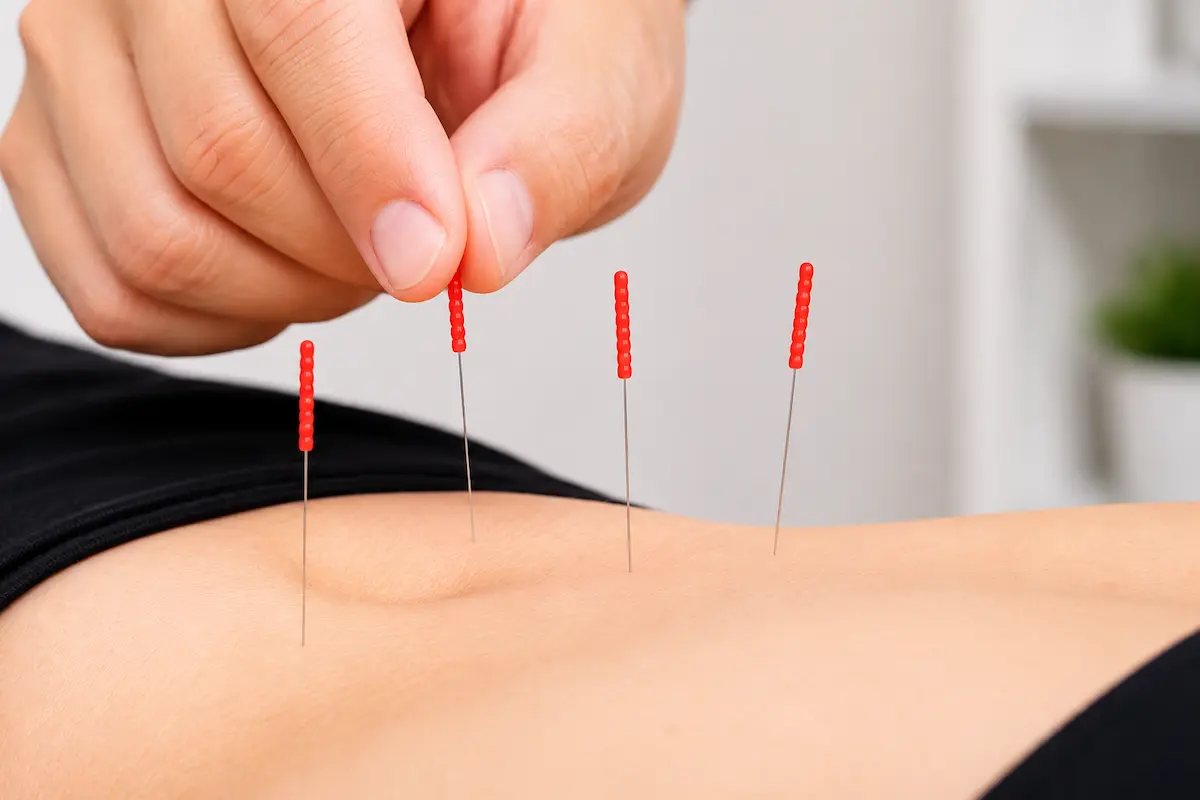
Every plan is customized after a detailed bowel and dietary history, review of your GI workup, and a TCM assessment. Foundational points commonly include ST36 (Zusanli) and ST25 (Tianshu), adapted dynamically to the subtype: for IBS-D patterns we may pair treatment with soothing moxibustion over the abdomen to settle hyper-motility, while for IBS-C patterns gentle electroacupuncture across ST25 can help restore peristaltic contractions. Between visits, we teach most patients a few acupressure points, such as PC6 and ST36, to use during flares.
What Is Not IBS
Patients sometimes arrive calling everything IBS, including reflux, food intolerances, and inflammatory bowel disease, and the first job is making sure the diagnosis is correct. IBS does not cause inflammation visible on colonoscopy, does not damage the gut wall, and does not increase colon cancer risk. Crohn’s disease and ulcerative colitis are progressive autoimmune conditions with visible ulceration; acupuncture can support stable IBD patients only with their gastroenterologist’s coordination and never replaces disease-modifying therapy. Celiac disease is a systemic autoimmune reaction to gluten, and acupuncture has no role in modifying the celiac response itself.
What a Typical Course Looks Like
Most positive trials use 10 to 15 sessions over 4 to 6 weeks. In our office, a typical initial course is 10 to 15 sessions over about 6 weeks, then reassessment. Patients often report improvements in stress and sleep within 2 to 3 visits, with meaningful change in bowel symptoms by sessions 6 to 8. Quality of life frequently improves before pain frequency does. Acupuncture works best as part of a broader plan: diet (often low-FODMAP guidance from your GI), stress modulation, sleep, and any prescribed gut-directed therapy.
Evidence Note: improving quality of life and symptom severity, with honest limits
A 2025 systematic review and meta-analysis (Zhou et al., PLOS ONE: 14 trials, 2,038 patients) found acupuncture significantly improved IBS quality of life and symptom severity scores versus conventional treatment, though it was not associated with a significant reduction in abdominal pain specifically. The 2025 ACTION trial (Gastroenterology: 280 patients with IBS-D, 6 hospitals) was stricter: 15 sessions over 6 weeks versus sham, with the real acupuncture group reaching the composite response rate more often and maintaining benefits through 18 weeks of follow-up. Effects are real and larger than sham but not curative, and most trials come from China, so higher-quality Western trials are still needed.
Your First Visits, Step by Step
Assessment and first treatment (60 to 75 minutes)
We take a detailed bowel and dietary history, review your GI workup and red-flag screen, perform a TCM assessment, and begin a first gentle treatment. We use the IBS-SSS and IBS-QoL at baseline so improvement is something we can both see, not guess at.
Follow-up sessions (30 to 45 minutes)
A typical initial course is 10 to 15 sessions over about 6 weeks, with the protocol adjusted to your subtype. Sessions pair needling with acupressure homework for flares, and sometimes moxibustion or gentle electroacupuncture depending on the pattern.
After each visit
A light meal 60 to 90 minutes beforehand is ideal, and hydration helps. Avoid caffeine if it is a known trigger. Many patients notice stress and sleep improving in the first few visits, with bowel symptoms shifting by sessions 6 to 8.
Why Choose Licensed Care
Licensed and coordinated care. Before booking acupuncture anywhere, confirm three things: the practitioner is licensed in New York State, they use sterile single-use needles, and they will coordinate with your gastroenterologist or primary care provider. Messina Acupuncture meets all three. Bring your medication list: never stop a prescribed gut medication without consulting your physician.
Acupuncture is not the right first step if you have blood in your stool or black tarry stools, unexplained weight loss, persistent vomiting, diarrhea that wakes you at night, anemia or iron deficiency, a new change in bowel habits after age 50, or a first-degree family history of colon cancer, IBD, or celiac disease. If any of these are present, we will pause care and help you connect with a GI specialist before needling. Fever with abdominal pain also needs prompt medical evaluation.
Frequently Asked Questions
How many sessions before I notice a difference?
Most patients report some improvement in stress and sleep within 2 to 3 visits, and meaningful change in bowel symptoms by sessions 6 to 8. A typical initial course is 10 to 15 sessions over 6 weeks, then reassessment.
Will acupuncture cure my IBS?
No honest practitioner promises a cure. IBS is a chronic disorder, and the goal is to reduce symptom severity, improve quality of life, and lower flare frequency. Many patients move from severe scores into mild or moderate ranges and stay there with maintenance care.
Should I continue my GI medications during acupuncture?
Yes. Never stop a prescribed medication without consulting your physician. Acupuncture is complementary, not a replacement, and we work alongside your gastroenterologist, not around them.
Is acupuncture safe if I have IBD instead of IBS?
Acupuncture is generally safe in stable IBD as a complement to gastroenterology care, but it requires coordination with your GI team and should never replace disease-modifying therapy. Tell us about any Crohn’s or ulcerative colitis diagnosis at intake.
What should I eat before a session?
A light meal 60 to 90 minutes beforehand is ideal. Never come fasted, and avoid a heavy meal immediately before. Hydrate, and avoid caffeine if it is a known IBS trigger for you.
Does insurance cover acupuncture for IBS in New York?
Coverage varies by plan and diagnosis. Some commercial plans cover acupuncture for chronic pain conditions but not specifically for IBS. Call our front desk at 631-403-0504 and we will run a benefits check before your first visit.
Ready to Stop Planning Your Day Around Your Gut?
If you are tired of canceling dinners, planning around the nearest bathroom, or feeling like your gut runs the show, acupuncture is worth an honest conversation. We will review your GI workup, listen to the full picture, and tell you plainly whether acupuncture fits, including the cases where it does not.
Messina Acupuncture PC
100 N Country Road, East Setauket, NY 11733
Sources and Further Reading
- Zhou et al. The effect of acupuncture on quality of life in patients with irritable bowel syndrome: a systematic review and meta-analysis. PLOS ONE, 2025.
- Efficacy of ACupuncTure in Irritable bOwel syNdrome (ACTION): a multicenter randomized controlled trial. Gastroenterology, 2025.
- National Center for Complementary and Integrative Health: Acupuncture effectiveness and safety.