
Self-Care Guide · East Setauket, NY
Your hands are always with you, which makes acupressure the most portable self-care tool there is. With the right points and a little technique, you can ease a tension headache at your desk, settle nausea on a rough ferry ride, or wind down before sleep. This guide teaches eight of the most useful points, how to press them correctly, how to sequence them, and when not to.
It is 9 p.m., she is answering emails from the couch, and the band of tension across her forehead has been tightening since lunch. She does not want another painkiller; she wants the ache to loosen. Two minutes of steady thumb pressure in the web of her hand and at the base of her skull, and the band starts to soften. It is not magic. It is a learned skill, and this guide teaches it.
At Messina Acupuncture, we teach point self-massage to nearly every patient as homework between visits. Below are the eight points we teach most, with the same instructions we give in the clinic, including the safety notes that matter.
- Eight versatile points: LI4, GB20, ST36, Yintang, KI1, PC6, CV17, and LV3 cover headaches, stress, nausea, sleep, and tension.
- Technique: firm, achy pressure at about 5 out of 10, 1 to 2 minutes per point, breathing slowly; never sharp or breath-holding pain.
- Sequencing: match the routine to the complaint, calming points for sleep, moving points for tension and irritability.
- Evidence: trials support self-acupressure for stress and sleep quality, with the usual caveats about small studies.
- Safety first: LI4, SP6, and BL60 are traditionally avoided in pregnancy; go easy with blood thinners, fragile skin, or dizziness.
What Self-Massage Can and Cannot Do
Acupressure self-massage is symptom support you administer yourself: easing a tension headache, calming pre-meeting jitters, settling mild nausea, or creating a wind-down ritual before bed. It does not replace acupuncture, where a licensed practitioner reaches deeper tissue, holds the stimulus longer, and diagnoses the full pattern. Think of self-massage as the homework and acupuncture as the class.
A note on honesty: pressing a point does not purge anything from the body, reset your nervous system in any clinical sense, or treat disease. It is a low-risk comfort measure with modest evidence behind it.
How to Press a Point Correctly
Use the pad of your thumb, fingertip, or knuckle, not the nail. Sink in gradually until you feel a firm, achy, “good hurt” sensation, about a 5 out of 10. Hold for 1 to 2 minutes while breathing slowly, or use small, steady circles. Sharp, stabbing, or breath-holding pain means too much pressure. Small tools help for hard spots: a tennis or lacrosse ball against a wall for the back, or a pencil eraser for small points. Avoid hard metal or sharp-tipped tools.
The 8 Points
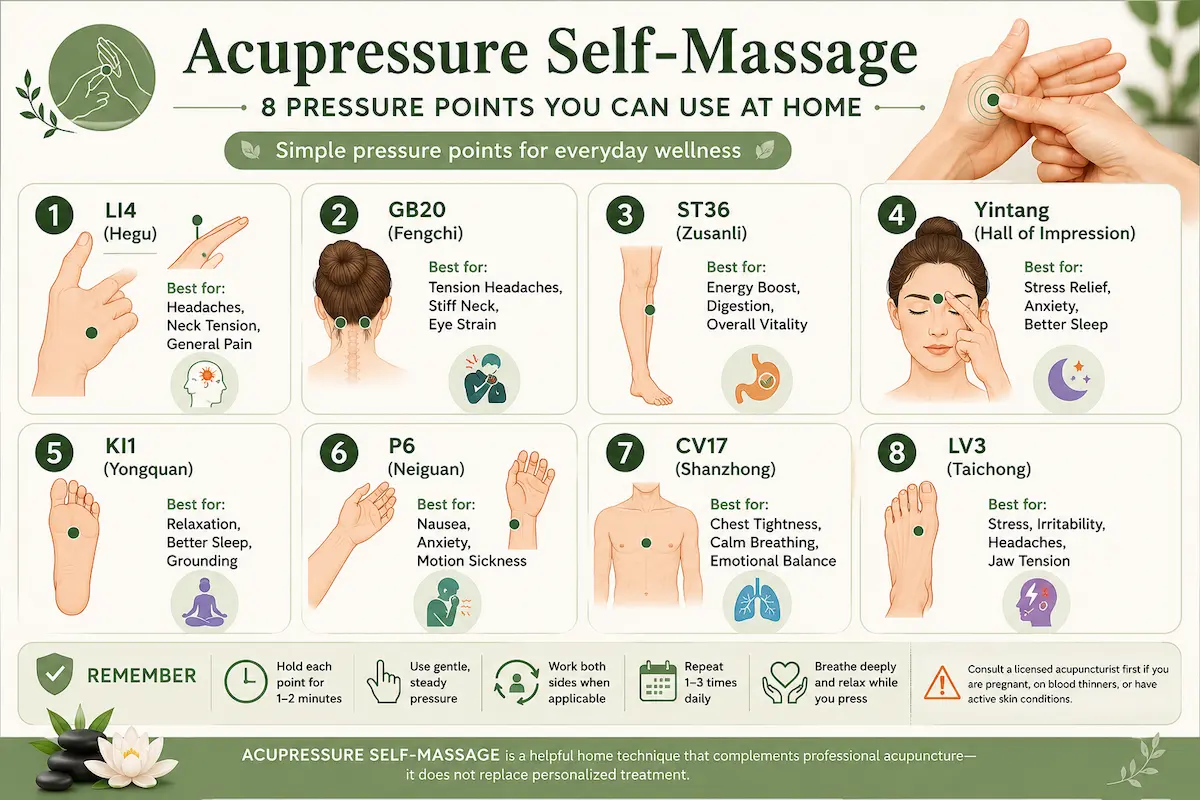
- 1. LI4 (Hegu), for headaches, neck tension, and general pain: the fleshy web between thumb and index finger. Squeeze firmly toward the bone for 1 to 2 minutes per hand. Avoid during pregnancy.
- 2. GB20 (Fengchi), for tension headaches and stiff neck: the hollows at the base of the skull. Thumbs press upward into the hollows; let the head rest into your hands.
- 3. ST36 (Zusanli), for energy, digestion, and recovery: four finger-widths below the kneecap, one finger-width outside the shin. Steady thumb pressure while seated.
- 4. Yintang, for stress, racing thoughts, and sleep onset: midpoint between the eyebrows. One fingertip, gentle sustained pressure, eyes closed.
- 5. KI1 (Yongquan), for grounding and insomnia: the sole of the foot, in the depression below the ball of the foot. Press with a thumb or roll a ball underfoot.
- 6. PC6 (Neiguan), for nausea, anxiety, and palpitations: inner wrist, three finger-widths below the crease, between the two central tendons. The classic motion-sickness point.
- 7. CV17 (Shanzhong), for chest tightness and emotional tension: center of the breastbone, level with the nipples. Gentle fingertip pressure with slow breathing.
- 8. LV3 (Taichong), for irritability, headaches, and jaw tension: top of the foot, in the web between big and second toe. Pairs well with LI4 for tension patterns.
How to Sequence Them for Your Issue
For a tension headache: LI4, then GB20, then LV3, finishing with Yintang. For stress or winding down: Yintang, PC6, CV17, then KI1, moving attention downward. For nausea: PC6 first, then ST36. For sleep onset: a short calming sequence, Yintang, PC6, KI1, done lying down with lights low. Use a routine once or twice daily for a week or two to judge whether it helps; one attempt is not a fair trial.
Safety Notes and Contraindications
Acupressure is low risk, but a few cautions matter. LI4 and similar strongly stimulating points are traditionally avoided during pregnancy; if you are pregnant, get point selection from your clinician or a licensed acupuncturist. If you take blood thinners, have fragile skin, or bruise easily, use lighter pressure. Do not press on rashes, wounds, varicose veins, or areas of acute injury. Sit down for points that make you lightheaded, and stop if you feel dizzy, nauseated beyond the intended effect, or unwell. After surgery, check with your surgeon before pressing near the site.
When to See a Licensed Acupuncturist
Self-massage handles the everyday layer. Book a professional assessment when pain keeps returning despite self-care, when sleep or anxiety is significantly affecting your life, or when you want a diagnosed, individualized plan rather than a generic routine. A full session reaches what fingers cannot, and the diagnostic lens is the real difference.
The evidence: real trials, modest claims
A 2023 randomized trial of 159 healthcare providers (PMC10732584) found a self-acupressure routine improved self-reported stress and mental-health quality of life, though the trial was unblinded, so expectation effects cannot be ruled out. A 2025 meta-analysis of 41 trials and 3,680 inpatients (Nursing and Health Sciences, 2025) found acupressure improved sleep quality and sleep parameters. Encouraging, not conclusive: small samples and blinding challenges run through this literature.
Learn the points in person
At a visit we check your point location and pressure so your home routine is accurate from day one.
Pair self-care with treatment
Most plans combine in-office acupuncture for the deeper pattern with a short daily point routine for maintenance.
Reassess together
Bring notes on what helped. We refine the routine and the treatment plan around your actual response.
Taught by licensed professionals. Messina Acupuncture is a licensed New York practice, and point self-massage is standard homework we teach in the clinic, with safety screening built in. We would rather you learn it correctly from a professional than from a random video. Verify any acupuncturist through the New York State Office of the Professions.
Traditionally avoid strongly stimulating points such as LI4 during pregnancy unless a qualified professional advises otherwise. Use lighter pressure with blood thinners, fragile skin, or easy bruising. Never press on broken skin, rashes, or injured areas, and stop if you feel dizzy or unwell. Self-massage is for everyday symptom support; new, severe, or worsening symptoms deserve medical evaluation, not more pressure.
Frequently Asked Questions
How often should I do acupressure self-massage?
For most healthy adults, 1 to 3 times daily is reasonable, either as prevention (morning routine, evening wind-down) or when symptoms strike. Stop if you feel dizzy or unwell.
How long until I feel something?
Many people notice a softening or easing within 60 to 90 seconds on a given point. For sleep or persistent tension, judge the routine after 1 to 2 weeks of consistent use.
Can acupressure replace acupuncture?
No. Acupressure complements acupuncture but does not replace it. Needled treatment reaches deeper tissue, holds the stimulus longer, and is guided by a full diagnostic assessment.
Is acupressure safe during pregnancy?
Most gentle points are low risk, but strongly stimulating points, notably LI4, are traditionally avoided in pregnancy. If you are pregnant, get a routine from a licensed acupuncturist or your clinician.
What if a point hurts a lot?
Tenderness is common and often marks a useful point, but sharp, stabbing, or breath-holding pain is too much. Back off to about a 5 out of 10 and breathe.
Can I use a tool instead of my thumbs?
Yes. A tennis or lacrosse ball, a wooden acupressure pen, or a pencil eraser all work for hard-to-reach or small points. Avoid sharp metal points or hard plastic tips.
Learn It Right, Then Use It Anywhere
Self-massage is a portable tool, but a full acupuncture session works at a different level: deeper, longer-lasting, and individualized to your pattern. If pain, stress, or poor sleep keeps returning despite your best home efforts, come in and let us build the full plan with you.
Messina Acupuncture PC
100 N Country Road, East Setauket, NY 11733
Sources and Further Reading
- Randomized trial of a self-acupressure routine for stress in 159 healthcare providers, 2023.
- Effectiveness of acupressure on sleep quality among inpatients: systematic review and meta-analysis. Nursing and Health Sciences, 2025.
- National Center for Complementary and Integrative Health: Acupuncture effectiveness and safety.