
Metabolic Health · East Setauket, NY
Insulin resistance often simmers quietly for years before a diabetes diagnosis, and many people in that window ask what else they can do beyond diet and exercise. Self-acupressure, pressing specific points on the body with your fingers, has been studied as a possible complement. The research is early and mixed, but worth understanding honestly. Here is what the trials show, which points researchers focus on, and the non-negotiables that come first.
He is 52, works in tech, and his last labs came back with the word “prediabetes” for the first time. His doctor talked about walking after meals and cutting back on the late-night snacks, and he is doing that. But he keeps wondering whether there is anything else, something he can do with his own hands in the evening, that might help his body respond to insulin a little better. A friend mentioned acupressure points for blood sugar, and he is skeptical but curious.
That skepticism is healthy, and this article is written for it. At Messina Acupuncture, we follow this research closely because metabolic patients ask about it every week. Below is what the studies actually found, including the ones with disappointing results, so you can make an informed decision with your clinician.
- What it is: insulin resistance means your cells respond less efficiently to insulin, pushing the pancreas to produce more and nudging blood sugar upward over time.
- Early, mixed evidence: small trials of self-acupressure report modest improvements in fasting glucose, but results are inconsistent and study quality varies.
- Most studied points: ST36, SP6, LV3, and KD3 appear most often in the metabolic research.
- Adjunct only: acupressure does not replace medication, glucose monitoring, diet, exercise, or your clinician’s care.
- Honest framing: one trial found no statistically significant between-group differences, a reminder that this is complementary, not established therapy.
What Insulin Resistance Actually Is
The CDC defines insulin resistance as a condition in which cells in your muscles, fat, and liver do not respond well to insulin and cannot easily take up glucose from your blood. In plain language: insulin is the key, and the locks on your cells are getting harder to turn. To move the same amount of glucose, your pancreas must produce more insulin, and over time fasting blood sugar creeps upward.
Why It Matters Before a Diabetes Diagnosis
Insulin resistance is often present for 5 to 10 years before type 2 diabetes is diagnosed. That is a long window, and it is the window where lifestyle change does the most good: walking after meals, strength training, sleep, and weight management where appropriate. It is also the window where many of our Setauket patients find us, holding a “prediabetes” lab slip and asking what else might help. Acupressure belongs, at most, in the “might help a little” category, behind the fundamentals.
What the Evidence Actually Shows
Research here is young, and readers deserve the full picture, including the null results.
A small randomized trial of self-acupressure in type 2 diabetes patients used a home-replicable protocol: pressing ST36, LIV3, KD3, and SP6 for five minutes per point (published in a peer-reviewed medical technology journal). It reported favorable changes in blood sugar measures compared with controls.
But a separate randomized trial (PMC8053207) found no statistically significant between-group differences in blood glucose or HbA1c, a useful corrective against overclaiming.
A 2024 meta-analysis in Frontiers in Endocrinology pooled trials of auricular (ear) acupressure added to conventional diabetes treatment and found improvements in fasting glucose, HbA1c, lipids, blood pressure, and BMI (Frontiers in Endocrinology, 2024), while noting that more high-quality trials are needed. Taken together: modest, inconsistent signals that justify interest but not confidence.
The Four Points With the Most Research Attention
These are the points studied most often for metabolic effects. Use firm, comfortable pressure, about a 5 out of 10 intensity, in a 10-seconds-on, 2-seconds-off rhythm, for about five minutes per point:
- ST36 (Zusanli), “Leg Three Miles”: about four finger-widths below the kneecap, one finger-width outside the shin bone, in the belly of the tibialis anterior muscle. Among the most studied points in all of acupuncture research.
- SP6 (Sanyinjiao), “Three Yin Intersection”: four finger-widths above the inner ankle bone, just behind the shin bone. Traditionally used for digestive and metabolic complaints.
- LV3 (Taichong), “Great Rushing”: on top of the foot, in the web between the big toe and second toe. Often paired with ST36 in metabolic protocols.
- KD3 (Taixi), “Great Ravine”: in the depression between the inner ankle bone and the Achilles tendon.
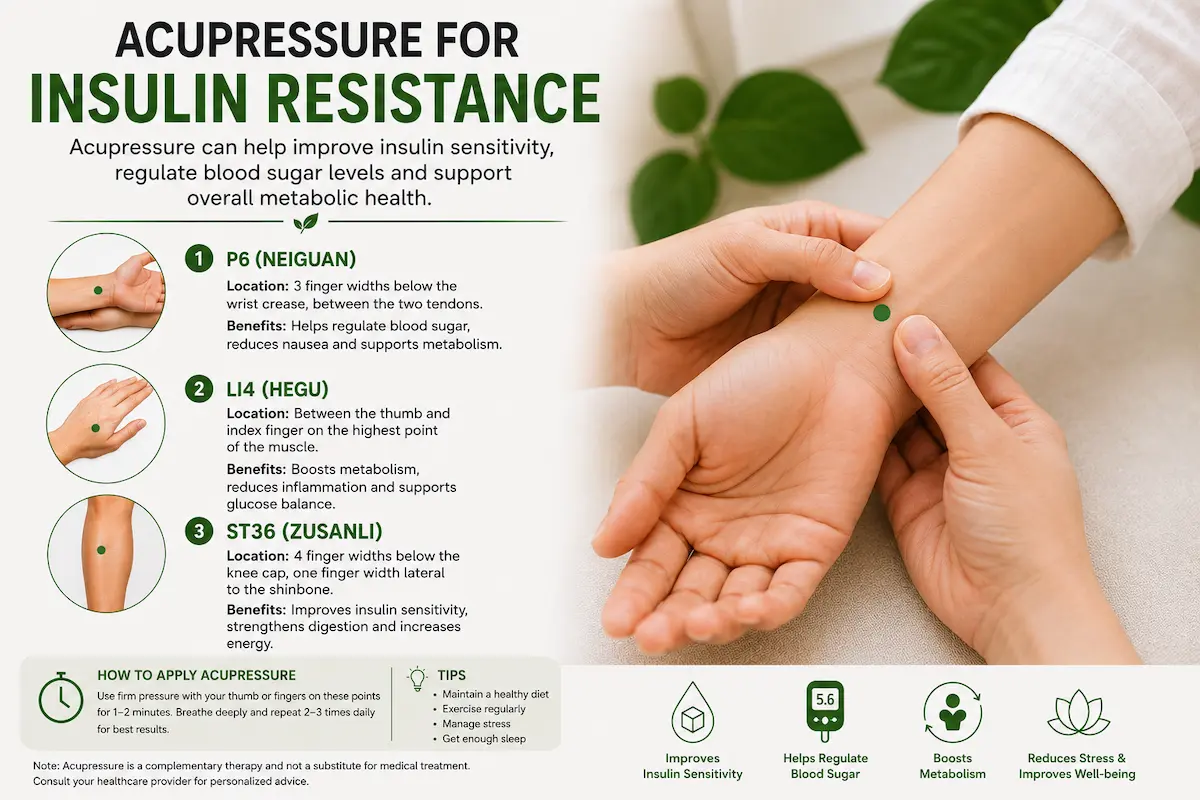
A Simple Home Routine
Work through the four points on both sides, five minutes each, once daily, ideally at a consistent time. Sit comfortably, breathe normally, and stop if you feel dizzy or unwell. In the trials, protocols typically ran 8 to 12 weeks, so judge a routine over weeks, not days. Keep a simple log of your fasting readings if your clinician has asked you to monitor, and bring it to your appointments.
Lifestyle Is the Main Event
No point protocol competes with the fundamentals: regular movement (including walking after meals), strength training, consistent sleep, and a diet your clinician or dietitian endorses. Acupressure is, at best, a small addition to that foundation. Anyone selling it as an alternative to lifestyle change or medication is misleading you.
Where Professional Acupuncture Fits
Some patients prefer in-office treatment, where a licensed acupuncturist can combine body points with ear acupressure seeds and tailor the approach to your full pattern, stress, sleep, and digestion included. If you are curious, that is a conversation to have with both your acupuncturist and your diabetes care team.
The evidence: small trials, mixed results
A small randomized trial of self-acupressure (ST36, LIV3, KD3, SP6, five minutes per point) reported favorable blood sugar changes (medical technology journal, peer-reviewed), while a separate trial found no statistically significant between-group differences in glucose or HbA1c (PMC8053207). A 2024 meta-analysis of auricular acupressure as an adjunct to conventional diabetes care found improvements in fasting glucose, HbA1c, lipids, blood pressure, and BMI, with a call for more high-quality trials (Frontiers in Endocrinology, 2024). Most trials are small and short; this is complementary care, not established therapy.
Talk with your clinician first
Before adding any routine aimed at blood sugar, tell your doctor or diabetes educator, especially if you take insulin or glucose-lowering medication.
Learn the points properly
At a consultation we teach point location and pressure so your home routine is accurate, and we screen for any reason to modify it.
Track and reassess
Keep your usual glucose log, note how the routine fits your day, and review it with your care team at follow-ups.
Licensed, cautious, coordinated. Metabolic conditions demand coordination, not solo experimentation. Messina Acupuncture is a licensed New York practice; we teach self-acupressure as a complement to your medical plan, communicate with your diabetes care team when appropriate, and will tell you plainly when something is outside what acupressure can offer.
Acupressure cannot replace medication, glucose monitoring, diet, exercise, or your clinician’s guidance, and there is no evidence it reverses diabetes. Never stop or adjust prescribed medication because of a self-care routine. Contact your clinician promptly for unusual glucose readings, symptoms of low blood sugar (shakiness, sweating, confusion) or very high blood sugar (excessive thirst, frequent urination, fruity-smelling breath), or any new concerning symptom. If you are pregnant, check point selection with your clinician first.
Frequently Asked Questions
Can acupressure reverse insulin resistance or diabetes?
There is no evidence that acupressure reverses insulin resistance or diabetes. Small trials show modest, inconsistent effects on glucose measures, which is why it is studied only as a possible complement to standard care.
Do I still need my medication if I do acupressure?
Yes. Never stop or change prescribed medication without talking to the clinician who prescribed it. Acupressure is an addition to medical care, never a replacement.
Which points should I press?
The most studied points in the metabolic trials are ST36 (below the knee), SP6 (above the inner ankle), LV3 (top of the foot), and KD3 (behind the inner ankle bone), about five minutes each.
How often should I do it?
Trial protocols typically used daily sessions for 8 to 12 weeks. Consistency over weeks matters more than any single session.
Is it safe with insulin or metformin?
Acupressure itself is low risk, but any routine aimed at blood sugar deserves a conversation with your prescriber, since glucose patterns can shift. Keep monitoring as your clinician advised.
When should I call my doctor?
For unusual glucose readings, symptoms of low or very high blood sugar, or any new symptom that worries you. Self-care routines should never delay medical evaluation.
Support Your Metabolic Health With Honest Guidance
If you are navigating prediabetes or type 2 diabetes and want to explore acupuncture or self-acupressure as a complement to your medical care, we will give you a straight assessment, teach you the techniques properly, and coordinate with your diabetes care team.
Messina Acupuncture PC
100 N Country Road, East Setauket, NY 11733
Sources and Further Reading
- Randomized trial of self-acupressure (ST36, LIV3, KD3, SP6) in type 2 diabetes patients.
- Randomized trial of acupressure for blood glucose and HbA1c in type 2 diabetes (no significant between-group differences).
- Gong et al. Auricular pressure as an adjuvant treatment for type 2 diabetes: data mining and meta-analysis. Frontiers in Endocrinology, 2024.
- National Center for Complementary and Integrative Health: Acupuncture effectiveness and safety.