
Treatment Options · East Setauket, NY
Both involve skilled hands, both ease tension, and both leave you feeling looser than when you arrived. But acupressure and massage therapy work differently: one targets specific points with sustained pressure, the other works broadly across muscles and soft tissue. Understanding the difference helps you spend your time and money on the right session. Here is how they compare and how they work together.
He books a massage every few months when his shoulders seize up from desk work, and it helps for a week. Then a coworker suggested acupressure for the tension headaches that ride along with the shoulder tightness, and he realized he did not actually know how the two differed. Was acupressure just massage with a different name? Would it do anything his massage therapist was not already doing?
Good questions, and the answers matter for choosing well. At Messina Acupuncture, our work sits closer to the acupressure end of the spectrum, and we refer to excellent massage therapists when broad soft-tissue work is what a patient needs. Here is the honest comparison.
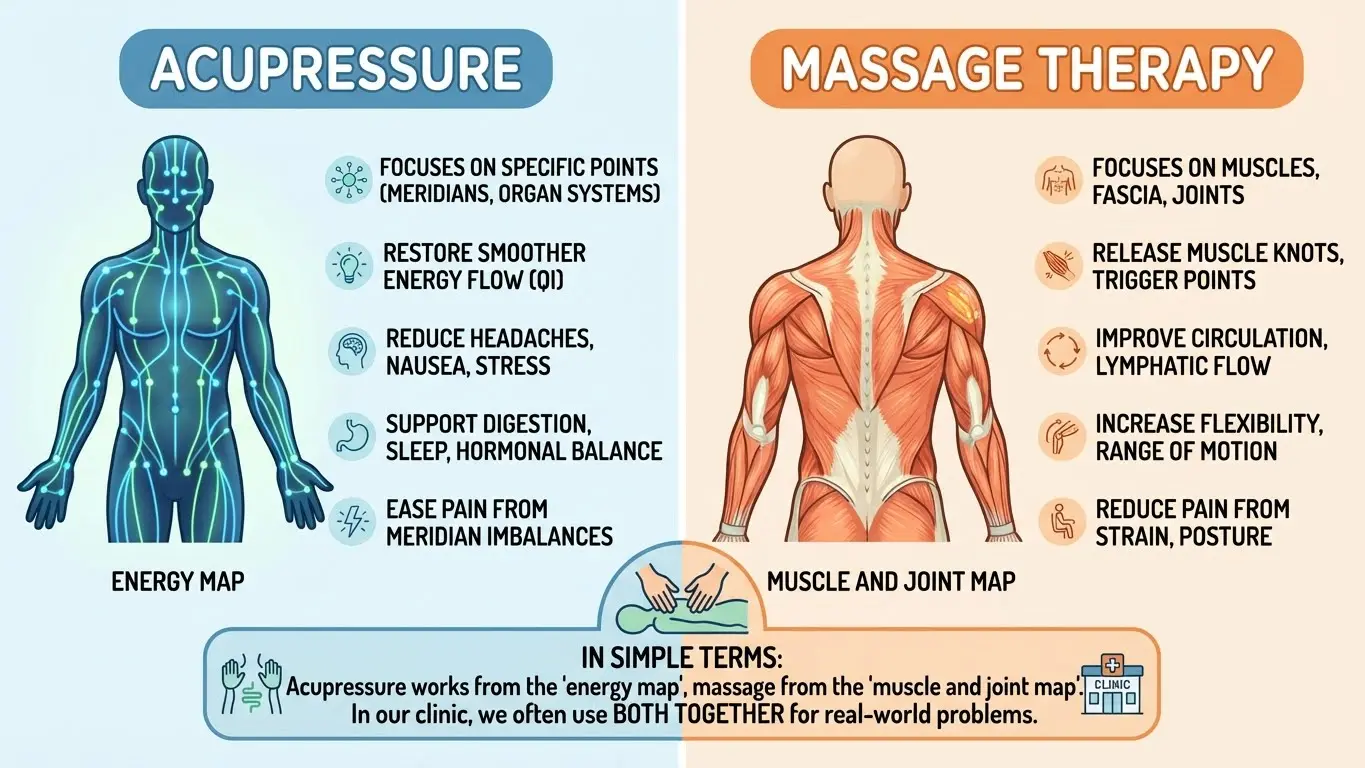
- Core difference: acupressure applies sustained pressure to specific points; massage works broadly across muscles and soft tissue with strokes, kneading, and compression.
- Session feel: acupressure is typically done clothed, with stillness on points; massage usually involves oils or lotion and continuous movement.
- Best fits: acupressure suits point-specific complaints like tension headaches and nausea; massage suits widespread muscle tightness and general relaxation.
- Evidence: both have supportive but modest research bases; neither has been shown to meaningfully alter hormones, organs, or lymphatic flow.
- They combine well: many patients use massage for general tension and acupressure or acupuncture for specific, stubborn complaints.
Origins and Background
Acupressure comes from Traditional Chinese Medicine, sharing acupuncture’s point map and meridian framework but using pressure instead of needles. Massage therapy, in its modern Western form, developed from Swedish massage and related soft-tissue traditions, focusing on muscles, fascia, and circulation through direct manual techniques. Different lineages, different logic, overlapping benefits.
What Each Therapy Primarily Focuses On
Acupressure is point-specific. A session targets a small set of points chosen for your complaint: LI4 and GB20 for a tension headache, PC6 for nausea, a sequence of points for stress. The practitioner holds each point with steady pressure, often for a minute or two, and the session has a quiet, still quality.
Massage therapy is tissue-broad. The therapist works across muscle groups with effleurage (gliding strokes), petrissage (kneading), compression, and stretching, aiming to reduce overall muscle tension, improve comfort, and promote relaxation. It is the better choice when everything is tight and you cannot name a single spot.
How the Techniques Differ in Practice
In an acupressure session you typically remain fully clothed, lying or seated, while the practitioner applies thumb, finger, or elbow pressure to points, sometimes with small circular motions. In a massage session you usually undress to your comfort level under draping, and the therapist uses oils or lotion with continuous flowing strokes. Acupressure sessions often run 30 to 45 minutes; massage commonly runs 60 to 90.
Tools and Equipment
Acupressure needs almost nothing: hands, and optionally simple tools like balls or blunt-tipped pens for self-care. Massage therapy uses a table, oils or lotions, and sometimes hot stones, cups, or percussive devices depending on the modality. Neither requires elaborate equipment, which is part of why both are so accessible.
What Conditions Each Commonly Addresses
Acupressure is most often used for tension headaches, nausea and motion sickness, stress and difficulty winding down, jaw tension, and as self-care between acupuncture visits. Massage is most often used for widespread muscle tightness, post-exercise soreness, general stress relief, and the simple human need to be worked on after a hard month. For specific nerve symptoms, pronounced weakness, or pain with a concerning pattern, both take a back seat to medical evaluation.
Pain Management: How They Compare
For localized, point-like complaints, a tension headache, a stubborn knot with a clear epicenter, acupressure’s specificity is an advantage. For diffuse muscular pain and postural tightness, massage’s broad coverage usually accomplishes more per session. Research supports both for short-term pain and tension relief, with modest effect sizes; neither has strong evidence for lasting structural change. Anyone claiming either therapy purges the body, rebalances hormones, or decompresses nerves is overstating what the science shows.
Stress Relief and Emotional Support
Both help people downshift, through different doors. Massage’s continuous touch and warm, unhurried setting reliably promote relaxation. Acupressure’s stillness and focused breathing create a meditative quality many anxious patients prefer. The honest truth is that a meaningful share of the benefit from either is the nervous system responding to safe, attentive touch and an hour without demands. That is a real benefit, even if it is not a mystical one.
Should You Choose Acupressure or Massage?
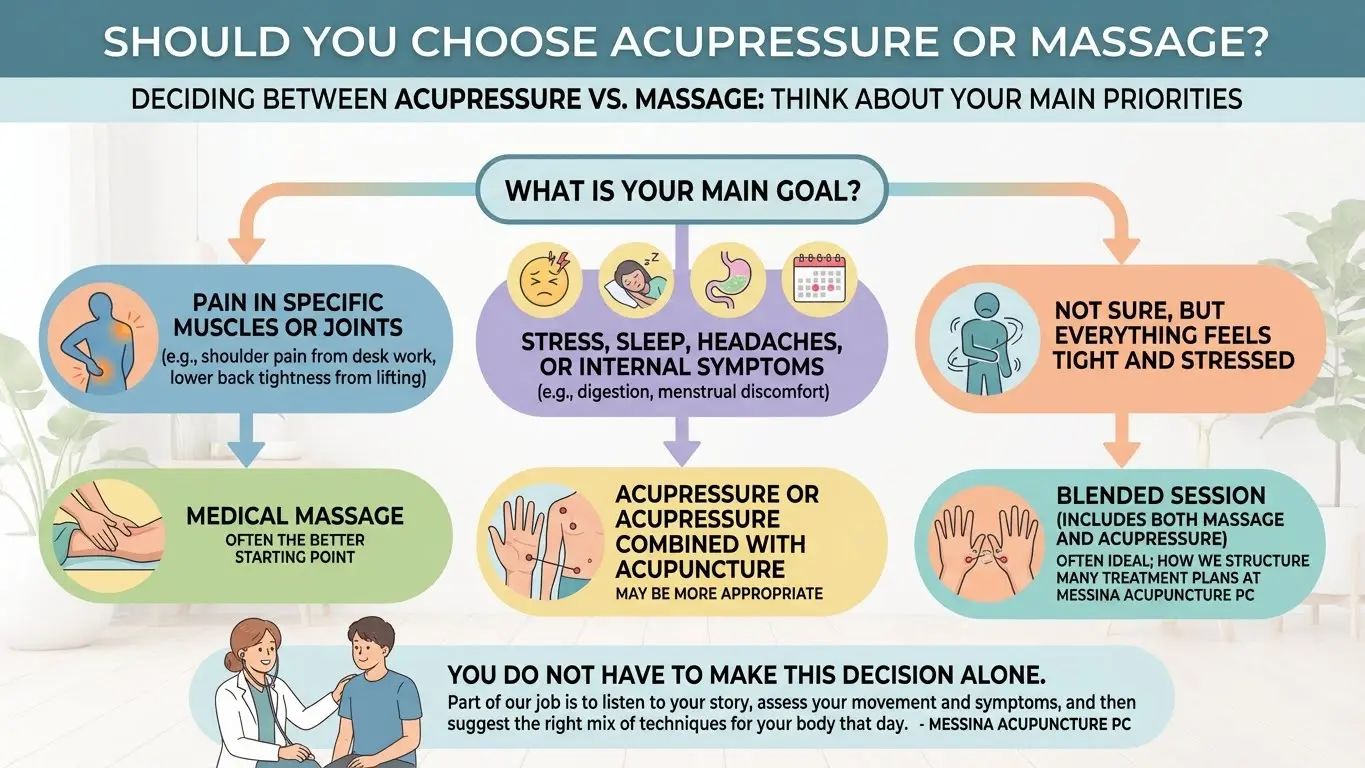
Choose acupressure when your complaint is specific: headaches with a pattern, nausea, jaw tension, or stress you want a self-care tool for. Choose massage when your whole body feels tight, after heavy physical effort, or when you simply want broad relaxation. Choose medical evaluation first for new severe pain, numbness, weakness, or symptoms that do not fit a muscular pattern. And consider combining them: massage for the general layer, acupressure or acupuncture for the specific stubborn spots.
How We Combine Approaches at Messina Acupuncture
Our clinic’s work centers on acupuncture and acupressure, and we build self-acupressure routines into most plans. When a patient’s picture calls for broad soft-tissue work, we say so and refer to trusted local massage therapists, because the right referral beats the wrong treatment. Blended care, each modality doing what it does best, consistently outperforms loyalty to any single approach.
The evidence: supportive, modest, and honest
Both modalities have small-to-moderate trial support for short-term pain, tension, and stress relief, and both suffer from the same research limitations: small samples, hard-to-blind treatments, and short follow-ups. What the evidence does not show for either: meaningful changes to hormones, internal organ function, lymphatic flow, or nerve compression. We describe both as useful comfort and symptom measures with real but limited effects. The NCCIH provides a balanced overview of needling and pressure therapies.
Tell us the whole picture
At a consultation we map whether your complaint is point-specific, widespread, or something needing medical evaluation first.
Targeted in-office care
Acupuncture and acupressure address the specific patterns; we refer to trusted massage therapists when broad soft-tissue work fits better.
Self-care between visits
You leave with a short point routine for flare-ups, so progress does not depend entirely on appointments.
Licensed, and honest about scope. Messina Acupuncture is a licensed New York practice focused on acupuncture and acupressure. When massage is the better tool, we refer to qualified local therapists rather than stretching our scope. Verify any acupuncturist through the New York State Office of the Professions.
Neither acupressure nor massage should delay medical evaluation for new or worsening numbness or weakness, severe or unrelenting pain, chest symptoms, unexplained swelling, or any symptom that feels wrong. Avoid deep pressure over blood clots, fractures, acute injuries, skin infections, or varicose veins, and tell any practitioner about blood thinners, pregnancy, and medical devices.
Frequently Asked Questions
Is acupressure painful?
It should feel like a firm, achy “good hurt,” about a 5 out of 10, never sharp or breath-holding. Tell the practitioner if pressure is too much; more pain does not mean more benefit.
How many sessions will I need?
For a specific complaint, many people assess acupressure over 3 to 4 sessions; for general tension, massage benefits are usually felt immediately but are shorter-lived. Persistent issues deserve a professional assessment.
Can I receive massage and acupressure in the same plan?
Yes, and they complement each other well: massage for broad muscular tension, acupressure or acupuncture for specific stubborn complaints.
I’ve never tried either. Which should I try first?
If you can point to the problem, start with acupressure. If everything aches and you want to unwind, start with massage. Either way, a consultation can point you correctly.
Will massage or acupressure fix my posture or alignment?
No. Both ease muscular tension and discomfort, which can make good posture easier, but neither structurally realigns the body. Persistent postural pain deserves assessment, not just rubbing.
Do you offer massage at your clinic?
Our clinic focuses on acupuncture and acupressure. When broad soft-tissue massage is the better fit, we refer to trusted local massage therapists.
Not Sure Which Hands-On Care Fits? Ask Us
Describe what you are feeling and what you have tried, and we will give you a straight recommendation: acupressure, acupuncture, massage with a trusted local therapist, or a medical evaluation first. The right starting point matters more than the modality.
Messina Acupuncture PC
100 N Country Road, East Setauket, NY 11733