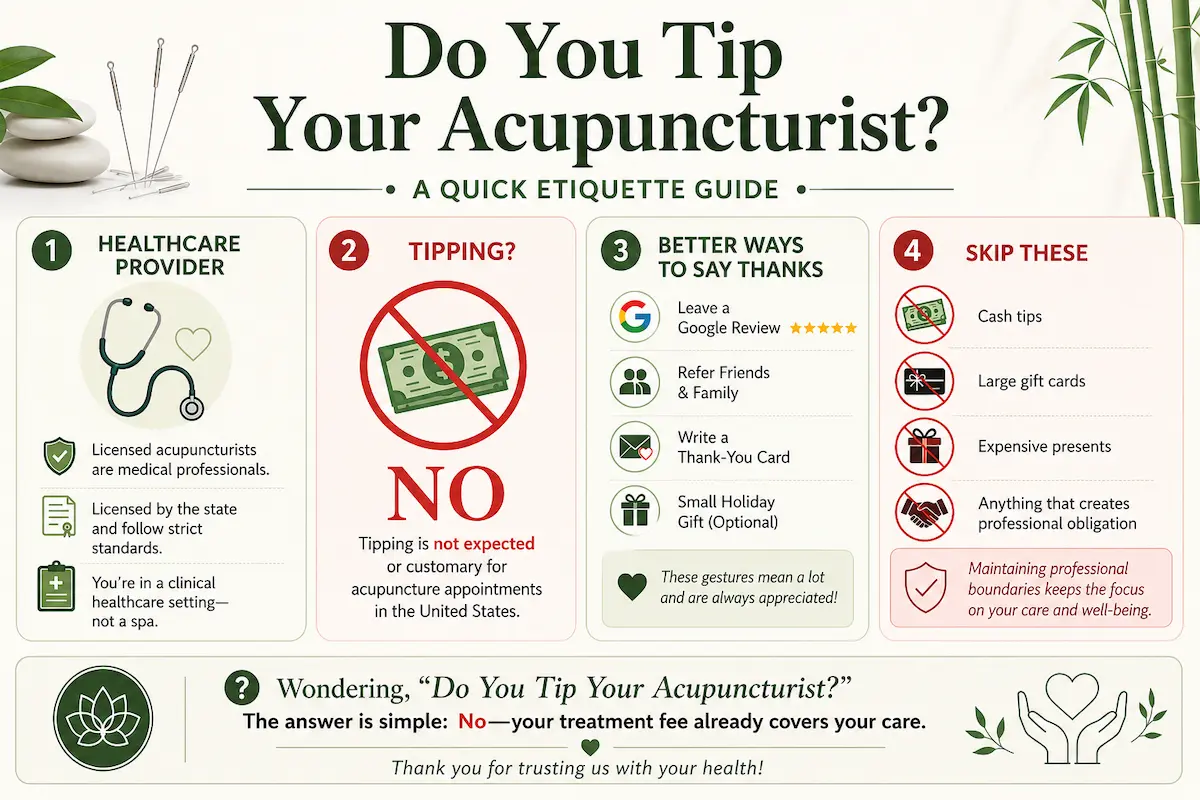
If you are wondering, “do you tip your acupuncturist?” the short answer is no, you do not tip your acupuncturist.
A patient at our Setauket office wrapped up her first session last week, walked to the front desk, and quietly asked our team this very question. She is not the only one. We hear this question almost every week from new patients on the North Shore, especially those who are coming to acupuncture from a background of regular massage, spa visits, or salon appointments. The longer answer of why that is, how acupuncture payment actually works, and what to do instead if your treatment really helped, is what this guide is for.
Key Takeaways
- Acupuncturists are licensed healthcare providers, not service or hospitality workers, so tipping is not customary or expected in the United States.
- Insurance, cash, and package payments are handled at the front desk the same way you’d settle a bill at a physical therapist’s or chiropractor’s office.
- Holiday gifts, if you’d like to give one, should be small and personal, a card, baked goods, or a thoughtful note. Cash is not appropriate.
- The most valuable “thank you” you can give your acupuncturist is a Google review and a referral to a friend, family member, or neighbor.
- Standards of conduct from the National Certification Commission for Acupuncture and Oriental Medicine (NCCAOM) reinforce the clinical, healthcare-provider framing of the profession.
- At Messina Acupuncture in Setauket, you will never see a tip line on your receipt or be prompted for one at checkout.
Why So Many Patients Wonder About Tipping
Acupuncture sits in a strange middle space in the American mind. The treatment involves hands-on contact, a private room, soft lighting, and what feels to a first-time patient a lot like a spa appointment. If your prior reference point for any kind of “needle and table” experience was a massage at a wellness center in Port Jefferson or a facial in Stony Brook, the instinct to tip is completely understandable. You are simply applying the rules of a service economy you already know.
The confusion is compounded by the fact that acupuncture clinics vary widely in how they present themselves. Some lean into the spa aesthetic. Others, like our Setauket practice, present as a medical office: licensure displayed on the wall, treatment notes in your chart, insurance billed when appropriate. Both can deliver excellent care, but the framing matters because it shapes what patients expect at the front desk.
Massage Therapy vs. Acupuncture: Not the Same Profession
The cleanest way to think about this is by comparison. Licensed massage therapists, when they work in a spa setting, are part of a hospitality and personal-services economy where 15 to 20 percent gratuity is standard. That is the social contract of that environment, and good massage therapists earn every dollar of it.
Acupuncture is a different profession with different training, different regulation, and a different payment structure. In New York State, a licensed acupuncturist (L.Ac.) completes a master’s-level program of roughly 2,000 to 3,000 clinical and didactic hours, passes board examinations administered by the NCCAOM, and operates under the Office of the Professions just like a physical therapist, audiologist, or dentist. We bill insurance, we maintain medical records, and we operate inside a clinical scope of practice. That regulatory framework is also why you do not tip your physical therapist or chiropractor and the same logic applies to your acupuncturist.
The Healthcare Provider Framing
The single most useful mental shift, if you are a new patient, is this: think of acupuncture the way you think of physical therapy or chiropractic care.
You would not tip your PT after a dry-needling session or your chiropractor after an adjustment. Acupuncture sits in the same regulatory and clinical category. The National Center for Complementary and Integrative Health (NCCIH) classifies acupuncture as a clinical intervention, with growing evidence for low back pain, neck pain, knee osteoarthritis, tension headaches, and migraine prevention. Medicare even covers acupuncture for chronic low back pain under specific conditions, as outlined on Medicare.gov. When a treatment is covered by Medicare, it is by definition a medical service, not a personal-services purchase.
What Licensure Actually Means
In New York, an acupuncturist’s title L.Ac. is regulated by the state. We must hold an active license, carry malpractice insurance, document treatment plans, take continuing education, and follow a written code of professional ethics. The American Society of Acupuncturists and NCCAOM both publish ethics standards that emphasize the clinical, patient-first nature of the work and the boundaries that come with being a healthcare provider.
That clinical framing is also why, at our Setauket office, you fill out an intake form, your session is documented in a chart, and your acupuncturist may coordinate with your PCP or referring physician. None of those things happen at a spa.
How Acupuncturists Actually Get Paid
If tipping is not the answer, you may wonder how acupuncturists are compensated especially since insurance coverage for acupuncture is notoriously uneven on Long Island.
In most Long Island practices, payment comes through three main channels:
- Insurance. When your plan covers acupuncture (no-fault auto, certain commercial plans, some Medicare beneficiaries with qualifying chronic low back pain), your acupuncturist submits a claim and is paid by the carrier. You pay your copay or coinsurance at the desk.
- Cash or self-pay. Many patients pay out of pocket per visit. The fee is set by the practice and is what your acupuncturist’s time, expertise, supplies, and overhead actually cost.
- Treatment packages. A common option in clinical acupuncture: you prepay a bundle of sessions at a discount per visit. This reflects the reality that most musculoskeletal conditions respond best to a course of treatment, not a single session.
In all three cases, the fee already includes the acupuncturist’s compensation. There is no “service tip” piece that is being withheld and made up by gratuity, the way it might be at a restaurant. For more on the insurance side of the question, our guide on whether acupuncture is covered by insurance walks through how Long Island patients can verify their own benefits.
Why Practices Don’t Have a Tip Line
If you have ever bought a coffee or a haircut in the last few years, you’ve seen the screen flip around with suggested tip amounts of 15, 20, and 25 percent. The reason you don’t see that at a healthcare practice is regulatory and ethical, not just stylistic. Healthcare billing has to map cleanly to services rendered that’s what insurance carriers, the IRS, and state regulators expect. A gratuity line muddies that, and most clinical software simply doesn’t include it.
Holiday Gifts and Thank-Yous: What’s Appropriate
The “no tipping” rule does not mean you can’t show appreciation. Patients, particularly long-term patients who have come to us through a difficult chronic pain journey or a postpartum recovery sometimes want to mark the holidays or a milestone with something thoughtful, and that is genuinely lovely. Here is the etiquette.
What Is Welcome
- A handwritten card, especially around the holidays or after a meaningful clinical outcome.
- Baked goods, a plant, a small box of tea, or a similarly modest gift shared with the whole front-desk and clinical team.
- A homemade or hand-picked item produced from your garden, a book you think your practitioner would enjoy, a piece of art.
- An update on how you are doing months after wrapping up a course of care.
What to Avoid
- Cash, gift cards in significant amounts, or anything that resembles a tip dressed up in wrapping paper.
- Expensive gifts. NCCAOM ethics standards and most practice policies cap or discourage high-value gifts to protect the clinical relationship.
- Anything that would make the practitioner feel obligated to alter your treatment plan or give you priority scheduling.
When in doubt, a card with a note about what changed for you is more meaningful than any gift. We genuinely save those.
Practical Etiquette Tips at Your Setauket Appointment
Tipping is one of several “how does this work?” questions new patients have. A few practical notes that smooth out the first visit at our office on 100 N Country Road:
- Arrive 10 to 15 minutes early on your first visit. You will fill out a medical intake health history, current medications, prior procedures, and the specifics of your chief complaint. This is the same paperwork you would expect at any new healthcare office.
- Wear loose, comfortable clothing. Many of our musculoskeletal treatments target points on the lower legs, forearms, and back, so easy access to those areas saves time. We have gowns and drapes when needed.
- Eat a light meal 1 to 2 hours before. Coming in fasting can make some patients lightheaded during or after treatment. There is more guidance in our post on how often you should get acupuncture, including how nutrition, sleep, and stress affect treatment response.
- Bring your insurance card. Even if you plan to self-pay, we can verify benefits for future sessions and let you know if any portion of your care is reimbursable.
- Phones are silent in the treatment room. Once the needles are placed, most patients rest for 20 to 30 minutes. This is part of the parasympathetic shift that gives acupuncture much of its calming effect, silencing your phone protects it.
- No tip prompts at checkout. When you settle up, the receipt will show your session fee, any insurance adjustment, and your balance. That is it.
For the full list of common new-patient questions, our frequently asked questions page covers timing, modesty, needle sensation, and what to do between sessions.
How to Genuinely Thank Your Acupuncturist
If your acupuncturist has helped you, really helped you, the kind of help where your shoulder is working again or your tension headaches have eased, there are two things that mean more to a small practice than any gift.
Leave a Google Review
For an independent healthcare clinic, Google reviews are oxygen. They help other Setauket, Stony Brook, and East Setauket residents who are searching at 9 p.m. with their back in spasm find a clinic they can trust. A specific, sentence-or-two review describing your situation and how the treatment helped is dramatically more useful than five stars and no words. It also reflects the NCCAOM’s emphasis on truthful representation, your honest story is the most credible signal a clinic can earn.
Refer Someone Who Needs It
The patients who change a small practice the most are the ones who tell their sister, their CrossFit coach, their PCP, and their neighbor. If you know someone struggling with the kind of pain you came in with, a long-running low back issue, post-surgical recovery, TMJ, headaches pass along the number. Referrals from satisfied patients are how clinics like ours stay rooted in the community.
When to See a Licensed Acupuncturist
Tipping etiquette is the kind of question patients usually ask after a successful first visit. If you have not had that first visit yet, the right question is: when should you book one?
You are a reasonable candidate for an acupuncture consult if you have:
- Chronic neck, back, or joint pain that hasn’t responded to standard care.
- Tension headaches or migraine patterns that disrupt work or sleep.
- TMJ pain, jaw tension, or facial pain.
- Stress-related symptoms that are physically expressed, clenching, shallow breathing, sleep disturbance.
- A post-injury or post-surgical recovery that has plateaued.
- Persistent pain after a motor vehicle accident, New York no-fault often covers acupuncture in this scenario.
A consult is not a commitment. We will look at your history, examine the area of complaint, explain what an acupuncture course of care typically looks like for your condition, and tell you honestly whether we’re the right next step or whether a referral to PT, your PCP, or another specialist makes more sense. The full list of conditions we treat is on our services page.
Frequently Asked Questions
Do you tip your acupuncturist in the United States?
No. In the U.S., acupuncturists are licensed healthcare providers, not personal-services or hospitality workers. The standard expectation is the same as it is with a physical therapist, chiropractor, or dentist. You pay the session or copay and that is the entire transaction.
Is it different if my acupuncturist works inside a spa?
The setting can confuse the question, but the rule still follows the credential. If the person treating you is a licensed acupuncturist (L.Ac.), tipping is not expected. If you are getting a massage from a licensed massage therapist (LMT) at the same location, a tip for the massage portion is customary in a spa setting.
What about a holiday gift?
A small, modest gift: a card, baked goods, tea, a plant is welcome and appreciated. Avoid cash, large gift cards, or anything expensive enough to feel like an obligation. A thoughtful note about how treatment has helped you is the most meaningful gift of all.
What if I had an exceptional experience and really want to give more?
Leave a detailed Google review and refer to a friend or family member who is struggling with a condition your acupuncturist helped you with. Both of those are worth dramatically more to an independent practice than any tip ever could be.
Does Messina Acupuncture accept tips at all?
No. Our checkout process and our receipts do not include a tip option. Your bill reflects the clinical fee, any insurance adjustment, and your balance, nothing else.
Is tipping common in other countries?
In Japan, Korea, mainland China, and most of Europe, tipping a healthcare provider is not customary and can occasionally be seen as inappropriate. The “should I tip?” The question is largely an American phenomenon driven by U.S. service-economy norms not by anything specific to acupuncture as a discipline.
Ready to Book at Messina Acupuncture
If you have been wondering about tipping, you are almost certainly thinking about booking your first session or you just finished a great one and want to know how to thank us. Either way, we would love to see you.
We are at 100 N Country Road in Setauket, serving North Shore patients from East Setauket, Stony Brook, Port Jefferson, Three Village, and across Suffolk County. Call 631-403-0504 to schedule a first visit, or learn more about the team and our approach. No tip required just bring your story and your goals.