
If you live in Setauket and suffer from migraines, you know that calling it “just a headache” is an insult. A migraine is a neurological event. It is the sensitivity to light that forces you to retreat to a dark room, the nausea that makes it impossible to eat, and the throbbing pain behind one eye that can steal days of your life at a time.
For many patients, the standard route of care involves a cocktail of triptans (like Imitrex), NSAIDs, or even preventative Botox injections. While these can help, they often come with side effects or diminishing returns. This leaves many asking: “Is there a way to treat the root cause of the trigger without more medication?”
The answer gaining traction in the medical community is Dry Needling. But how can a needle in your neck stop a pain in your brain?
At Messina Acupuncture, we specialize in treating the neuromuscular triggers of migraines. In this comprehensive guide, we will explore the anatomy of the Trigeminal Cervical Complex, the specific muscles that refer pain to your head, and the rigorous clinical evidence supporting dry needling as a powerful tool for migraine relief.
The Anatomy of a Migraine: It’s Not Just in Your Head
To understand why dry needling works, you have to understand where the pain signal comes from. Most people think migraines start in the brain. However, current research suggests a massive component of migraine pathology begins in the Neck.
The Trigeminal Cervical Complex (TCC)
This is the “Grand Central Station” of head pain. The TCC is a cluster of nerves in your brainstem where sensory input from your face (Trigeminal Nerve) and sensory input from your upper neck (C1-C3 spinal nerves) converge.
The Glitch: Because these nerve pathways cross, the brain gets confused. If you have a tight trigger point in your upper neck (Trapezius or Suboccipital muscles), it sends a constant “danger” signal to the TCC. The brain misinterprets this neck pain as head pain, triggering the migraine cascade. This is called Referred Pain.
Sensitization
When these muscles are chronically tight (from stress, posture, or injury), they bombard the TCC with nociceptive (pain) signals. Eventually, the TCC becomes sensitized. This means it creates a hair-trigger response. Suddenly, things that shouldn’t hurt—like a change in barometric pressure, a glass of wine, or a bright light—trigger a massive pain response. Dry needling aims to calm this sensitization by removing the peripheral input from the neck.
What is Dry Needling for Migraines?
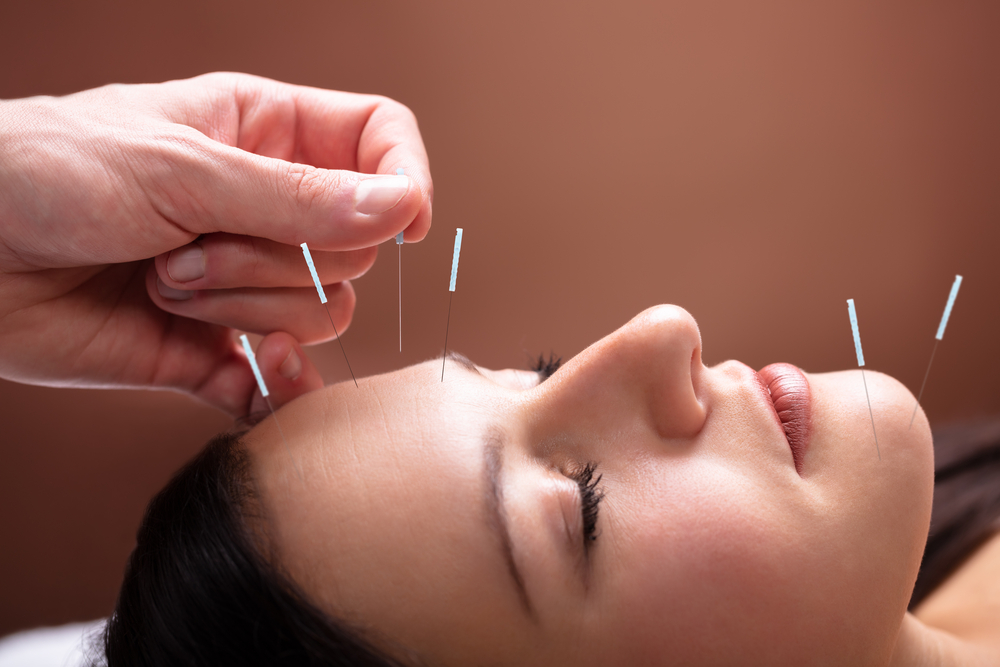
Dry Needling is a targeted therapy where a licensed practitioner inserts a thin, solid filament needle directly into a Myofascial Trigger Point within the muscle. It is different from acupuncture, which focuses on holistic energy flow (Qi). Dry needling focuses on the mechanical release of muscle knots.
The Goal: The Local Twitch Response
When the needle hits the trigger point in your neck or shoulder, it elicits a Local Twitch Response (LTR). This involuntary muscle contraction does three things:
- Mechanical Reset: It forces the contracted muscle fibers to lengthen and relax, instantly taking tension off the vertebrae and nerves.
- Chemical Flush: It restores blood flow to the hypoxic (oxygen-starved) tissue, flushing out inflammatory chemicals like Substance P and CGRP (Calcitonin Gene-Related Peptide), which are known migraine triggers.
- Neurological Downregulation: By resolving the constant pain signal from the neck, it lowers the volume on the TCC, making your brain less likely to trigger a migraine in the future.
The “Migraine Muscles”: Where We Needle
Migraine patterns are predictable. Specific muscles refer pain to specific parts of the head. During your session at Messina Acupuncture, we map your pain to these common culprits.
1. Upper Trapezius
Referral Pattern: The classic “Question Mark” pattern. Pain starts at the base of the neck, travels up the side of the head, and curls around to the eye/temple. The Treatment: We needle the bulky part of the shoulder to release the tension pulling on the skull base.
2. Sternocleidomastoid (SCM)
Referral Pattern: This strap-like muscle on the front of the neck is a notorious migraine mimicker. It refers pain deep into the eye, over the eyebrow, and can even cause dizziness, ear fullness, or nausea. The Treatment: Careful pincer-grip needling of the SCM can often resolve “sinus” or “eye” headaches instantly.
3. Suboccipitals
Referral Pattern: These tiny muscles connect the base of the skull to the top vertebrae. Tightness here feels like a vice grip around the head (“band-like” pain). The Treatment: Precise needling at the base of the skull reduces the compression on the Occipital Nerves.
4. Temporalis
Referral Pattern: Pain in the temples and teeth, often associated with jaw clenching or TMJ issues. The Treatment: Needling the temple muscles can stop the localized throbbing associated with stress migraines.
Scientific Evidence: Does It Work?
We believe in evidence-based care. The research on dry needling for headaches is robust and growing.
Reduced Frequency and Intensity
A 2021 Systematic Review and Meta-Analysis published in the journal Physical Therapy (PTJ) analyzed 11 randomized controlled trials regarding dry needling for tension-type headaches and migraines. The researchers concluded that dry needling significantly reduced headache frequency and health-related disability in the short term compared to other interventions.
Furthermore, this analysis highlighted that dry needling is particularly effective for Tension-Type Headaches, often reducing the intensity of pain by resolving the muscular component that “feeds” the headache loop.
Dry Needling vs. Medication
While medication treats the chemical outcome of a migraine, dry needling treats the mechanical trigger. Many of our patients find that a course of dry needling allows them to reduce their reliance on abortive medications (like Excedrin or Triptans), sparing their stomach and liver from long-term side effects.
What to Expect During a Session
If you have never had dry needling, the idea of needles near your head might sound intimidating. Here is exactly what happens at our Setauket clinic.
- Palpation: We start by mapping your triggers. We will press on specific muscles in your neck and ask, “Does this reproduce your headache?” When we find the spot that recreates your specific pain pattern, we know we have found the source.
- Insertion: We gently tap the thin filament needle into the muscle. You typically do not feel the insertion itself.
- The Release: We guide the needle to the trigger point to elicit the “twitch.” This may feel like a deep ache or a quick cramp. It is a strange sensation, but deeply satisfying because you can feel the tension melting.
- Post-Care: After needling, we may use medical massage or heat to flush the area and reduce soreness.
Safety and Side Effects
Dry needling is generally very safe, but when treating the head and neck, precision is vital. This is why seeing a highly trained expert is non-negotiable.
Common Side Effects:
- Soreness: It is normal to feel like you had a heavy workout in your neck muscles for 24 hours.
- Bruising: Minor hematomas can occur.
- Fatigue: The release of tension can be exhausting for the nervous system.
The Safety Difference: In New York, Licensed Acupuncturists (L.Ac) undergo thousands of hours of training, including detailed anatomy of the cervical spine and skull. We know exactly where the nerves and arteries are to ensure your safety.
Who Is a Good Candidate?
Dry needling is not for every migraine sufferer, but it is highly effective for specific types:
- Cervicogenic Headaches: Headaches that clearly start in the neck and move up.
- Tension-Type Migraines: Migraines triggered by stress, computer work, or driving.
- Chronic Migraineurs: People who have 15+ headache days a month and have “failed” on standard medications.
Note: If your migraines are strictly hormonal (menstrual migraines) or purely vascular, we may recommend Traditional Acupuncture instead to balance the endocrine system.
Why Setauket Residents Choose Messina Acupuncture
We treat patients from Stony Brook University Hospital, teachers, and professionals across the North Shore who cannot afford to lose another day to a migraine. We pride ourselves on a comprehensive approach—we don’t just chase the pain; we look at your posture, your stress levels, and your mechanics to solve the puzzle.
We combine the precision of Dry Needling with the holistic wisdom of Acupuncture to give you the best chance at a pain-free life.
See Our 5-Star Reviews on Google
Frequently Asked Questions (FAQ)
Will dry needling trigger a migraine?
In rare cases, releasing a trigger point can momentarily trigger a referral headache. However, this usually subsides quickly and is followed by profound relief. We start gently to gauge your sensitivity.
How many sessions will I need?
Most migraine patients notice a difference in neck tension after the first session. For lasting reduction in migraine frequency, we typically recommend a course of 4 to 6 weekly sessions.
Can I combine this with Botox?
Yes. Botox paralyzes the muscle to prevent contraction. Dry needling releases the existing knots that Botox might miss. They work via different mechanisms and can be complementary.
Stop the Cycle of Pain Today
You do not have to live in fear of the next storm. If your neck feels like a rock and your head feels like a drum, it is time to address the muscular triggers directly.
We are conveniently located to serve Setauket, Port Jefferson, and Stony Brook:
Messina Acupuncture 100 N Country Road, Setauket, NY 11733
Ready to turn off the pain signal? Contact us today or call (631) 403-0504 to schedule your consultation.