
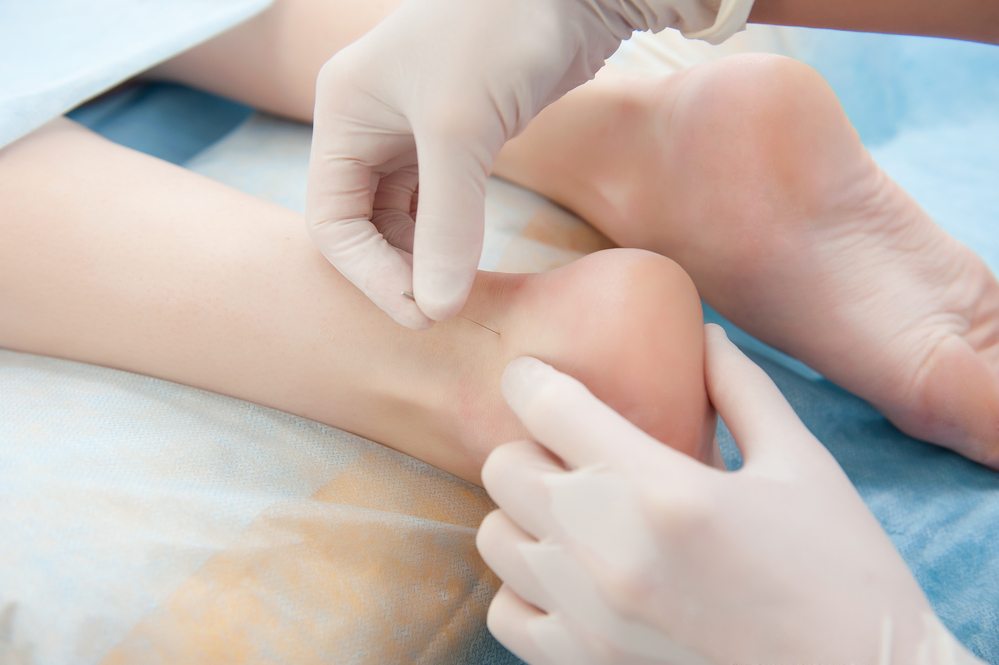
There is a specific, dread-inducing moment that people with Plantar Fasciitis know all too well: The First Step of the Morning.
You wake up, swing your legs out of bed, and the moment your heel touches the floor, a sharp, stabbing pain shoots through your foot. It feels like stepping on a nail or a jagged piece of glass. You hobble to the bathroom, gripping the wall for support. As the day goes on, the sharp pain might dull to a deep ache, only to return with a vengeance after you sit for lunch or drive home from work.
If you are a nurse at Stony Brook University Hospital on your feet for 12 hours, a runner hitting the trails on the Setauket Greenway, or a teacher in Port Jefferson standing all day, this condition can bring your life to a screeching halt. Standard treatments often involve ice, orthotic inserts, or painful cortisone shots. But what if the problem isn’t just “inflammation”? What if it’s a mechanical failure in the kinetic chain?
At Messina Acupuncture, we use a combination of Traditional Acupuncture and Dry Needling to treat the root cause of the tension, not just the symptom in your heel. In this comprehensive guide, we will explore the anatomy of the foot, the hidden danger of steroid injections, and the science of how needles can physically remodel your connective tissue.
Anatomy 101: What is the Plantar Fascia?
The Plantar Fascia is not a muscle; it is a thick, fibrous band of connective tissue (fascia) that runs from your heel bone (calcaneus) to your toes. It acts as the “bowstring” of your foot, supporting the arch and absorbing the massive shock of every step you take.
Shutterstock
Fasciitis vs. Fasciosis: A Critical Distinction
For years, doctors called this condition “Plantar Fasciitis.” The suffix -itis implies inflammation. This is why you are typically prescribed Ibuprofen, Ice, and Rest.
However, modern medical research has shifted our understanding. We now know that in chronic cases (pain lasting longer than 3 months), there is very little active inflammatory tissue. Instead, the tissue is degrading. The collagen fibers are fraying, disorganized, and dying due to a lack of blood flow. The correct medical term for this is Plantar Fasciosis (degeneration).
Why does this matter? Because anti-inflammatory drugs do not fix degeneration. To fix degenerated tissue, you need to stimulate angiogenesis (new blood vessel formation) and collagen synthesis. This is exactly what acupuncture is designed to do.
The Kinetic Chain: The Problem Isn’t Just Your Foot
One of the biggest mistakes in treating heel pain is looking only at the heel. The Plantar Fascia is part of a continuous line of connective tissue called the Superficial Back Line, which runs from your toes, up your calves, up your hamstrings, and all the way to your skull.
In 90% of the cases we see at our Setauket clinic, the root cause is Tight Calves (specifically the Gastrocnemius and Soleus muscles). When these muscles are shortened and tight, they pull on the Achilles tendon. The Achilles tendon pulls on the heel bone. The heel bone pulls on the Plantar Fascia.
Imagine wearing a hoodie. If someone pulls down hard on the hood, the fabric at your throat gets tight. You can rub your throat all day, but until the person lets go of the hood, the tension remains. Treating the foot without treating the calf is like rubbing your throat while the hood is still being pulled.
Mechanism 1: Dry Needling (Releasing the Tension)
To stop the “tug-of-war” on your heel, we must release the calf muscles. We use Dry Needling to target Trigger Points in the lower leg.
How It Works:
- We insert a thin filament needle into the tight bands of the Gastrocnemius and Soleus muscles.
- This elicits a Local Twitch Response. The muscle jumps involuntarily and then immediately lengthens.
- This creates mechanical slack in the system. The tension on the Achilles tendon drops, which instantly reduces the tension on the Plantar Fascia.
A 2014 randomized controlled trial published in the journal Physical Therapy (Cotchett et al.) found that dry needling provided statistically significant reductions in plantar heel pain compared to sham needling. By treating the muscle, we save the tendon.
Mechanism 2: Electro-Acupuncture (Stimulating Repair)
Once we have released the mechanical tension, we need to fix the damaged tissue in the foot itself. The Plantar Fascia has a notoriously poor blood supply (which is why it takes months to heal). We use Electro-Acupuncture to change that environment.
The Process:
- We place needles locally in the heel and arch (using points like Kidney 3, Bladder 60, and local Ashi points).
- We attach small clips to the needles and run a gentle, rhythmic electrical current through the tissue.
- This stimulation triggers the release of Calcitonin Gene-Related Peptide (CGRP), a powerful vasodilator. It forces blood vessels to open up, flooding the white, starved tissue with oxygen, red blood cells, and nutrients.
This process also stimulates fibroblasts, the cells responsible for building new collagen. We are essentially jump-starting the body’s stalled healing process.
Acupuncture vs. Cortisone Shots: A Warning
Many patients come to us after their doctor has suggested a Corticosteroid injection. While these shots can numb the pain temporarily, they come with significant long-term risks that you should be aware of.
The Rupture Risk: Cortisone is catabolic—meaning it breaks down tissue. Repeated injections weaken the collagen structure of the fascia. A study published in Foot & Ankle International (Acevedo & Beskin) found that steroid injections are associated with a significantly higher risk of Plantar Fascia Rupture (a complete tear) and fat pad atrophy (losing the natural cushion on your heel).
Acupuncture is anabolic—it builds tissue. It may take longer to feel the full result than a numbing shot, but it leaves your foot stronger, not weaker.
What to Expect During a Session at Messina Acupuncture
If the idea of needles in your foot sounds painful, don’t worry. We prioritize your comfort and use specific techniques to minimize sensation.
Step 1: The Calf Release
You will lie face down on the table. We will likely start by needling the calves (Gastroc/Soleus). You will feel a quick twitch (like a muscle cramp that releases instantly). This is usually the most intense part of the session, but it provides the most immediate relief.
Step 2: Local Treatment
We insert thinner, smaller needles into the foot itself. We do not jam needles into the bottom of the painful heel pad (that would hurt!). Instead, we approach from the sides of the foot and the ankle, targeting the nerves that supply the fascia.
Step 3: Medical Massage
We typically finish with medical massage (Tuina) or Gua Sha (scraping) to smooth out the fascia and improve lymphatic drainage.
Essential Tips for Your First Session
Preparing for your first session can make a significant difference in your experience.
- Eat a Snack: Have a light meal 1-2 hours before your appointment. Acupuncture moves blood and lowers blood sugar; coming in on an empty stomach can cause lightheadedness.
- Wear Shorts: Or loose pants that can be pulled up above the knee. We need access to your calves.
- Hydrate: Drink water before and after. Hydrated tissue responds better to the electrical signaling of acupuncture.
Self-Care: Stop Rolling on Golf Balls!
We give all our patients homework. However, much of the advice on the internet is wrong.
The Mistake: Rolling your foot aggressively on a golf ball or frozen water bottle. If your fascia is degenerating (fasciosis), grinding it with a hard object further damages the fraying fibers.
The Fix:
- Calf Stretching: Hang your heels off a step for 30 seconds, 3 times a day. Keep your knee straight to hit the Gastrocnemius, and then bent to hit the Soleus.
- Toe Yoga: Practice lifting just your big toe while keeping the others down. This strengthens the intrinsic foot muscles (like the Flexor Hallucis) that support the arch.
- Night Splints: While annoying to sleep in, keeping your foot flexed at night prevents the fascia from shortening while you sleep (which causes that morning tear).
Why Setauket Residents Choose Messina Acupuncture
We treat the active community of the North Shore. Whether you injured your foot running the trails at West Meadow Beach or standing on the concrete floors of local retail shops in Port Jefferson Village, we understand the biomechanics of your pain.
We don’t just treat the symptoms; we analyze your gait, your footwear, and your posture to ensure the pain doesn’t come back.
See Our 5-Star Reviews on Google
Frequently Asked Questions (FAQ)
How many sessions does it take?
Plantar Fasciitis is stubborn. Most patients need a course of 6 to 10 treatments, usually twice a week for the first few weeks. You should feel a difference in morning stiffness within 3-4 visits.
Does dry needling hurt?
Dry needling the calf can be intense (a deep ache or cramp), but it is very satisfying because the relief is often immediate. Needling the foot is surprisingly gentle because we use specialized micro-needles and avoid the thick skin of the sole.
Can I still run during treatment?
We usually recommend a short period of relative rest (reducing mileage or switching to cycling/swimming) for 2 weeks. Continuing to hammer the damaged tissue while trying to heal it is like picking a scab—it will never heal if you don’t give it a break.
Walk Pain-Free Again
You don’t have to dread that first step out of bed. By combining ancient acupuncture techniques with modern dry needling science, we can help your body repair the damage and restore your stride.
We are conveniently located to serve Setauket, Port Jefferson, and Stony Brook:
Messina Acupuncture 100 N Country Road, Setauket, NY 11733 Phone: (631) 403-0504
Ready to heal your heels? Contact us today to schedule your consultation.