
Acupuncture · History · East Setauket, NY
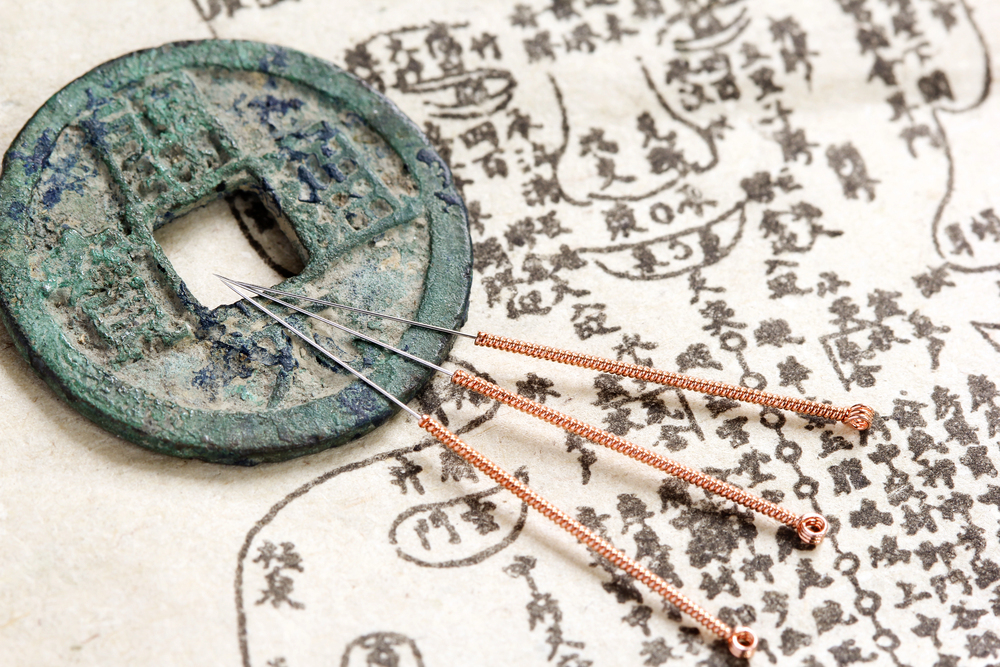
Acupuncture has been practiced for more than 2,000 years, from the courts of imperial China to modern clinics on Long Island. This is the story of how it evolved: the ancient texts, the physicians who shaped it, its slow and skeptical introduction to the West, and the modern science now studying how it works.
Patients sometimes ask us, only half joking, whether acupuncture is ‘real medicine or ancient superstition.’ It is a fair question, and the history is the best answer. Few therapies have been observed, debated, refined, and studied for as long as this one. When you understand the 2,000-year road from sharpened stones to sterile single-use needles, the modern clinic starts to make more sense.
At Messina Acupuncture in East Setauket, we see ourselves as part of that living history: traditional diagnostic thinking combined with modern anatomical knowledge, practiced to current safety standards.
- Ancient roots: the earliest records trace to China’s Zhou Dynasty, with formal documentation beginning in the Han Dynasty and the Huangdi Neijing
- Imperial China: the Tang Dynasty brought structure and new point discoveries, including the work of Sun Simiao, the ‘King of Medicine’
- Spread east: acupuncture reached Korea and Japan by the 6th century, where practitioners developed finer needles and guide tubes still used today
- The American turning point: New York Times reporter James Reston’s 1971 account of acupuncture during Nixon’s China visit sparked US interest
- Today: single-use sterile needles, professional licensing, and a growing body of research on mechanisms and clinical effects
Origins of Acupuncture: The Beginnings in Ancient China
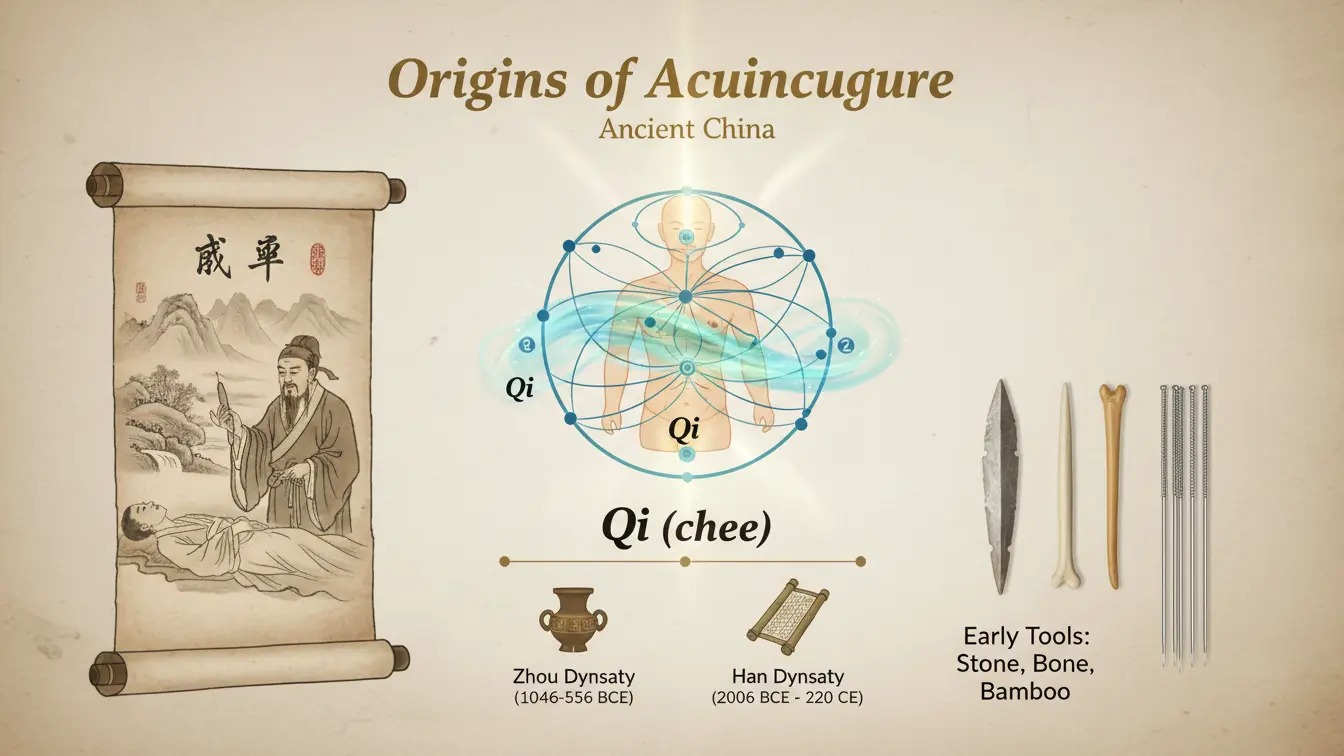
The earliest records of acupuncture date back to the Zhou Dynasty (1046 to 256 BCE) in China, though formal documentation began later, in the Han Dynasty. It evolved within Traditional Chinese Medicine, a system rooted in Taoist philosophy that seeks balance in the body’s energy, or qi (pronounced ‘chee’). The foundational text, the Huangdi Neijing (The Yellow Emperor’s Classic of Medicine), mapped the pathways of qi, the meridians, and described how stimulating specific points could treat various ailments. As a historical note: before stainless steel needles existed, practitioners used sharpened stones, bamboo, and even bone to stimulate points.
Evolution in Imperial China
During the Tang Dynasty (618 to 907 CE), acupuncture became more structured. Scholars documented new techniques, and the famous physician Sun Simiao, known as the ‘King of Medicine,’ helped identify new acupuncture points. Treatment was often combined with herbal medicine, moxibustion (heat therapy), and early needling techniques: an integrated approach that will feel familiar to anyone who has visited a modern clinic.
Spread to Korea and Japan
By the 6th century, acupuncture had spread to Korea and Japan. Japanese practitioners in particular developed distinctive refinements, including much finer, more delicate needles and the use of guide tubes for gentler insertion. Those comfort-focused techniques are still used in clinics today, including ours.
Introduction to the Western World
European missionaries encountered acupuncture in the 1600s, but Western medicine took little serious notice until the 19th century. In 1822, French physician Jean-Nicolas Marjolin began studying it, though skepticism remained high: Western doctors struggled to reconcile qi and meridians with their own anatomical models. That tension between observed effects and unexplained mechanisms would define acupuncture’s Western story for another century.
The 1971 Breakthrough in America
Acupuncture’s American moment arrived in 1971, when New York Times reporter James Reston, covering Nixon’s visit to China, underwent an emergency appendectomy and received acupuncture for post-operative pain. His first-person account of the relief he experienced sparked nationwide curiosity. In the years that followed, research institutions including the NIH began funding studies of acupuncture for pain relief, starting its slow move into mainstream American healthcare.
The Science Behind Acupuncture Today
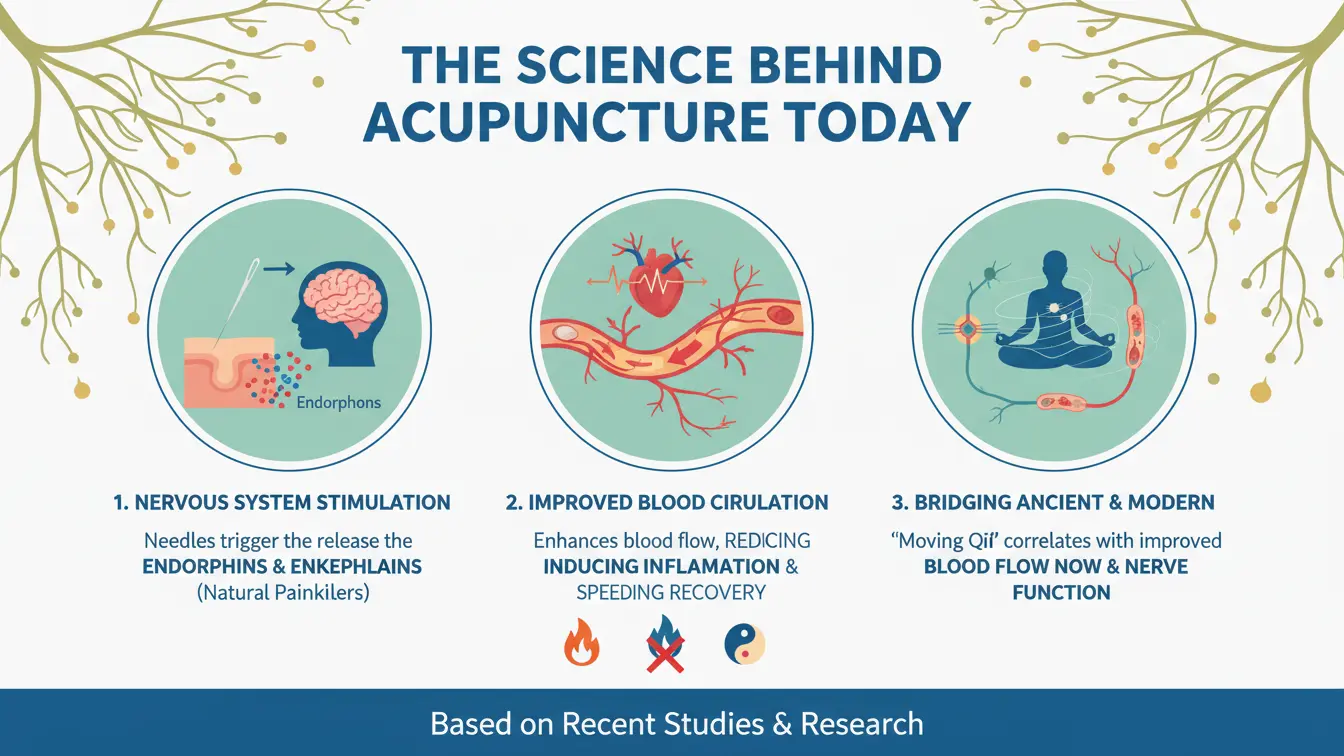
Modern researchers have proposed several mechanisms for acupuncture’s effects. Needle insertion appears to stimulate the nervous system, triggering the release of endorphins and enkephalins, the body’s own pain-modulating chemicals. Studies also suggest improved local blood flow, which may support tissue recovery. Animal research has even identified specific pathways, such as adenosine release at needling sites, that may contribute to pain relief. The ancient idea of ‘moving qi’ and the modern language of nerves and circulation may be describing related phenomena from different centuries.
Acupuncture for Chronic Conditions and Stress
One of acupuncture’s most significant modern roles is in chronic pain care. It is now used as a drug-free option that some patients explore for arthritis, back pain, and fibromyalgia, sometimes as part of broader efforts to reduce reliance on pain medications. Its role in stress care is also growing: by engaging the parasympathetic nervous system, the body’s ‘rest and digest’ mode, acupuncture may help lower the physiological stress response. As always, these are supportive roles within a care plan, not replacements for medical treatment.
Frequently Asked Questions About Acupuncture History
Is modern acupuncture different from ancient styles?
The core principles are similar, but safety standards have transformed. Today we use single-use, sterile stainless steel needles, licensed practitioners, and modern hygiene protocols: a very different experience from the sharpened stones of antiquity.
Do I have to believe in qi for acupuncture to work?
No. Qi is a historical framework for describing observed effects. Modern research discusses nervous system responses, endorphins, and blood flow instead. You can benefit from the physiological effects regardless of which framework you prefer.
How old is acupuncture, really?
Documented practice goes back more than 2,000 years to China’s Han Dynasty, with earlier roots in the Zhou Dynasty. The foundational text, the Huangdi Neijing, was compiled around 2,000 years ago.
Why did it take so long to reach the West?
Early European observers in the 1600s found the theoretical framework difficult to accept, and 19th-century study remained marginal. It took Reston’s 1971 reporting and subsequent NIH-funded research to give acupuncture a serious hearing in American medicine.
Is acupuncture regulated in New York?
Yes. New York licenses acupuncturists through the State Education Department, which sets education, examination, and practice standards. You can review consumer information on the state’s licensing site.
What is acupuncture used for in modern clinics?
Most commonly for musculoskeletal pain, headaches, and stress-related symptoms, as part of broader care plans. Research is strongest for certain chronic pain conditions, and evidence for other uses varies.
What to Expect at Messina Acupuncture
A modern take on a traditional assessment
We combine traditional diagnostic observation with modern anatomical assessment to understand your pain pattern and overall health.
Comfortable, sterile treatment
Fine, single-use sterile needles are placed with guide tubes for comfort. Most patients rest quietly and many find the session deeply relaxing.
Care rooted in both worlds
Your plan draws on traditional point knowledge and modern musculoskeletal understanding, such as dry needling where appropriate.
Experience an Ancient Practice, Modernized
Two thousand years of history, practiced to today’s safety standards. Book a visit and see what acupuncture can do for your pain or stress.
Messina Acupuncture PC
100 N Country Road, East Setauket, NY 11733