
Acupressure · Nausea Relief · East Setauket, NY
Nausea can derail a workday, a ferry ride, or a whole morning. Acupressure gives you a drug-free tool you can use anywhere: firm pressure on a few well-known points, especially P6 on the inner wrist. This guide shows you where the points are and how to use them correctly.
She takes the Port Jefferson ferry to Bridgeport twice a month for work, and on choppy crossings she spends the whole ride queasy and miserable. Motion sickness medication makes her groggy, so she started pressing the inside of her wrist on a friend’s suggestion, and it took the edge off. Now she wants to know whether she is doing it right.
That is a great question, and one we hear at Messina Acupuncture from commuters, expectant mothers, and anyone who would rather not reach for medication first. Here is the technique, done properly.
- P6 (Neiguan): on the inner forearm, about three fingerbreadths from the wrist crease, between the two tendons. The most studied point for nausea.
- ST36 (Zusanli): just below the knee on the outer shin; traditionally used to support digestion.
- LI4 (Hegu): in the webbing between the thumb and index finger; commonly used for pain and nausea. Avoid this point during pregnancy.
- Technique: firm, steady pressure for 2 to 3 minutes with slow, even breathing. Repeat several times a day or whenever nausea starts.
- Wristbands: apply continuous P6 pressure and can help during travel. They complement manual pressure; they do not replace good technique.
Why Pressure Points May Help Nausea
Nausea most often signals an underlying issue: digestive upset, hormonal shifts, motion, or emotional stress. Acupressure comes from traditional Chinese medicine and uses firm touch (rather than needles) on specific points connected to digestion and the autonomic nervous system, the system that governs nausea and vomiting.
Applying steady pressure encourages relaxation and may help rebalance the body’s internal signals, which often reduces the intensity of nausea. For people seeking a non-pharmaceutical option, it is a gentle, low-risk place to start.
The Three Key Points for Nausea
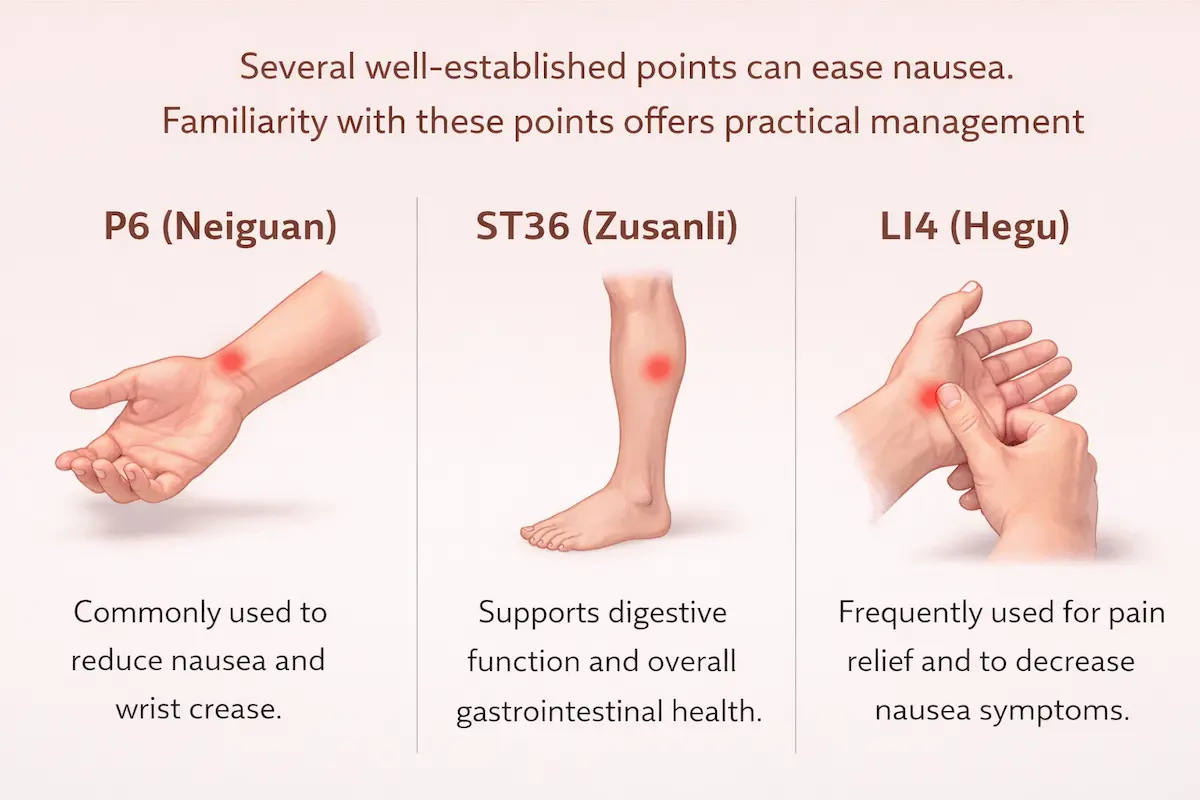
Several well-established points can ease nausea. Learn their locations once, and you have a practical tool for life:
- P6 (Neiguan): on the inner forearm, about three fingerbreadths from the wrist crease toward the elbow, in the center between the two tendons. The most researched point for nausea and vomiting.
- ST36 (Zusanli): about four fingerbreadths below the kneecap, one fingerbreadth to the outside of the shin bone. Traditionally used to support digestive function.
- LI4 (Hegu): in the fleshy webbing between the thumb and index finger. Frequently used for pain and to help decrease nausea. Skip this point if you are pregnant.
How to Do P6 Acupressure, Step by Step
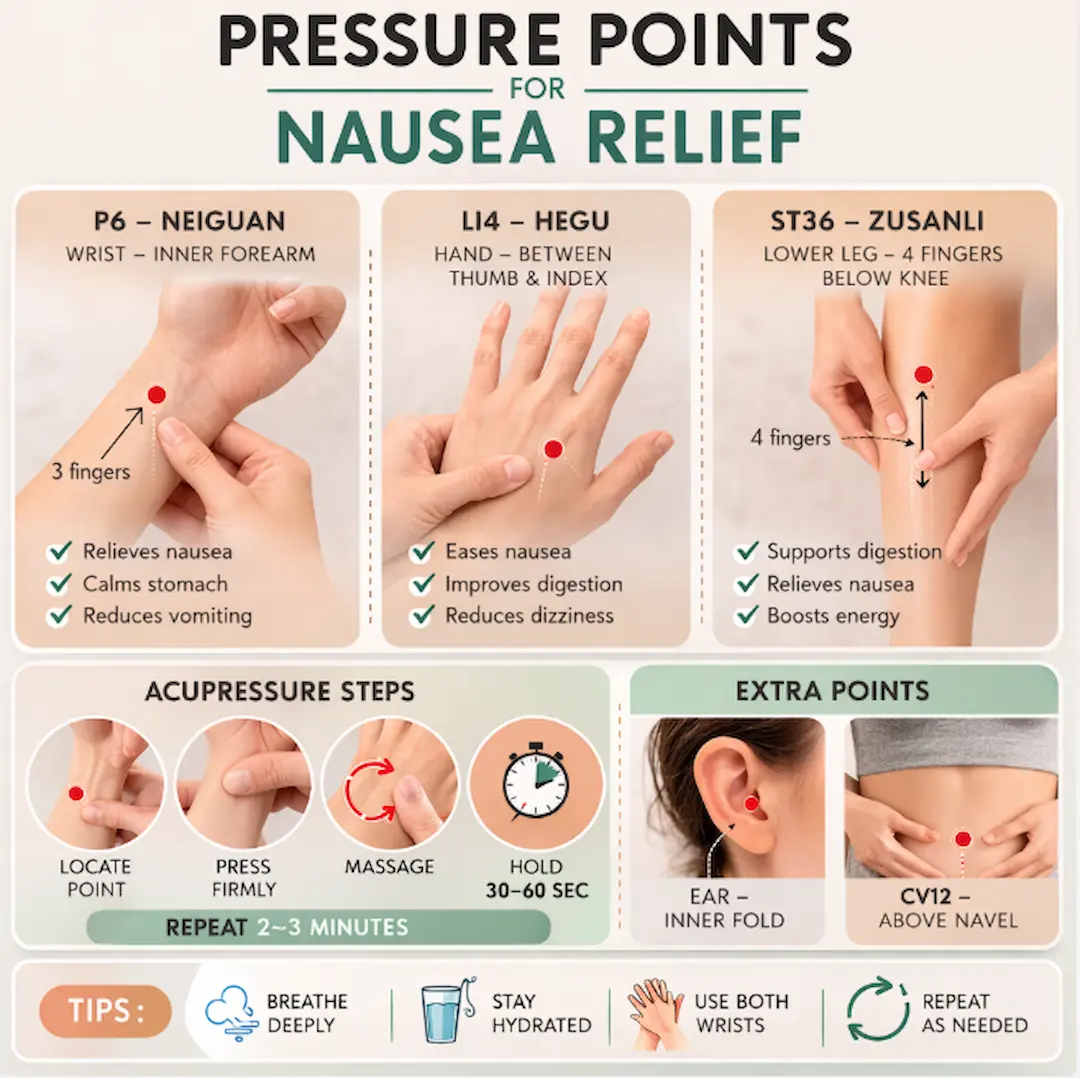
Acupressure is easy to do anywhere and requires no special equipment. For the P6 point:
- Get comfortable: sit or lie down in a relaxed position.
- Find the point: measure three fingerbreadths from the wrist crease on the inner forearm and locate the center between the two tendons.
- Press with your thumb: apply firm, steady pressure. Avoid sharp or painful force.
- Hold 2 to 3 minutes: maintain pressure while focusing on slow, even breaths.
- Check your sensations: a gentle ache or warmth is normal. Stop if you feel sharp pain or significant discomfort.
Many people find this especially helpful for motion sickness and anxiety-related queasiness. You can repeat it several times a day or whenever nausea starts.
Wristbands and Tools for Continuous Relief
Acupressure wristbands provide ongoing pressure to the P6 point and can be useful during travel or other nausea-prone stretches. They are non-invasive and commonly used for motion sickness and pregnancy-related nausea.
Options include adjustable bands and models with built-in pressure studs. They apply steady pressure to P6 to help reduce symptoms, which makes them convenient for continuous, hands-free relief. Think of them as a complement to manual acupressure, not a replacement for learning the technique.
What Else Can Help
Several gentle remedies pair well with acupressure. Ginger is widely used for nausea: try ginger tea or candied ginger as tolerated. Peppermint tea can soothe stomach discomfort, and chamomile is a calming option. Keep fluids up, especially if vomiting has occurred, and try small, frequent meals rather than large ones.
If you are pregnant, check with your obstetrician before starting herbs or supplements, and before beginning any new treatment for nausea. Used together with acupressure, these simple strategies can strengthen overall symptom control.
The evidence: P6 is well studied; results vary by cause
The strongest evidence for P6 comes from a Cochrane review updated in 2009 (Lee and Fan): 40 randomized trials with 4,856 participants found that P6 stimulation, including acupressure wristbands, reduced postoperative nausea and vomiting compared with sham treatment, with minimal side effects. In pooled comparisons it performed similarly to antiemetic drugs for nausea. The evidence is strongest for postoperative and anesthesia-related nausea; support for motion sickness and pregnancy-related nausea is more mixed, though many people find it helpful in practice.
What to Expect at Messina Acupuncture
Assessment and first treatment (60 to 75 minutes)
We review your nausea history and triggers, rule out causes that need medical evaluation, and perform your first acupuncture session targeting P6 and related points.
Follow-up sessions (30 to 45 minutes)
A typical course is 4 to 6 visits. We refine the point selection and teach you self-acupressure techniques to use between visits and after discharge.
After each visit
Most people feel calm and settled. Keep note of which triggers remain and use the P6 technique at home as needed. If nausea persists or worsens, we will direct you back to your physician.
Licensed and coordinated care. Before booking needling or acupuncture anywhere, confirm three things: the practitioner is licensed in New York State, they use single-use sterile needles, and they will communicate with your physician or physical therapist if needed. Messina Acupuncture meets all three, and we coordinate with your physician, physical therapist, or other providers as needed.
Contact a healthcare provider if nausea lasts more than a few days, is severe enough to interfere with daily life, or comes with high fever, severe abdominal pain, severe headache, or signs of dehydration such as dry mouth, dizziness, or notably reduced urination. Acupressure is a complement to medical evaluation, not a substitute for it. If you are pregnant, coordinate any new treatment with your obstetrician.
Frequently Asked Questions
Why is the P6 pressure point effective for nausea relief?
P6 (Neiguan) sits on the inner forearm and is linked to digestive regulation and the autonomic nervous system. Stimulating it can reduce the sensation of nausea and lower the urge to vomit, and it is the most studied acupressure point for this purpose.
Can acupressure help with motion sickness?
Many people find P6 pressure or wristbands helpful during car, boat, or plane travel. The research evidence for motion sickness is more mixed than for postoperative nausea, but it is a low-risk option worth trying.
Is acupressure safe during pregnancy for nausea?
Acupressure is generally low-risk, but check with your obstetrician before starting any new treatment. Avoid the LI4 point during pregnancy, and see a practitioner experienced with prenatal care.
How often can I do acupressure for nausea?
You can apply it multiple times per day as needed. Aim for 2 to 3 minutes per point and repeat based on your symptoms.
Do acupressure wristbands really work?
They apply continuous pressure to the P6 point and were included in the Cochrane trials of P6 stimulation. Many people find them helpful for travel; individual responses vary.
When should I see a professional about nausea?
If nausea is frequent or recurrent, has no clear trigger, or interferes with daily life, come in for an assessment. We will map your triggers and build a plan, and direct you to your physician when the cause needs medical evaluation.
Tired of Nausea Running Your Day?
If nausea keeps showing up, whether from motion, stress, or something you cannot quite pin down, acupuncture and guided acupressure may help. Dr. Daniel Messina will assess your triggers honestly and show you techniques you can use at home.
Messina Acupuncture PC
100 N Country Road, East Setauket, NY 11733
Sources and Further Reading
- Lee A, Fan LTY. Stimulation of the wrist acupuncture point P6 for preventing postoperative nausea and vomiting. Cochrane Database of Systematic Reviews, 2009.
- National Center for Complementary and Integrative Health: Acupuncture effectiveness and safety.
- New York State Office of the Professions: Acupuncture consumer information.