
Medical Massage · Athletes · East Setauket, NY
Training breaks the body down; recovery builds it back up. Medical massage is the clinical end of bodywork: assessment-driven, targeted at the tissues limiting you, and coordinated with the rest of your care. Here is what it does for athletes, and where the evidence stands.
She plays midfield for a travel lacrosse team and trains year-round, and her hamstrings have been a recurring problem every spring. Her coach suggested medical massage, but she is not sure how it differs from the sports massage tent at tournaments.
That is a good question, and the distinction matters. At Messina Acupuncture our medical massage starts with orthopedic assessment, not just a routine. Here is the full picture.
- Medical massage is diagnosis-driven: assessment first, then targeted techniques, with measurable goals for pain, motion, and function.
- How it differs: sports massage centers on event preparation and recovery; deep tissue targets chronic tightness; medical massage targets specific dysfunctions within a rehab or performance plan.
- Techniques: myofascial release, trigger-point therapy, neuromuscular re-education, and scar mobilization.
- Timing: pre-event tuning, post-event recovery, and regular maintenance during heavy training; acute injuries may need 1 to 3 sessions per week.
- Integrated care: pairs well with acupuncture, dry needling, and physical therapy when providers coordinate.
What Medical Massage Is
Medical massage is a results-oriented form of manual therapy prescribed or recommended for specific conditions. It combines orthopedic assessment with targeted techniques: trigger-point therapy, myofascial release, neuromuscular re-education, and scar tissue mobilization.
The session starts with testing, not a template. Range of motion, strength, pain patterns, and tissue quality are assessed, and the work focuses on the structures limiting you. Progress is documented against measurable goals: less pain, better motion, improved function.
Medical vs. Sports vs. Deep Tissue Massage
These terms get used interchangeably, but they are different tools:
- Sports massage: geared toward athletes around training and competition: pre-event stimulation and warm-up, post-event recovery, and regular maintenance during heavy training blocks.
- Deep tissue massage: sustained pressure to reach deeper muscle layers and fascia, commonly used for chronic tightness and postural patterns.
- Medical massage: the most clinical of the three. It starts with diagnosis-style assessment, uses outcome-based techniques, and is often coordinated with physicians, physical therapists, and athletic trainers.
How It Supports Common Sports Injuries
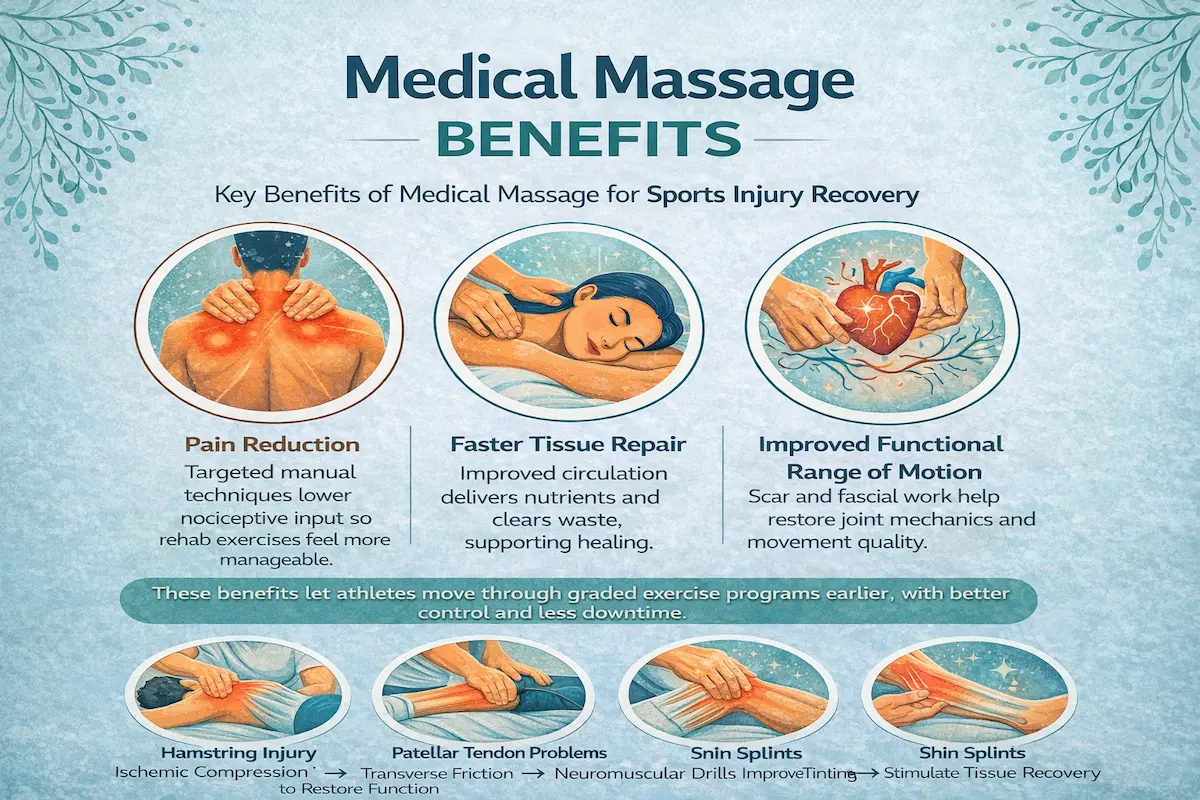
Medical massage is commonly used in the recovery process for injuries such as hamstring strains, patellar tendon irritation, and shin splints. The approach is staged: reduce pain and protective guarding first, then restore tissue mobility, then support reintegration into training.
For chronic overuse patterns, trigger-point work and myofascial release can address the adhesions and restricted tissue that alter mechanics and predispose athletes to re-injury. This is rehab-adjacent care: it works best alongside your training and any physical therapy, not instead of them.
Performance, Flexibility, and Recovery
Regular medical massage can support the things athletes care about most: maintaining full range of motion, keeping tissue pliable under load, and managing the delayed soreness that follows hard sessions. Many athletes also report feeling looser and more mobile after treatment, which makes the rest of training more productive.
To keep expectations honest: the evidence that massage speeds tissue healing or prevents injury is limited, and claims about performance gains rest mostly on clinical experience and plausible physiology. What it reliably offers is well-targeted relief of soreness and restriction, which keeps training consistent, and consistency is what drives performance.
Timing and Frequency
- Pre-event: lighter, mobility-focused work 2 to 3 days before competition; nothing aggressive right before game day.
- Post-event: gentle recovery work within 24 to 72 hours to ease soreness.
- Heavy training blocks: weekly or biweekly sessions to keep tissue quality up.
- Off-season: monthly maintenance is usually enough.
- Acute injuries: may need 1 to 3 sessions per week early on, coordinated with the rest of your care.
Signs You Might Need It
Consider an assessment if soreness routinely outlasts normal post-workout recovery, range of motion loss is changing your technique, the same trigger points keep flaring, or performance has dipped without a clear training explanation. Pain that is sharp, worsening, or associated with swelling, numbness, or weakness should be evaluated by a physician first.
The evidence: plausible mechanisms, limited sport-specific trials
Few high-quality trials test medical massage specifically in athletes, so many performance claims rest on clinical experience and plausible physiology rather than proof. The best-supported adjacent evidence: a 2015 Cochrane review of 25 trials (Furlan et al.) found massage improved short-term pain for subacute and chronic low back pain compared with inactive controls, with low-to-very-low quality evidence. Evidence that massage speeds recovery from muscle soreness or prevents injury is mixed. Related reading on recovery science: how massage therapy supports muscle health. Our read: reasonable as part of a training and rehab plan, not a performance guarantee.
What to Expect at Messina Acupuncture
Assessment and first treatment (60 to 90 minutes)
We review your sport, training schedule, and injury history, perform orthopedic and movement testing, and deliver a targeted first session. Wear or bring athletic clothing.
Follow-up sessions (30 to 60 minutes)
Frequency is set around your training calendar. We track pain, range of motion, and training tolerance, and adjust the plan as you progress.
After each visit
Mild soreness for a day or so is normal. Hydrate, move gently, and keep training notes so we can see how the work is carrying over.
Licensed and coordinated care. Before booking medical massage anywhere, confirm three things: the therapist is properly trained and credentialed, they take a full health history before treating, and they will communicate with your physician or physical therapist if needed. Messina Acupuncture meets all three, and we coordinate with your physician, physical therapist, or other providers as needed.
Postpone massage for acute fractures, dislocations, or suspected tears until evaluated; uncontrolled osteoporosis; active skin or systemic infections; fever; or signs of deep vein thrombosis such as sudden one-sided leg swelling and pain. Always tell your therapist about injuries, surgeries, medications (especially blood thinners), and pain levels, and speak up during the session if pressure is too much. Mild soreness or light bruising afterward is common and usually fades in a day or two.
Frequently Asked Questions
Which athletes benefit most from medical massage?
Team-sport and endurance athletes, weekend warriors, and anyone rehabbing an injury or managing chronic pain. It also helps athletes focused on performance maintenance during heavy training.
Are there risks with medical massage for athletes?
It is generally safe. Postpone treatment for fractures, acute tears, infections, or uncontrolled osteoporosis. Tell your therapist about injuries, medications, and pain levels, and communicate during the session.
How does medical massage fit into a training schedule?
Pre-event mobility work a few days before competition, gentle recovery work after events, higher frequency during heavy training blocks, and monthly maintenance in the off-season.
What happens during a medical massage session?
Expect an intake and orthopedic assessment, then targeted techniques such as trigger-point work or myofascial release. Sessions run 30 to 90 minutes; your feedback guides the pressure.
Can medical massage help with the mental side of sport?
Many athletes report less stress and better focus with regular sessions. It is not a substitute for mental-health care when that is needed.
Can it be combined with other therapies?
Yes. Medical massage pairs well with physical therapy, acupuncture, dry needling, and chiropractic care. Share your full plan so your providers can coordinate.
Train Hard, Recover Smarter
If injuries or stubborn tightness are costing you training time, assessment-driven medical massage may help you get back sooner. Our team will evaluate the problem, build a staged plan, and coordinate with your coaches and providers.
Messina Acupuncture PC
100 N Country Road, East Setauket, NY 11733