
Acupressure · Self-Care · East Setauket, NY
Acupressure is the needle-free cousin of acupuncture: firm finger pressure applied to specific points on the body to ease tension, calm the mind, and support everyday comfort. It is simple to learn, costs nothing, and can be done almost anywhere. Here are the basics every beginner should know, including which points to use and which to avoid.
Setauket context: Between long commutes, desk work, and the general pace of Long Island life, neck tension and stress headaches are practically a local pastime. Many of our East Setauket patients learn a few acupressure points to use at their desks, and save their acupuncture visits for the deeper work.
Dr. Daniel Messina and our licensed acupuncture team teach safe self-care as part of treatment. Compare the two approaches at acupressure vs. acupuncture, and explore self-massage techniques for more hands-on methods.
- Pressure, not needles: Acupressure stimulates the same points acupuncture uses, but with finger or thumb pressure instead of needles, making it ideal for daily self-care.
- Best for comfort and relaxation: It may ease everyday tension, mild headaches, nausea, and stress. It does not diagnose or treat medical conditions.
- A few points cover most needs: LI4, PC6, GB20, ST36, SP6, GV20, and Yintang are beginner-friendly points that are easy to locate and forgiving to press.
- Pregnancy caution is real: LI4 and SP6 are traditionally avoided during pregnancy. If you are pregnant or trying to conceive, check with your provider first.
- Gentle and consistent wins: Firm, steady pressure for 30 seconds to two minutes per point, once or twice daily, beats occasional aggressive pressing.
What Is Acupressure?
Acupressure is a manual therapy rooted in Traditional Chinese Medicine. Where acupuncture inserts thin needles into specific points, acupressure stimulates the same points with sustained finger, thumb, or palm pressure. The underlying idea is familiar: the body has channels, or meridians, along which vital energy is said to flow, and stimulating points along those channels is thought to encourage balance and ease.
You do not need to accept the traditional theory to use the practical technique. Millions of people use acupressure simply as a structured form of self-massage: find the point, apply firm pressure, breathe, and notice what changes. It requires no equipment, has a strong safety profile when done gently, and fits into a lunch break.
How Acupressure May Affect the Body
Modern explanations for acupressure’s effects are modest and mechanical. Firm pressure stimulates local nerves and may temporarily modulate pain signaling, similar to how pressing on a bumped elbow eases the ache. Sustained pressure on tight muscles encourages them to release, which is why neck and shoulder points feel so satisfying after desk work.
There is also a mind-body component that should not be dismissed: pausing, breathing slowly, and focusing on physical sensation activates the body’s rest response. Some of what people love about acupressure may come from that deliberate pause as much as from the point itself. Honest practitioners present acupressure as a comfort and relaxation tool, not a cure for disease.
Acupressure vs. Acupuncture
The two share a point map but differ in delivery and depth. Acupressure is noninvasive, free, and entirely in your hands, which makes it ideal for daily self-care and for people who are uneasy about needles. Its effects tend to be gentler and shorter-lived.
Acupuncture, performed by a licensed practitioner with sterile single-use needles, can stimulate points more precisely and is typically used for more persistent or complex problems. In our clinic, the two often work together: acupuncture addresses the deeper pattern during your visit, and acupressure helps you maintain comfort between visits.
Common Acupressure Points for Self-Care
These five points are popular for good reason: they are easy to find, forgiving to press, and useful for everyday complaints. Use firm, steady pressure for 30 seconds to two minutes per point.
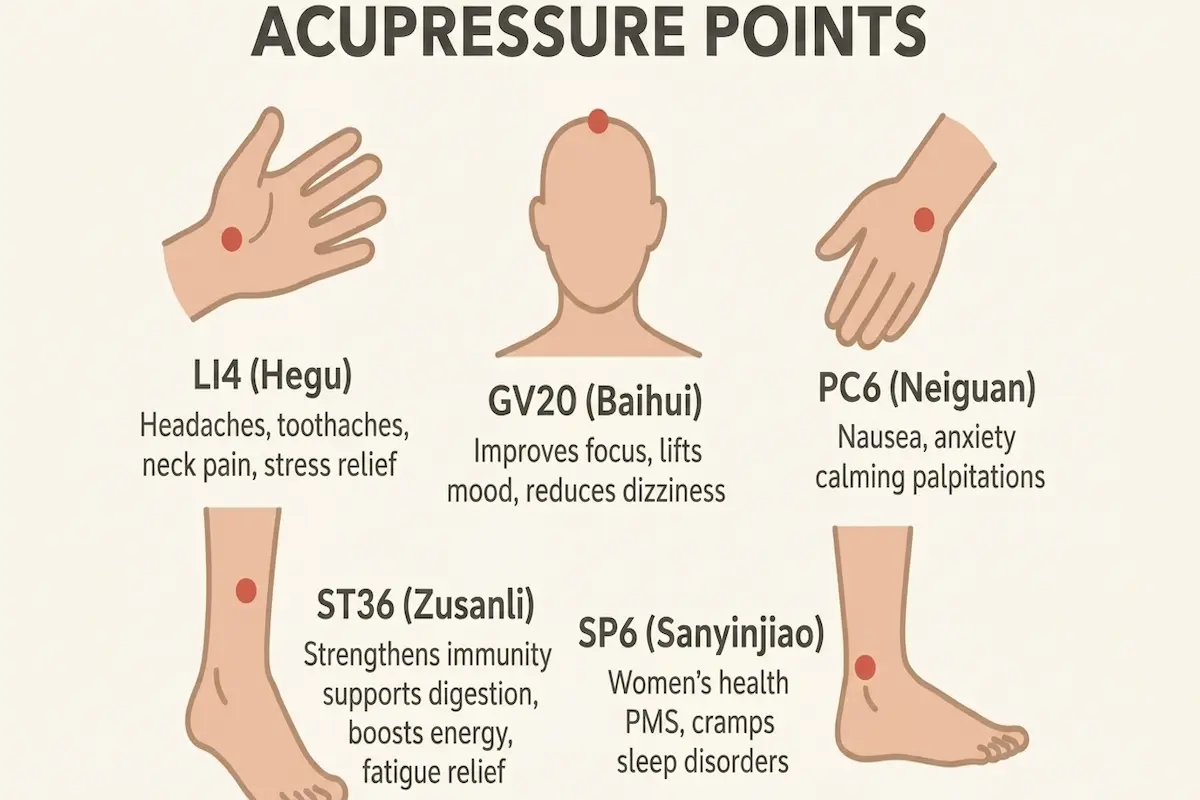
- LI4 (He Gu): In the web between thumb and index finger. Often used for head and neck tension. Avoid during pregnancy.
- PC6 (Nei Guan): Three finger-widths below the wrist crease, between the two central tendons. Traditionally used for nausea, including motion-related queasiness.
- GB20 (Feng Chi): In the hollows at the base of the skull, on either side of the spine. A favorite for neck stiffness and tension headaches; use thumbs with gentle upward pressure.
- ST36 (Zu San Li): Four finger-widths below the kneecap, just outside the shinbone. Traditionally used for digestive comfort and general energy.
- SP6 (San Yin Jiao): Four finger-widths above the inner ankle bone, just behind the shinbone. Traditionally used for menstrual comfort. Avoid during pregnancy.
- GV20 (Bai Hui): At the crown of the head. Traditionally used for mental clarity and calm; light fingertip pressure is enough.
- Yintang: Between the eyebrows. A calming point many people press during stressful moments.
If you are pregnant or trying to conceive, skip LI4 and SP6 entirely. When in doubt about any point, ask your acupuncturist at your next visit.
How to Perform Acupressure on Yourself
Good technique is simple: get comfortable, locate the point with your fingertip, and apply firm, steady pressure. You should feel a dull ache or deep pressure, never sharp pain. Breathe slowly and hold for 30 seconds to two minutes, then release gradually.
Work both sides of the body where a point is bilateral, such as LI4 or ST36. Once or twice daily is plenty for most people. If a point feels bruised afterward, use lighter pressure next time or give it a rest day. Consistency matters more than intensity: a calm two minutes daily beats one aggressive session a week.
Safety, Risks, and Contraindications
Acupressure is low-risk for most people, but a few cautions apply. Avoid pressing on broken skin, rashes, varicose veins, recent injuries, or areas with swelling you cannot explain. Use lighter pressure if you take blood thinners or have a bleeding disorder, and stop if you feel dizzy or nauseated.
Pregnancy deserves special care: LI4 and SP6 are traditionally avoided because they are believed to stimulate uterine activity. More broadly, check with your obstetric provider before starting any new self-care routine while pregnant. And remember the central rule: acupressure manages comfort; it does not diagnose. Persistent, severe, or worsening symptoms belong with your physician.
When to See a Licensed Acupuncturist
Book a professional visit when self-care is not resolving the problem, when symptoms keep returning, or when you want a trained assessment of what is actually going on. A licensed acupuncturist can confirm your point locations, tailor a plan to your pattern, and use needling for deeper or more stubborn issues.
Many patients find the combination ideal: acupuncture for the underlying pattern during office visits, acupressure for daily maintenance at home. If you are curious which points fit your situation, bring your questions to your next appointment and we will map them out together.
What the research shows
Research on acupressure is developing rather than settled. One of the stronger findings comes from a Cochrane review of P6 (Neiguan) point stimulation, which found that stimulating this wrist point reduced postoperative nausea and vomiting compared with sham treatment. That result is specific to nausea after surgery, not proof that acupressure works for every condition it is used for.
A systematic review of ear acupressure for allergic rhinitis, covering 11 trials and 1,094 participants, found benefits over control treatments for nasal symptoms. Smaller trials suggest acupressure may ease tension-type discomfort and support relaxation, but many popular claims still rest on traditional use and small studies rather than strong evidence. Treat acupressure as a low-risk comfort measure, not a proven treatment for disease.
Your Visit: What to Expect
Assessment and first treatment (60 to 75 minutes)
We review your health history, discuss what you want acupressure to help with, and confirm which points fit your situation. Your first acupuncture treatment usually happens the same day if you choose it.
Follow-up sessions (30 to 45 minutes)
We refine your self-care routine based on what helped, correct your point locations hands-on, and adjust the treatment plan as your symptoms change.
After each visit
Practice your points once or twice daily at home. Note what helps and what does not so we can fine-tune the routine together at your next visit.
A local practice you can talk to. Messina Acupuncture PC is a licensed acupuncture practice in East Setauket, led by Dr. Daniel Messina. We teach acupressure as part of treatment because patients who can care for themselves between visits tend to do better.
Self-care questions are always welcome at your appointment. We will confirm your point locations, flag any points you should avoid, and be honest about when acupressure is enough and when needling would serve you better. Read our frequently asked questions or contact the office to learn more.
Acupressure is a comfort measure, not a diagnostic tool. Seek prompt medical care for chest pain or pressure, difficulty breathing, sudden severe headache, sudden weakness or numbness, vision changes, or any symptom that feels like an emergency. Do not use acupressure to ride out symptoms that need evaluation.
Use lighter pressure if you take blood thinners or have a bleeding disorder, and avoid pressing on broken skin, rashes, varicose veins, or injured areas. If you are pregnant, skip LI4 and SP6 and check with your obstetric provider first. Stop any self-care that causes dizziness, pain, or bruising.
Frequently Asked Questions
What is the difference between acupressure and acupuncture?
Acupressure uses finger, thumb, or tool pressure on the same points acupuncture uses. It is noninvasive and easy to learn for self-care. Acupuncture uses thin sterile needles inserted by a licensed practitioner and can reach deeper or more precisely targeted effects. Many people use acupressure between acupuncture visits.
How much pressure should I use, and for how long?
Press firmly enough to feel a dull ache or pressure, never sharp pain. Hold steady pressure for 30 seconds to two minutes per point, breathing slowly. Repeat on both sides of the body where applicable, once or twice daily. If a point feels bruised or irritated, give it a rest day.
Is acupressure safe during pregnancy?
LI4 (the web of the hand) and SP6 (above the inner ankle) are traditionally avoided during pregnancy because they are believed to stimulate uterine activity. If you are pregnant or trying to conceive, skip those two points and check with your obstetric provider before starting any new self-care routine.
Can acupressure replace medical treatment?
It can be a helpful first step for everyday tension, mild headaches, motion-related nausea, and stress. But it does not diagnose or treat medical conditions. See a physician for severe, sudden, or persistent symptoms, and see a licensed acupuncturist when self-care is not resolving the problem.
Do I need any special tools?
You need nothing special: your fingers and thumbs do the work. Some people use a smooth massage ball or an acupressure tool for hard-to-reach points like GB20 at the base of the skull. Clean hands and trimmed nails keep the experience comfortable.
When should I stop and get help instead?
Stop and rest if you feel dizzy, nauseated, or unwell during self-acupressure. Avoid pressing on broken skin, rashes, varicose veins, or areas of acute injury. People with bleeding disorders or on blood thinners should use lighter pressure and mention it to their practitioner.
Want Guidance on Using Acupressure Safely?
Self-care works best when you know which points to use and which to avoid. Dr. Daniel Messina can show you safe acupressure techniques for your situation and provide acupuncture treatment when self-care is not enough.
Messina Acupuncture PC
100 N Country Road, East Setauket, NY 11733
Sources and Further Reading
- Lee A, Done ML. Stimulation of the wrist acupuncture point P6 for preventing postoperative nausea and vomiting. Cochrane Database Syst Rev.
- Ear acupressure for allergic rhinitis: a systematic review and meta-analysis of randomized controlled trials.
- National Center for Complementary and Integrative Health: Acupuncture Effectiveness and Safety.
- New York State Education Department: Acupuncture Consumer Information.